



Venus has no surface oceans and no rainwater carving channels through its rocks. Its sulphuric-acid clouds do contain droplets, but those droplets evaporate before reaching the ground. With almost none of the river erosion, sediment transport or freeze-thaw weathering that constantly edits Earth’s continents, long-lived topography can retain information that would be blurred much sooner here.
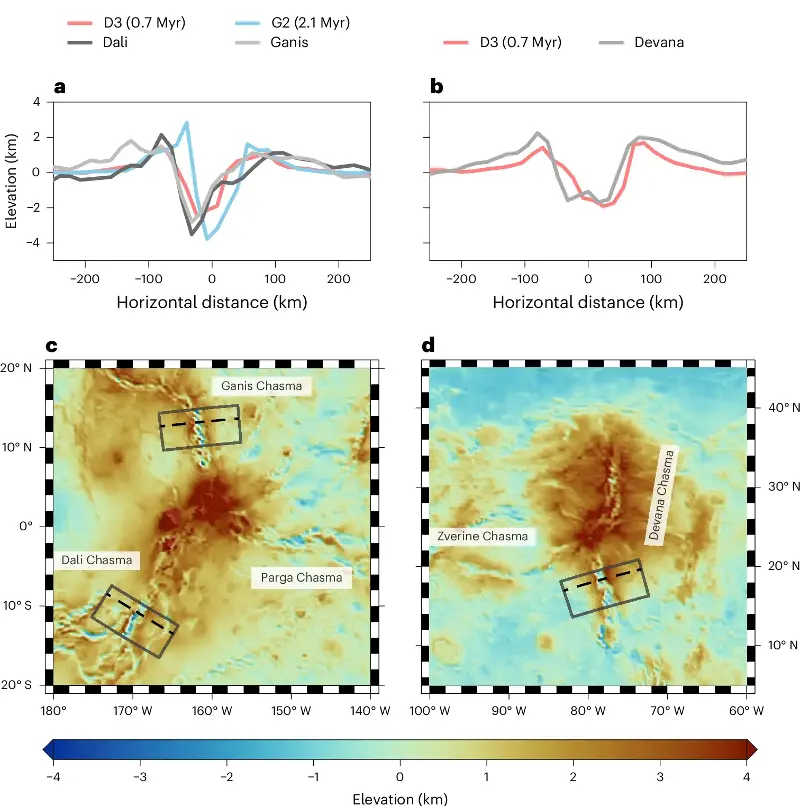
A Nature Geoscience study led by Xi Yang has used that unusually durable record to examine three of Venus’s great rift systems: Ganis Chasma, Dali Chasma and Devana Chasma. Its simulations connect broad, steep uplifts beside a rift valley with strong crust undergoing fast extension. All three chasmata have unusually wide flanks, making current or geologically recent rifting a plausible explanation.
This is one study, not settled consensus. The work does not measure the three rifts moving, and “rapid” refers to rates tested in numerical experiments rather than rates observed on Venus. The morphology is consistent with extension continuing today, but it can also survive for tens of millions of years after extension stops.
Why Venus keeps topography that Earth erases
Earth’s rifts are worked over by rain, rivers, glaciers, landslides and sediment. Those agents can cut into a raised flank, fill a valley and obscure the original shape. Venus has wind and chemical weathering, and lava can bury older ground, but NASA’s account of the Magellan mission notes that the lack of water makes erosion extremely slow.
A landform can therefore look crisp long after the process that built it has ended. In a rift, fault-bounded blocks subside while adjacent crust rises and flexes, producing elevated shoulders. Their height and breadth depend on crustal strength, extension rate and the time available for the relief to relax.
Venus contains about 40,000 kilometres of mapped rifts covering roughly eight per cent of the planet. Many cross broad volcanic rises associated with mantle upwelling. They are generally wider than terrestrial rifts, a difference explored in earlier numerical modelling of Venusian extension. The new paper asks whether their shoulders can also reveal when extension happened.
The experiments separate speed, strength and age
Yang and colleagues ran three-dimensional thermomechanical simulations of a Venus-like lithosphere. Most began with a 150-kilometre-thick thermal lithosphere, while the crust behaved like plagioclase, dry diabase or mafic granulite. Extension proceeded at one, three or ten centimetres per year, then stopped so the team could follow the relaxation.
Faster extension combined with stronger crust produced elevation offsets of two to eight kilometres, valleys wider than 120 kilometres and broad flanks. Runs with a 100-kilometre thermal lithosphere did not generate the faulted valleys sought in this experiment.
These are controlled experiments, not unique reconstructions of each chasma. A different rheology, thermal history or pattern of inherited faults could change the result.
Broad shoulders narrow after rifting stops
The time behaviour supplies the central diagnostic. In one dry-diabase run, the flank narrowed from about 120 kilometres to less than 90 within one million years after rifting ceased, then below 40 after about 15 million years. It was largely gone after roughly 105 million years.
A strong mafic-granulite model relaxed more slowly, narrowing from about 130 kilometres to 80 after three million years and to 60 after 26 million years. Across the tested models, a flank wider than 100 kilometres is associated with extension that continues or ended recently in geological terms.
The shoulders favour young, fast-forming rifts within these simulations. They do not independently measure a present rate on Venus.
The three chasmata preserve the signal differently
The team compared its experiments with Magellan-derived topography sampled at 16-kilometre intervals. Dali Chasma has a median flank width of about 110 kilometres. Its western side is steep, with an offset near five kilometres, while the eastern side is gentler. Nearby grabens complicate the comparison.
Ganis Chasma has a median flank near 160 kilometres and an offset near four kilometres on its steep western side. Devana exceeds 180 kilometres and has steep sides around a flatter valley floor. Its profile did not match the experiments neatly, so its breadth is a sign of recency within the model rather than a full mechanical fit.
Overall, the profiles most closely resembled strong dry-diabase or mafic-granulite crust stretched at three to ten centimetres per year after 60 to 70 kilometres of extension. That is not proof of a particular composition or one shared history.
Today’s activity remains a live possibility
The paper leaves two possibilities: rifting is still active, or it stopped within the past few tens of millions of years. Both count as recent on this slowly eroding planet. No repeated high-resolution geodetic survey has shown the sides of Ganis, Dali or Devana moving apart.
Independent signs make an active Venus credible without settling this case. Magellan images have revealed new lava flows at two volcanoes, while separate work links coronae and possible tectonics to subsurface plumes. Neither confirms that these three chasmata are widening now.
New radar maps can test the inference
NASA’s VERITAS mission is designed to return sharper radar and topographic maps than Magellan. ESA’s Envision orbiter is also intended to examine tectonic and volcanic activity with radar, altimetry and subsurface sounding.
Repeated observations could search for deformation rather than infer it from a preserved shape. Until then, the broad shoulders of Ganis, Dali and Devana are a geological diagnostic, not a stopwatch. Venus has kept the clue legible. It has not yet supplied an unambiguous date for when the pulling stopped, or proof that it has stopped at all.
A personal measure of deep time
See what has changed in the universe since you were born.
Begin with one date. Get a personal, sourced journey through everything that kept moving after you arrived.
Six sourced measurements. No predictions. No astrology.