



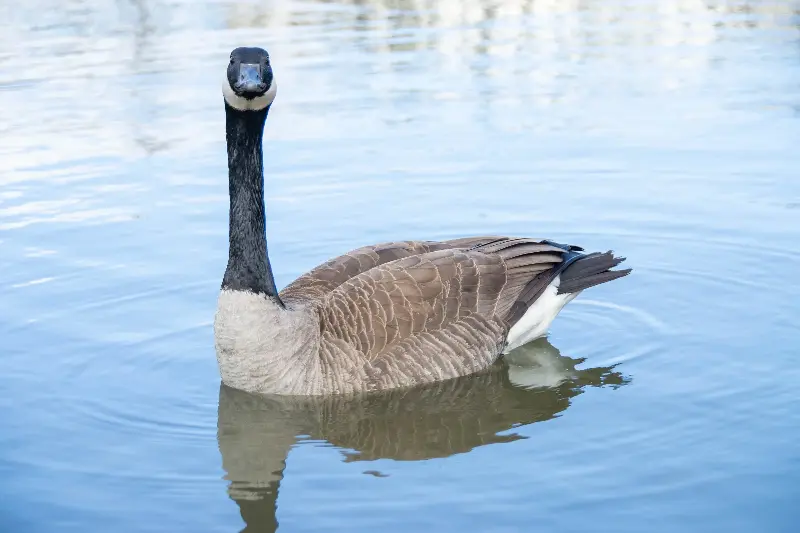
MINNEAPOLIS — At first, neighbors on Green Lake in east-central Minnesota were puzzled by the chick, who looked different than other baby sandhill cranes. Then they were delighted: It was a goose.
Martha Harding and Gary Noren watched the unlikely bird family from their window and were so taken with them that they wrote a children’s book called “Fam: The Remarkable Story of a Canada Goose Adopted by Sandhill Cranes.”
Evan Schnell read a recent interview with Harding in the Minnesota Star Tribune and said Fam’s story “really made my year.” He often watches sandhill cranes in the marsh outside his home in North Oaks.
It made him wonder: How often does this happen? He turned to Curious Minnesota, the Strib’s audience-powered reporting project, to ask: What other Minnesota animals adopt across species?
The short answer: Not many. It is relatively rare, and happens more often among birds than mammals.
“It’s not common that you see a true adoption where you have the animal or the bird adopting it [another species’ baby] and then raising it to adulthood,” Harding said.
“That’s what makes Fam’s story so incredible,” said Harding.
While the exact details of Fam’s adoption are difficult to know for sure, Harding believes a goose laid one egg in a nest alongside Green Lake. Then, a pair of sandhill cranes decided they wanted the nesting spot and chased the mama goose away. The female crane then laid her own egg in the crane’s nest, incubated both and accepted both hatchlings as her own.
Even though tales like this are uncommon, some kinds of birds found in Minnesota do often care for babies of a different species for at least a little while. Experts don’t necessarily use the term “adoption” to describe their behavior, however.
Brown-headed cowbirds, which have a population of about 2.9 million in Minnesota, tend to be raised by other kinds of birds.
That’s because cowbirds are considered brood parasites. They intentionally lay their eggs in other species’ nests. They often pick nests built by house finches, northern cardinals or chipping sparrows.
This is also known as egg-dumping, said Brittney Yohannes, communications and development director at the Wildlife Rehabilitation Center of Minnesota.
Cowbirds, with a blueish black body, brown head and 6- to 9-inch length, don’t make their own nests or raise their own babies. Building a nest, incubating eggs and feeding babies means months of work. Cowbirds instead focus their energy on laying eggs, and throughout a summer season they are able to lay more eggs than the average songbird.
This is to the detriment of the other baby birds in host nests, since cowbirds are often larger and require more food.
Cowbird eggs also tend to hatch sooner compared to their host species’ eggs, according to Yohannes. The host birds will still incubate their other eggs, but end up leaving them more than they typically would have in order to find food for the hatched baby cowbirds.
“It’s not uncommon to see a very tiny chipping sparrow adult feeding this massive brown-headed cowbird baby,” Yohannes said.
Wood ducks and hooded mergansers are also egg dumpers, although only sometimes.
The ducks typically do incubate and raise their own eggs. But they will also leave some eggs in other species’ nests. The ducks simply follow the old adage: Don’t keep all your eggs in one basket (or nest).
“If you lay all your eggs in one cavity, and a raccoon or another predator comes by and takes those eggs, then you’ve lost all of that investment,” Yohannes said.
The other mama bird’s maternal hormones are then so strong, that she raises the other bird’s chicks, said Kristin Hall, who supervises the Minnesota Department of Natural Resources’ Nongame Wildlife Program.
Sometimes, with luck or by accident, adoptions do happen. A few years ago, a bald eagle family in California even adopted a baby hawk.
Eagles tend to take young from other predatory birds’ nests and eat them. When the female eagle of the nest brought back a baby hawk, birdwatchers nearby thought she would eat it.
Instead, the bird’s maternal hormone took over, and the eagle pair began to raise the little hawk.
“We might see more of this kind of adoption happening because animals compete for space, and sometimes they end up adopting just as happenstance,” Harding said.
Other birds create different sorts of families. Some adult birds, including Canada geese and common eiders, work together to raise the flock’s baby birds.
“Have you ever seen a goose with what seems like way too many young gathered around it?” Hall asked. The expanded family unit is called a crèche.
Crèches free up time for adults to forage and give young birds a better chance of surviving than those reared alone.