



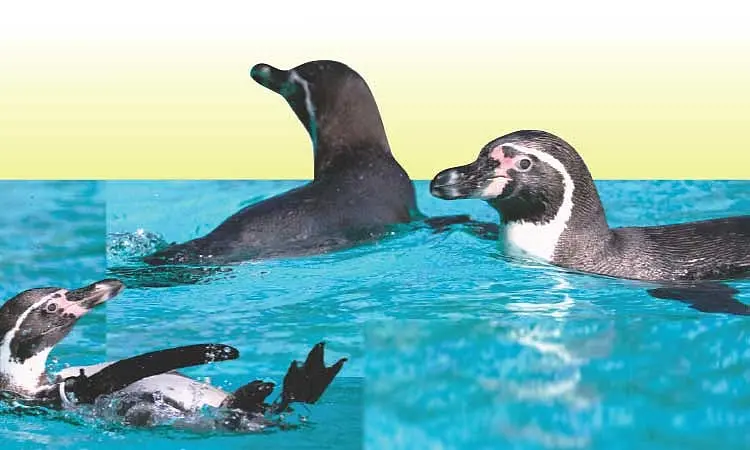
Imagine for a moment that you are a master of the Pacific. Your lineage is written in the salt-sprayed cliffs of Peru and the rugged coastlines of Chile — built for deep dives into the cold, powerful Humboldt Current. You are a jumper, a climber, a creature of sea caves. Yet your reality is an air-conditioned enclosure, observed by visitors through a sheet of acrylic.
Such is the life of Humboldt penguins in captivity — creatures that have sparked admiration, curiosity, and, in some circles, concern.
At a major ocean park in Cebu, these penguins have become one of the attraction’s most recognizable features. While facilities around the world house wildlife for educational and conservation purposes, the practice continues to generate discussion among scientists, environmental advocates and the public. Questions surrounding animal welfare, habitat authenticity and ethical responsibility remain central to the debate.
Supporters argue that wildlife parks provide valuable opportunities for education, research and conservation awareness, especially for species facing threats in the wild. Critics, however, contend that captive environments — particularly those situated within commercial or urban settings — may fall short of replicating the complex ecological conditions necessary for certain species to thrive.
For many visitors, the penguin is a delightful and memorable sight. Yet experts note that animals in captivity can exhibit signs of stress when deprived of adequate space and stimulation. This condition, known as “zoochosis,” refers to repetitive or abnormal behaviors observed in some captive animals. While not universal, it has been documented across various species in confined environments.
The Humboldt penguin (Spheniscus humboldti), native to the coasts of Peru and Chile, is uniquely adapted to cold, nutrient-rich waters and rugged coastal terrain. According to conservation groups, the species is classified as Vulnerable by the International Union for Conservation of Nature (IUCN), underscoring the importance of responsible stewardship both in the wild and in captivity.
In Cebu, public discourse surrounding wildlife captivity gained traction in 2019, when marine biologists, students and environmental advocates raised concerns ahead of the opening of a marine-themed attraction. Organizations such as Balyena.org called for greater transparency and stricter welfare standards, urging institutions to ensure that animal exhibits prioritize education and ethical care.
Their message reflected a broader global conversation: How do we balance public engagement with wildlife protection?
Beyond ethics lies biology. Humboldt penguins are built for cold waters and long-distance foraging. In captivity, their health depends on meticulously regulated conditions, including water temperature, lighting, diet and enrichment programs. Experts note that birds perceive light differently from humans, meaning artificial illumination must be carefully calibrated to avoid disrupting natural biological rhythms.
When properly managed, such environments can support animal welfare. However, specialists emphasize that maintaining these standards requires constant monitoring, scientific oversight and adherence to international best practices.
Ultimately, the presence of captive wildlife invites reflection. As we step out of climate-controlled exhibits and return to the vibrant, humid streets of Cebu, we are left with a question: What do we truly seek from these encounters?
In an age driven by curated experiences, it is easy to trade authenticity for accessibility. Yet genuine appreciation of the natural world requires both wonder and responsibility. Our curiosity, while deeply human, should never come at the expense of compassion.
The conversations sparked in 2019 serve as a reminder that society has a choice. We can support institutions that uphold ethical standards, promote conservation and foster meaningful education — or we can advocate for greater protections for wildlife in their natural habitats.
If we hope to inspire future generations to cherish the environment, we must teach them that some wonders are best experienced in the wild. The sea caves of Chile may lie thousands of miles away, but the decision to respect the life before us begins the moment we choose awareness over spectacle.