



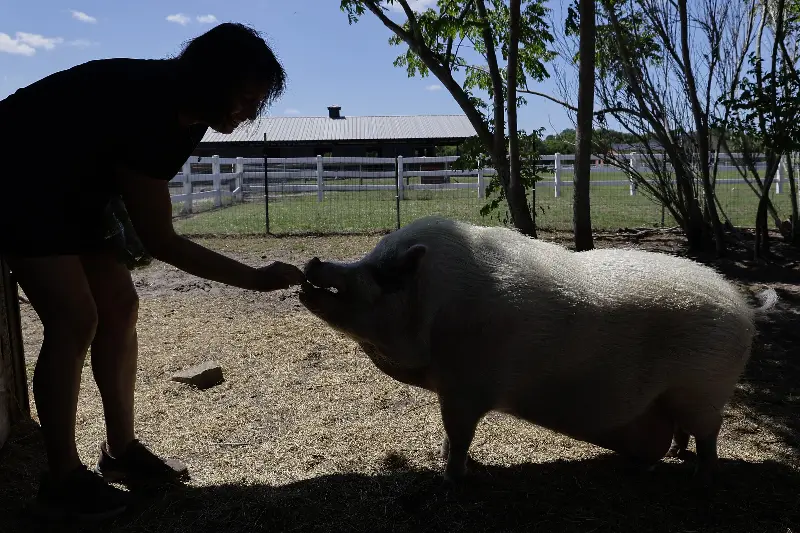
TAMPA, Fla. — Pinellas County, Florida, has a serious pig problem.
“We’ve got too many people taking in pigs,” Judge Kathleen Hessinger told a courtroom packed with animal lovers last week. “They get too big. People can’t take care of them.”
Maybe, she said, the county should just ban pig sales.
She was hearing the case of a 350-pound potbelly named Waddles, whose family had surrendered him to the SPCA. The county’s animal services department charged the SPCA with animal abuse, citing it for failing to protect the pig from becoming severely sunburned.
The judge cleared the nonprofit of any wrongdoing, saying the SPCA took in an animal no one else wanted.
Kelly Dill, who took Waddles from the SPCA to her Pork Butt Pastures pig rescue in Plant City, was furious about the ruling. But she agreed with the judge: The county should make it illegal to sell potbelly pigs.
“There’s enough out there now that people could adopt for the next 10 years,” Dill said.
Backyard breeders sell them for $20 online and at flea markets. They promise the pigs will only grow to 20, maybe 30 pounds.
When Dill got her first pig six years ago, she believed them. Then her pig topped 250 pounds. She started boarding pigs on her ranch, but people kept calling: Could she take their pet and keep it? So far this year, she has adopted out 25 pigs and needs homes for a dozen more.
Pigs became popular housepets in the 1980s, when people started importing Vietnamese potbellies. The number of pig owners in the U.S. has soared to more than 1 million.
Most people who adopt pigs don’t know what they’re signing up for, Dill said. The pigs get too big or expensive or ornery – then people abandon them. She’s gotten calls about pigs left in fields, tied to trees.
Here are five things to know before adopting a pig:
—There is no such thing as a pixie pig, a pocket pig or teacup pig.
Mini pigs can grow to 300 pounds. Even if you don’t overfeed them, they get tall and long and strong. “Most are so inbred you don’t know what you’re getting,” Dill said. They have big teeth and bite hard. “You’ll need stitches.”
—Pigs root and dig holes. A lot of them.
They love to trench under fences, digging deeper to unearth cool dirt. They munch flowers and foliage, root through fire pits and compost piles. “If you have a pig,” Dill said, “you might never have a nice yard.”
—Pigs are prolific breeders. And can live for 20 years.
At 4 months, they start mating. They can birth four litters a year, 10 babies each time. They should be at least 10 weeks old before they leave their moms, Dill said. And owners should spay and neuter.
—Pigs are smarter than most 3-year-old children.
They recognize faces and voices. You can teach them to sit, spin, stay, shake, even potty train. They can learn to open doors and refrigerators. They also can pull cabinets off hinges, gnaw through walls. “I’ve seen a lot of horror stories,” Dill said. Some pigs try to bully you. You have to discipline them like dogs, let them know who’s in charge.
—Pigs are highly social and live in herds.
“I recommend people take two pigs,” Dill said. “They do better with a friend. And they learn from each other. That way, they don’t try to adopt as much human behavior.” Even big pigs don’t need a lot of room. Just a fenced yard, with space to plop and nap in the shade.