



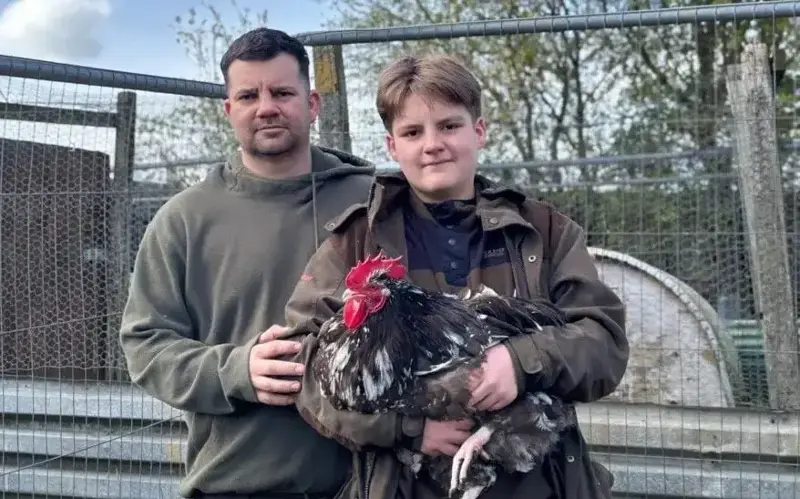
Cockerels could be culled or dumped in the street after a council banned them from allotments, owners have claimed.
Reform-run Durham county council will ban the birds from allotments next year after a slew of noise complaints.
Cockerel-keepers have urged the council to reverse the policy over fears it will lead to culls of the birds.
The council has now said it is “considering the concerns” of nearly 1,000 residents who have signed a petition opposing the ban.
Tom Amos, 41, and his son Tom Barker Amos, 14, are behind the campaign against the policy, which would end the residency of Brian, their three-year-old cockerel, at their allotment in Bishop Auckland, Co Durham.
Mr Amos said the rule changes would lead to cockerels, including rare native breeds, being killed or dumped on the streets.
“We are keeping rare, native chicken bloodlines going,” he told The Telegraph. “We keep Orpingtons, which are a rare breed now. Many of these chickens will die out in a year or two if the council goes through with this ban.
“People will just dump them to get rid of them.”
Eviction threat
Under the new rules, the council would have the power to evict those who continue to keep cockerels on their allotments.
The petition argues that keeping cockerels helps with “mental wellbeing” and that they “would have to be euthanised” if a ban were to be introduced.
David Watson, 37, who also keeps cockerels in Bishop Auckland, said: “We’re having to try and rehome our birds.
“We started out just keeping a few and then we ended up with nearly 80 of different breeding groups, rare breeds, harder to find ones.
“We’ve travelled across the country. We’ve travelled across Europe to buy certain eggs and breeds, and now all the hard work, the years of it, has just gone down the drain.
“Without the cockerels, you can’t continue lines that have been worked on for generations. The rare breeds will die out.”
Darlington Bird Rescue has warned the council that the “blanket ban” will increase the “rate of dumpings across Durham”.
“This means that we will likely see a massive spike in dumpings around the North East,” a spokesman for the charity said.
Durham is not the first council to introduce restrictions on keeping cockerels on allotments in recent years, with local authorities in Wakefield, West Yorkshire; Rotherham, South Yorkshire; and Mansfield, Nottinghamshire, all introducing bans since the pandemic.
Jane Howorth, chief executive of the British Hen Welfare Trust, said that cockerels were increasingly targeted by neighbours who do not enjoy their loud crowing.
‘Growing frustration’
“I would say there is a growing frustration, certainly,” she said. “I think it’s a great shame.
“It’s a real and a growing problem. I feel very empathetic towards the people that are being put under these rules. I understand why the councils are having to impose them, and I can only encourage those people to use the facility on our website to rehome them.”
There could still be hope for the cockerels of Co Durham, however, after the council announced it was “carefully” considering the concerns raised by campaigners.
Ian Hoult, Durham county council’s neighbourhood protection manager, said: “Alongside a petition, a number of people have contacted us expressing their concerns, and we will be considering these carefully.”
A spokesman for the council said cockerels had previously been “generally prohibited” and now exceptions to the ban were being closed following “complaints about noise and nuisance from cockerels”.
Council tenants currently have until March 18 2027 to get rid of their cockerels.