



“Ooh, look! That guy’s dressed up as a cowboy,” says my friend as the door swings open at the saloon. “Do you think they’re having a fancy-dress party later?”
I watch the man sidle across the room to the bar – tan Stetson, plaid shirt, blue jeans, cowboy boots, swagger. He certainly looks the part, as does the saloon, with its log-cabin walls lined with hunting trophies and paintings of cowpokes in simpler times. The man orders a bottle of beer and an ice bucket filled with water, then walks back outside – tipping his hat to a woman he passes en route – and places the bucket before the horse he has tied to a rail outside.
“I think he might actually be a cowboy,” I reply.
The funny thing about Jackson Hole is that you can never quite tell. He could just as well be a ranch hand as a cosplaying music producer, tech bro or financier.
This corner of Wyoming is the bona fide home of the cowboy, in a part of the American West that never really stopped being wild. But it’s also one of the wealthiest places in the United States. Real ranchers share bar stools with hedge-fund managers. Cowboys drink alongside chief executives. Private jets outnumber commercial flights at the airport on some days.
Jackson Hole has become known as the US’s “billionaire cowboy resort”. Famed for its world-class skiing, it attracts everyone from Hollywood actors to tech entrepreneurs, from old-money tycoons to newly minted rappers. Harrison Ford owns a sprawling ranch beside the Snake river here.
The Walton family – the richest in the US thanks to their Walmart dynasty – owns property here. Sandra Bullock has a second home in the area, while Pippa Middleton, Brad Pitt, Ryan Gosling, Uma Thurman and Matthew McConaughey have all been seen on holiday here. Unlike Aspen, however, where wealth often announces itself loudly, Jackson prefers understatement.
The following morning, under dazzling summer sunlight, I pass through the iconic elk-antler arches that welcome visitors into Jackson’s Town Square. Despite the wooden boardwalks, the general store sells tourist trinkets while an indoor market peddles Pandora and Swarovski. The store fronts around the square look like outdoor-adventure outfitters, but their facades mostly conceal art galleries, wine shops and real estate agents. On one side, a neon cowboy riding a bucking bronco rises above the Million Dollar Cowboy Bar.
As I queue for my morning flat white at a bustling café on the corner nearby, I chat to a local named Tyler about whether that reputation is deserved.
“Oh, sure,” he laughs. “Around here, the guy driving the oldest, most beat-up truck in the parking lot might own a cattle ranch the size of a county. The dude in the dusty boots at the front of this line might be worth five billion dollars.”
It’s a revealing answer because, despite the money, Jackson’s greatest luxury isn’t found in its swanky hotels, golf clubs, tennis courts or restaurants. It’s found in its wide-open spaces and in its landscapes.
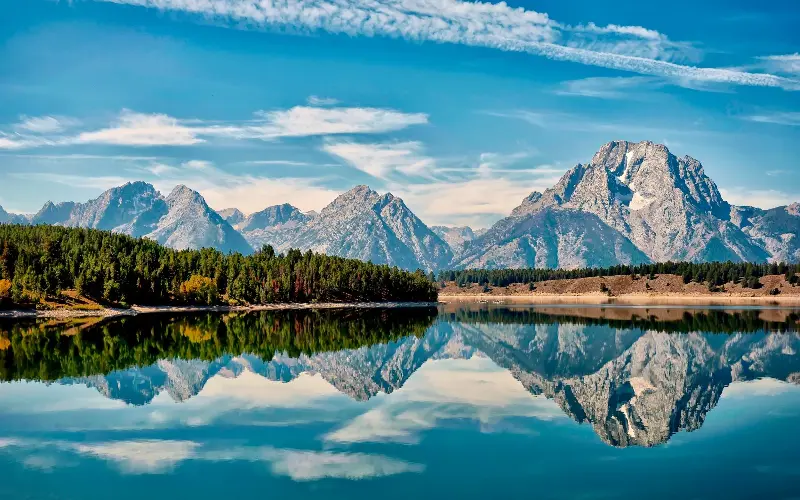
Jackson Hole gets its name from a 19th-century fur trapper (Davy Jackson) and a 19th-century fur trappers’ term for a low, flat valley surrounded by high mountains (hole). The Jackson Hole valley lies between the Gros Ventre mountains and the Teton mountain range, whose jagged peaks erupt from the earth with startling suddenness. Most mountain ranges ease themselves into the horizon – the Tetons simply appear, like a row of stone shark fins slicing through the sky.
It’s because of these mountains that British visitors know Jackson Hole primarily as one of North America’s greatest ski destinations – the country’s answer to the Dolomites – but locals repeatedly tell me, just as they do in Italy, that I’ve arrived in the better season.
“Winter gets all the magazine covers,” says Cassie, my guide on a rafting trip down the Snake river. “Summer’s when we get the place back.”
As we drift between forested banks, bald eagles perched high above the water and snow still lingering on distant peaks, it’s difficult to argue. The mountains remain dramatic, but summer softens everything else. Wildflowers bloom where ski runs were etched into snow. Long hiking trails open into the high country. Cyclists, anglers and horse riders replace skiers. Most importantly for me, the wildlife emerges.
“You’ll see more animals this time of year,” Cassie tells me. “Moose, elk, bears – even wolves if you’re lucky.”
I’m fortunate enough to see just that the next day, when I explore Grand Teton National Park, which begins mere minutes from Jackson. I drive the 42-mile loop that takes me along the base of the Teton range, the road skirting 19th-century Mormon homesteads, crystalline lakes and forests of pine, spruce and fir. Sagebrush ripples across open meadows. Along Jenny Lake Scenic Drive, mountains chew the horizon while reflections shimmer in water so clear it appears almost artificial.
By late morning I’ve seen mule deer, elk and a moose feeding in a marshy stand of willow. Later, standing at Snake river Overlook, I recognise the view from Ansel Adams’ celebrated 1942 black-and-white photograph, The Tetons and the Snake river. Despite having already appeared on a thousand postcards, it exceeds expectations in summer technicolour.
As late afternoon approaches, I spot a small group of people gathered in a lay-by, the tailgates of their two pick-up trucks hanging open, each acting as platforms for spotting scopes mounted on tripods. I pull over to ask what they’ve seen, and a couple of citizen scientists in their late sixties named Bob and Barbara point up to a distant grass-bearded mountainside on which I can see nothing but a distant scatter of rocks.
“Grey wolves,” Bob tells me, offering to let me look through his scope.
“A mother and four pups,” beams Barbara, as the scope reveals the rocks to be a line of wolf cubs following its mother up and into a fold in the ridge, disappearing from sight a few moments later.
“Barbara spotted them first,” says Bob. “She’s got good eyes,” he adds as he produces a notebook and starts to scribble down the sighting, which he says he’ll share with park rangers.
I could have passed the information on for him myself, around half an hour later when, as I round a bend, driving south through the park, I find myself brought to a halt by stationary traffic in both directions. It’s extremely unusual to see a tailback around these parts, and that’s one of the joys of driving in Wyoming, the least populous state in the US where just 590,000 people live spread out across nearly 98,000 square miles.
Engines idle and doors stand open. Drivers have abandoned their vehicles and gathered beside the road. A park ranger’s car sits parked on the grass verge, the lights on its roof flashing impotently, scrubbed and bleached by scouring sunlight.
“Back up! Get back in your vehicles now.”
The voice belongs to a National Park Service ranger. Despite the badge pinned to her chest, she appears to be losing an argument with several dozen tourists armed with telephoto lenses. The reason for the chaos is standing in the long grass – a female grizzly bear is watching over two cubs.
The youngsters tumble over one another, rolling on to their backs and wrestling with all the carefree enthusiasm of children in a playground. Their mother stands motionless nearby, her attention fixed entirely upon them.
“She may look cute,” the ranger announces, “but she’s a wild animal guarding her cubs. And she could cross the distance between us in a second.”
Everyone shuffles backward slowly, while simultaneously zooming in, their camera shutters still clacking like Action Man machine guns. Every one of us continues to take pictures through our car windows, using them as makeshift wildlife hides.
It’s only when the great bear eventually ambles toward the tree-line and disappears into dense forest with her cubs trailing behind her that the highway finally starts rolling again. Jackson Hole in summer may be the only place where a traffic jam can become a treasured travel memory.
Essentials
Fly to Jackson Hole via Salt Lake City with Delta or via Denver with United Airlines.
Four Seasons Resort Jackson Hole is the area’s smartest address (doubles from $1,133/£855), while The Cloudveil offers boutique luxury just off Town Square (doubles from $336/£290).
Ride the aerial tram, hike or bike high-alpine trails, go fly fishing, white-water rafting, rock climbing, horse-riding or paragliding, or tackle the Via Ferrata. For the best wildlife viewing, book an early-morning safari with Teton Wild, when bears, moose and wolves are most active.