



Paul Ricard’s great-grandson poured water into my pastis before sitting back in the Provençal sun. As the bell chimed from its terracotta-red tower and the ferry chugged into a dinky harbour lined with houses that could have come straight from toy-town, the waterside Café Paul Ricard was doing a brisk trade.
“This is my favourite part of an island full of family memories,” Marc de Jouffroy said, sipping the aniseed-flavoured Ricard that his great-grandfather created, and which has become synonymous with the south of France.
There was no better drink with which to toast the reopening of the Île de Bendor and its brace of hotels on this sliver of land bought in 1950 by the drinks magnate, who went on to join forces with Pernod as Pernod Ricard.
“It was just rock and trees when he bought it. There was one house and one sheep,” de Jouffroy told me. Ricard created a haven for his five children as well as a miniature Mediterranean world blending art, nature, water sports and hedonism on the island, a seven-minute ferry hop from the seaside town of Bandol.
Although it only measures 700m by 220m, Bendor featured two hotels, restaurants, an international diving club, an artisans’ village, a sailing club and a museum. Everyone from Brigitte Bardot to Salvador Dali visited, but so did locals – Ricard was passionate about sharing the island.
But after his death in 1997, when de Jouffroy was 12, Bendor slowly lost its sheen. One hotel closed in 2005, the second after the Covid-19 pandemic. Keen to recapture some of the island’s old magic, the extended Ricard family under de Jouffroy brought in Zannier Hotels with the challenging brief of transforming Bendor into its sixth upmarket resort while maintaining the original DNA.
Five years and more than €100m later, the result feels very much in keeping with Ricard’s motto, which he had carved into a statue outside the Delos hotel: Nul bien sans peine (no good without pain).
Delos, where I stayed, is on Bendor’s eastern tip. Like many of the buildings, its shell remains similar to its previous incarnation, but inside, there is a distinct air of what Arnaud Zannier, founder of the eponymous hotel group, calls “humble luxury, not bling-bling”. Rooms have a chic Sixties Riviera vibe, with baby-blue walls, striped sofas, and rattan-and-reed furniture. The large bathrooms come with Provençal-style tiles and Méditatif products created by Alicia Zannier, Arnaud’s wife (her swimwear is also for sale in the shop).
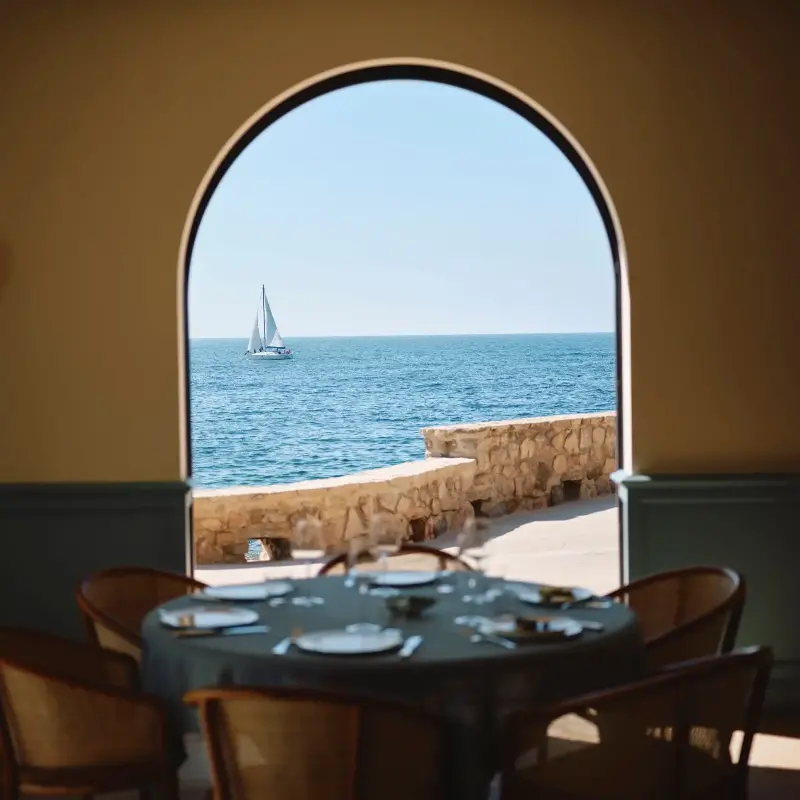
As with sister hotel Soukana on the western end of the island, décor never competes with the panorama beyond the large windows: all 93 rooms, including five cottages, have sea views.
Where Delos leans into Riviera nostalgia, Soukana takes a more restorative approach. Rooms come in soothing, earthy tones, with yoga mats and weights tucked into the cupboards; breakfasts are delicious but healthy and the rooftop bar is made for sunsets. Outside, the 30m-long pool is perfect for swimming lengths, and a capacious newly built spa is just steps away.
Neither hotel is cheap. But this is not a sealed-off luxury enclave. Anyone can jump on the ferry, stroll around and buy a drink or a crêpe for a few euros. Make a reservation in one of the restaurants – whether that’s the gourmet Grand Large, Soukana, with its superb Asian offering, or the Mediterranean Nonna Bazaar – and the €10 (£8.60) return boat trip is thrown in.
The food is tasty, with a few subtle nods to Ricard. At Delos Table, I ended lunch with a crème brûlée flavoured with olives, nuts and a dash of the famous aperitif (more delectable than in sounds) then returned in the evening for a pêches aux thon, whose single teaspoon of Ricard still delivered a hefty aniseed kick. Somewhere in between, I couldn’t resist a Ricard ice cream from the café before setting off to explore.
Just past the kids’ club, I found the artisans’ village with its lavender shop, potter and ceramicist, where visiting artists offer workshops. Then came the gallery, displaying some of the 300 artworks scattered across Bendor and its hotels in tribute to Ricard, who was also a prolific artist.
In the Place du Village, the island’s social heart, music drifted out from Bar Patrick while families tucked into €20 (£17) pizzas from Nonna Bazaar and sunbathers stretched out on the adjacent beach. Nearby, teenagers launched paddle-boards from the watersports centre as another visitor skimmed across the sea on an electric hydrofoil board.
“We have created more of a destination than a hotel,” Zannier said. “It’s a small world that preserves Paul Ricard’s original concept.”
Some 30 seconds beyond the buzz, past an imposing statue of Neptune presiding over the tennis and pickleball courts, the mood shifted entirely. About a third of Bendor remains private, with a handful of Ricard family houses on the cliffs. Beyond them runs a wild coastal path, on which you can walk the length of the island in 10 minutes.
It’s here that I got talking to Jean-Pierre Duval, from the mainland village of Le Beausset. He told me about his time on Bendor 40 years ago while training to be a diving instructor – and what he thinks of its transformation.
“They have kept the spirt of the island but somehow made it more beautiful,” he said.
It’s comments like his that bring a smile to de Jouffroy’s face. He remembers not only the summers spent running wild with his cousins here, during which he learnt to dive and sail, but also his great-grandfather explaining the importance of Bendor to him.
“When he was 75 he was asked by a journalist what his legacy would be. He said ‘Bendor will stay’,” said de Jouffroy.
Jane Knight travelled as a guest of Zannier Ile de Bendor, which offers B&B doubles from €620 (£536); of British Airways, which flies from London City to Toulon Saint-Tropez in summer from £113; and of Holiday Extras, which offers five days’ meet and greet parking at London City Airport from £146.