



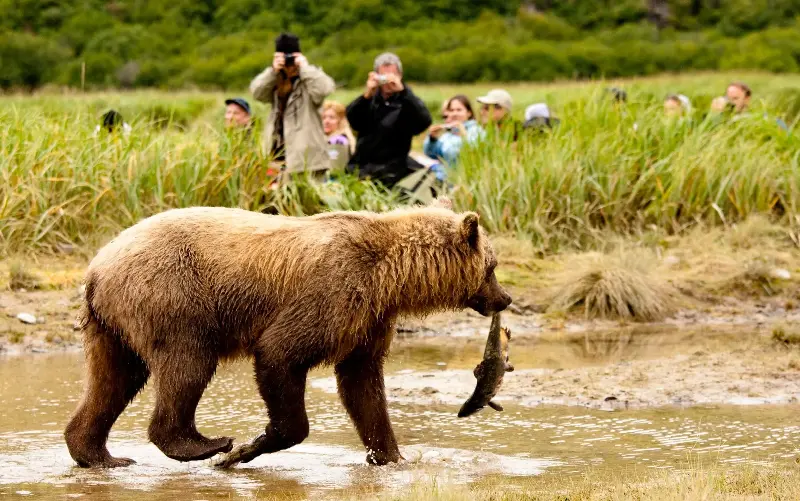
Encounters with wildlife are among the great joys of travel, whether you’re on an Africa safari (when, of course, it’s the whole point), touring the American west or exploring ancient eastern temples.
But encounters occasionally go wrong. Perhaps you’ve seen the recent viral videos: in Yellowstone, USA, a bison tosses a grandfather into the air; in Phuket, Thailand, a monkey sinks its teeth into a tourist; in Fukushima, Japan, a black bear chases a worker around a carpark. And when you learn that even in Denmark, the government has recently issued advice on how to avoid wolf attacks, you can be forgiven for feeling a little disquiet. What’s going on? Is the animal world turning on us?
In truth, such incidents remain rare. And they are invariably our fault, involving animals that have been needlessly provoked or have lost their fear of humans through being fed. Under natural conditions, wild animals – even the big, scary ones – try to avoid us. There’s really little to worry about, provided you show a little respect and never, ever, feed them.
The company of wolves
Wolves have had a bad rap since Little Red Riding Hood, but they generally keep well clear of humans. Should you meet one at close quarters, however, do not run away. As with all predators, this only triggers their instinct to chase. In Denmark’s Oksbøl region, where curious young wolves have approached tourists, the official advice is to stare a wolf in the eye to show dominance, while waving, shouting and clapping hands. If attacked (which is highly unlikely), put up “maximum resistance”.
Don’t underestimate rabies
Wolves can also carry rabies. This deadly disease explains why a normally shy animal might behave unpredictably. However, in this respect, stray dogs pose a greater danger than any wild wolf. Never be tempted to pet one, however appealing it might look. And be sure to get urgent medical treatment for any dog bites or scratches.
Bear necessities
Japan’s well-publicised recent bear attacks stem from a combination of more bears and less natural habitat, meaning bears and people run into each other more often. The Japanese black bear is a close cousin of the American one, and expert advice is the same: when walking in bear country, stick together in a group and make plenty of noise. They’ll generally give you a wide berth.
Don’t panic
If you do meet a black bear up close, don’t panic. Give it space, avoid eye contact and back away slowly, talking in a low, calm voice. If it acts aggressively, don’t run or climb a tree (bears are better than you at this). Rather, look big and fierce, shout and wave your arms or a stick. This generally works. In the highly unlikely event it does attack, fight back: kick, punch, scream. Don’t drop your backpack, which might protect you.
Do know your bear breeds
Brown bears (which include the famous North American grizzly) are bigger. Despite the fearsome reputation, however, these are shy animals and aggressive incidents are rare. Encounters can be avoided and confrontations de-escalated as with black bears. If attacked, however, the advice is not to fight back: rather play dead, lying face-down, with your legs apart and your hands protecting your head and neck.
Monkey business
“Monkeys are very smart, have a long memory and learn from each other,” writes Professor Tracie McKinney, senior lecturer in Biological Anthropology at the University of South Wales. Certainly, monkeys are smarter and quicker to learn than the tourists who feed them snacks for TikTok videos. Many celebrated tourist sites in South and South-East Asia, from the Taj Mahal to Angkor Wat, are home to habituated troops of macaques, which have long lost their fear of humans and will snatch food – even phones – from hand or backpack. Other trouble spots include South Africa’s Cape Point, where marauding baboons do the same.
Do watch for warnings
Most such places display warning notices. Heed them. Never feed monkeys, avoid eating in front of them, keep bags zipped and keep your distance. If one becomes aggressive, back away quietly, avoiding eye contact or showing your teeth – both of which are challenges in monkey language. If it persists, drop any food you’re carrying. Don’t fight back or scream. If bitten, get immediate medical help.
Angry hooves
Even herd-loving herbivores value personal space. And at certain seasons, such as during the rut and when females have young calves, they demand extra respect.
Do keep your distance
The North American bison is a formidable beast, with males weighing up to a ton. Most of the incidents making the news have been in Yellowstone, USA, where bison graze beside roads and people – ignoring park regulations – approach to pose for photographs, sometimes ludicrously close. The advice is simply to keep your distance. If you do find yourself too close to an unhappy bison, back away slowly, putting a large barrier like a car, tree or boulder between you and the animal.
Don’t let dogs off lead
Similar advice applies to other hoofed mammals, from moose in Alaska (which injure more people than do bears) to red deer in Richmond Park. Always give them space. Watch for warning signs such as stamping feet or raised hair. If approached, back slowly away behind a large obstacle. Keep dogs leashed: deer see dogs as predators – which, of course, is exactly what they are.
Safari safety
You might expect an African safari to top the wildlife risk list, what with the fearsome likes of elephants, hippos, lions and buffalo. In fact, the dangers are negligible. In a vehicle, even an open one, wildlife does not recognise you as a threat. A lion might be breathtakingly close but is still oblivious to you. Plus, you’ll generally be with an expert guide, who knows exactly what to do.
Do stick to your group
On a self-drive safari, take care around elephants – especially cows with calves: these giants generally tolerate vehicles but always demand respect. On a walking safari, you’ll have an armed ranger and a strict briefing. Besides, all self-respecting wild animals try to avoid a group of noisy humans tramping through the bush.
Don’t let your guard down
The most problematic safari encounters tend to be with smaller “harmless” animals around camp, such as monkeys. As ever, it’s because they’ve been fed and habituated. Over decades of safari adventures, my only wildlife-inflicted injury came courtesy of a yellow-billed kite at Victoria Falls, which inadvertently raked my nose with a talon when swooping to snatch my sandwich.
Risky reptiles
Snakes top the terror list for many travellers. However, most species are non-venomous and even the deadliest do their best to avoid people. Snakes will only bite a human in self-defence, and bites in a tourism context are extremely rare. Should you meet a snake, stand still and let it go its own way. If it’s in your accommodation, contact management. Don’t try to catch it or whack it with a stick. Count yourself lucky to see one: they are fascinating animals that play a vital role in the ecosystem.
Don’t swim in crocodile country
Crocodiles are also interesting – unfortunately, they are also among the very few wild animals that might see you as lunch. Avoiding crocs comes down to common sense. In crocodile country, from Africa to northern Australia, treat all natural waterways as dangerous. Never swim. Always stay at least five metres from the water’s edge.