



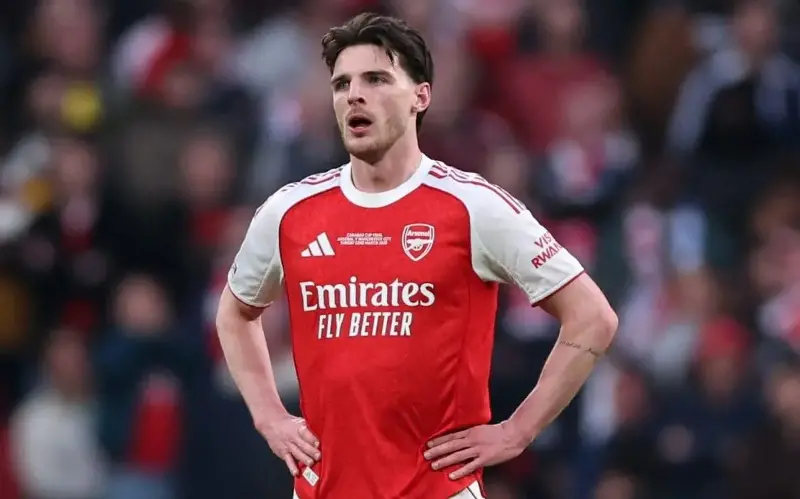
Arsenal were still on their way home from Wembley, following their Carabao Cup final defeat by Manchester City last Sunday, when the news broke that William Saliba had pulled out of international duty with France. It proved to be the start of a first wave of international withdrawals by Mikel Arteta’s players.
That same evening, the Dutch football association announced that Jurrien Timber would not be joining up with the Netherlands team. The following day, Gabriel Magalhães was excused from duty with Brazil, and Leandro Trossard withdrew from the Belgium squad. It was also confirmed that Eberechi Eze had been taken out of the England set-up.
The second wave of withdrawals came on Saturday and Sunday. First, when it was confirmed that Declan Rice, Bukayo Saka and Noni Madueke had all left the England camp. Secondly, when Piero Hincapié and Martín Zubimendi left the Ecuador and Spain squads on Sunday. It meant that, in total, 10 Arsenal players have been removed from international duty after initially being selected by their countries.
Are the league leaders suddenly in the midst of a brutal injury crisis or is something else at play? It depends on the individual, to some extent. Eze is expected to be out for at least a month, for example. He could never have played for England this week. Timber was already injured when he was selected by the Netherlands, having missed the last two club games before the break.
And Madueke picked up his injury, a seemingly worrying knee problem, while playing for England against Uruguay on Friday night. Madueke left Wembley limping heavily, with his leg in a brace. Hincapié appeared to suffer a hamstring problem when playing against Morocco.
For the others, though, there is less clarity. Saliba and Gabriel both played 90 minutes against City before withdrawing from their international teams with ankle and knee problems, respectively. Rice and Saka, too, played the full match at Wembley, while Trossard played 82 minutes.
The precise details of their fitness problems remain unknown but, on a wider level, it points towards an obvious conclusion: the demands of this campaign, in which Arsenal were pushing for a quadruple and are still dreaming of a treble, are clearly taking a toll on Arteta’s players.
From the last international fixtures, in mid-November, to the start of this current break, Arsenal played 33 competitive matches in 17 weeks. In that same time, only Newcastle United played more games (34) in Europe’s major leagues. Newcastle, too, are unquestionably feeling the effects of the schedule, having won only one of their past five matches.
“I’m shattered,” Rice said after the recent Champions League victory over Bayer Leverkusen. “It’s non-stop. It has been every three days since October. We have been coping with it the best we can.”
The sight of Rice gingerly walking down the Wembley stairs last Sunday, after collecting his runners-up medal, was evidence of the physical load he has been carrying. Rice’s legs (and perhaps also his back) were so fatigued that he supported himself on the rails with both arms.
The six outfielders who have played the most minutes for Arsenal this season are Zubimendi, Rice, Timber, Saliba, Gabriel and Saka. It is clearly no coincidence that all six of those players have withdrawn from this current international break.
There will certainly have been no objections from Arteta to these players coming home from international duty. The Arsenal manager admitted earlier this month that the international break is “a period I don’t enjoy a lot” because of his fears around possible injuries. In the case of Madueke, those fears appear to have been realised.
Some Arsenal supporters have wondered whether the spate of withdrawals represents Arteta’s “Sir Alex Ferguson moment”. The former Manchester United manager was famously keen for his players to be removed from international duty, especially when it came to friendly games. Former midfielder Nicky Butt once said that Ferguson forced him to withdraw from an England friendly. In 2011, Ferguson described international friendlies as a “waste of time”.
If all goes to plan in the remaining weeks of this season, Arsenal could still have 15 matches to play. The campaign will become even more intense, and the stakes will become even higher. For Arsenal, it is probably the most important two-month spell of the last two decades. If ever their players needed protecting, even if it weakens their national squads for these friendly games, it is now. It is also worth noting that Arsenal players are not alone in needing a break: Erling Haaland, the City striker, has been given “special treatment” by Norway, who rested him against the Netherlands on Friday.
Time will tell just how badly hurt the likes of Saliba, Gabriel, Rice, Saka, Zubimendi and Hincapié are. They could all still line up in the FA Cup quarter-final against Southampton next weekend. There can be no doubt, though, that Arsenal’s players are pushing their bodies to the limit in pursuit of historic success this season. The withdrawals are proof of that, and Arsenal fans will be worrying that their players are simply running out of gas.
Indeed, for all the questions that are asked about Arsenal’s mentality, it is the physical state of the players that could ultimately prove to be far more important in the defining phase of this attritional and exhausting campaign. The finish line is fast approaching, but will Arsenal have enough energy remaining to cross it first?
For the latest from Thomas Tuchel’s England camp – plus insight on the title race, relegation battle and the Champions League – sign up for the Telegraph Total Football newsletter, in your inbox for free, every Monday.