



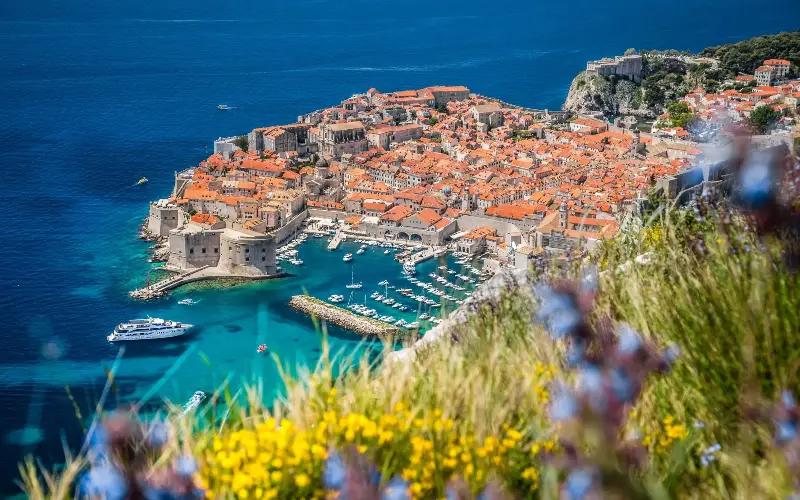
The terracotta muddle of Dubrovnik old town dazzled below, but I was 1,300ft up in the wild. Balkan whip snakes slithered through rosemary thickets nearby, and carob pods longer than Curly Wurlys slapped me in the face – but I was focused on looking for blue moons.
These bright little icons have been spraypainted on everything from beehives to an abandoned Yugo as they – literally – trailblaze the Camino Dubrovnik, Europe’s newest pilgrimage trail. As pilgrim number one, the moons were to be my guide on a route where I wouldn’t see another hiker all week.
My day had started at the 13th century Church of St James in Dubrovnik, the official start-point of the pilgrimage. I inked the first of 23 stamps in my pilgrim passport – the first ever issued – then carefully removed a spider’s web from the path and went on my way.
My destination was the Church of St James in Medjugorje in Herzegovina, where the Virgin Mary is said to have appeared to six schoolchildren in 1981. The connection to St James (“Santiago” in Spanish), the patron of pilgrims, is seen as providence. Spain’s popular Camino de Santiago inspired this hiking trail to the “Lourdes of the Balkans”, but the half million annual pilgrims that clog the Spanish route might certainly prefer this bucolic zigzag on shepherds’ tracks. It’s a pilgrimage where lunch means wild strawberries, serenaded by the tweeting of blackcaps, and a good deal more solitude.
My progress was being tracked by GPS on the brilliant Camino Dubrovnik app. Stage two’s nine-mile route was mapped on my phone by way of 15 landmarks, water refill stops and viewpoints. I peeked into Neolithic caves at Mociljska, and stamped my pilgrim passport with a reassuring clack at Komoloc, where the 14th century Chapel of the Annunciation is being gradually ripped asunder by the arboreal limbs of fig trees.
Stages one and two were merely warm-up acts to the harrowingly gorgeous stage three. My dawn start to this 12-mile section appeared simple at first, and I blithely filled up my bottle and stamped my passport at the Church of Our Lady in the vineyard village of Orasac, before cheerfully stomping off.
By lunchtime, it was like hiking through the Holy Land. Pencil thin poplars demarcated forgotten estates, where millennia-old olive trees sat hunched and crab-armed. The pathway looked biblical. Arabis rock cress framed a drystone wall, behind which a goat’s bell tinkled in the wind. In one field were perfectly square foundations hewn from solid granite. Roman? Ottoman? There’s no-one from the 21st century to ask.
The real sting came two hours before sundown. My app map zigzagged, indicating a contour-twisting climb. A quickening hum preceded 20 hives of bees swarming in a wildflower sugar rush. I got wet feet hopping across a watercourse that reeked of blooming sage.
But this isn’t supposed to be easy: the Camino is intended to remind pilgrims of all faiths that life is a marathon, not a sprint. My mini-miracle came as the route suddenly tumbled 1,000 feet, down into the Croatian beach resort of Slano, silhouetted by a sunset the colour of Aperol spritz. God loves a trier, I thought.
Completing a pilgrimage stage gives the sense that you’ve earned your dinner. At Slano’s Admiral Grand Hotel – which offers hikers a 40 per cent discount upon presentation of their pilgrim passport – I devoured a buffet of fisherman’s stew, fried squid, lamb knuckle, rice, pasta salad, two portions of chips and an almond tart. The good Lord certainly wouldn’t object if you spent a few days on Slano’s sand before tackling the tortuous corkscrew of stage four.
I started the day’s section at perhaps the loneliest border post in the European Union, Orahov Do, where a sole customs officer sucked a Marlboro and officially stamped me into Bosnia and Herzegovina, where the blue moons of the Camino Dubrovnik led me on into a Tolkienesque landscape of crags and heather.
By noon, I was deep into oregano country. There was nowhere to stop for lunch – though for better or worse, this will soon change, I’m sure (on my favourite long-distance walks, Turkey’s Lycian Way and Azerbaijan’s new Transcaucasian Trail, an ecosystem of teashops, pancake stops and honey vendors has burgeoned along the route).
By the time I reached Ravno, the terminus of stage four, I was appropriately ravenous and ready to sleep – which I duly did, at the village’s Austro-Hungarian railway station, now converted into a romantic inn, Hotel Stanica (which still shows the timetable from 1975, when steam trains puffed on towards Mostar and Dubrovnik).
Stage five brought with it a change of pace, set along the abandoned rail route itself. In the trickiest parts, train tracks have been repurposed as handrails, sleepers at steps. Sadly there’s no way around the (really exceptionally spooky) abandoned train tunnel, a 370-yard black hole filled with hissing horseshoe bats. Yet if the trail had taught me one lesson, it was that you can achieve anything by putting one foot in front of the other. Fortunately, there was soon light at the end of the tunnel, together with more of my blessed blue moons.
I was beginning to feel my mental state change, too. By halfway through stage six – criss-crossing the topaz Neretva River via ochre-rusted railway bridges – the previous five-and-a-half days’ solitary introspection had begun to bring my own recent loss to the surface.
Time stood still, and I remembered my late father, ill-grieved amid the slurry of everyday demands. Sometimes there’s no time to cry, but a pilgrimage gives you six hours a day to process your emotions. Here, my heaving sobs were absorbed by the gentle gushing of the river, where trout splashed under the shade of pendulous oaks. That night I sank a bottle of indigenous Blatina red chased by two cherry slivovitzs in my dad’s honour.
Alcohol may have been poor preparation for the next day’s 1,500ft ascent of the Camino’s final stage – but when I began, I felt lighter. I powered forward up bare gravel, under a sun that beat down without mercy, until at last I reached the highest point, rewarded by the sight of snowy peaks near Sarajevo, the same spot where the 1984 Olympics had welcomed Torvill and Dean. And then, at last, the hot wind became a cool breeze, and I bowled merrily downhill to my journey’s end – through a butterfly-filled enchanted forest, past more blue moons – and into Medjugorje for my final stamp.
Essentials
Tristan Rutherford travelled as a guest of Visit Dubrovnik, Hotel Excelsior Dubrovnik (doubles from £230) and Admiral Grand Hotel (doubles from £154).