



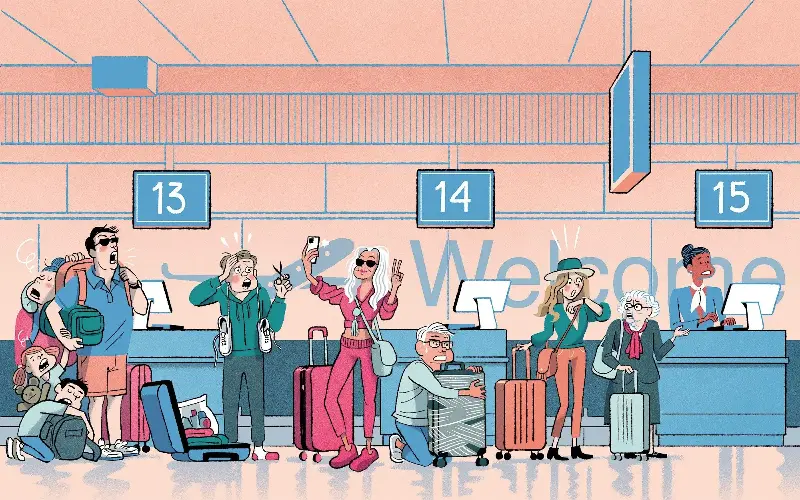
The airport does strange things to people. It turns teddy bears into tyrants, makes the most organised among us crumble into incoherent messes and brings out hidden, horrible habits.
Take the “Airport Dad”, dispensing orders at top volume and walking several yards ahead of his family, or the dithering unloader at security, holding up the queue while they remove several forgotten toiletries from their bag.
Below, we delve into six airport archetypes to find out their typical traits, why they are the way they are – and if there’s any hope of recovery. Which one are you? What annoying airport habits haven’t we mentioned? Please let us know in the comments.
The classic Airport Dad
You know the one: he’s barking instructions to the members of his family who are trailing behind as he exits his car park at a steady jogging pace, bound for the fast bagdrop he marked on his hand-drawn airport plan.
He was up at dawn (for a 3pm flight) and added an hour to the journey time in order to get the car washed on the way – so it will be nice and clean on return. That was in addition to the other two hours he added to be on the safe side, and now the family has arrived before check-in has even opened.
Though it may grate, there’s much that makes sense about this behaviour. Psychologist Dr Ritz Barah explains: “Airports concentrate multiple stressors such as time pressure, unpredictability, queues, and a loss of control. The nervous system responds quickly to that combination, particularly when you are also managing children.
“A couple of practical shifts can help. Giving yourself more time… reduces the sense of urgency that tends to escalate stress. It can also help to simplify decision-making where possible, deciding in advance what you’ll eat, where you’ll sit, or what the plan is once you arrive. Small pockets of predictability can create a sense of steadiness in an otherwise unpredictable environment.”
The flapper
Shoes off or on? Toiletries in a plastic bag or still at the bottom of a rucksack? Laptops in or out? The ever-changing rules are enough to send anyone into a tizz – but some people really spiral. The shoes come off and on again a few times in the queue, leaving absolutely no time for bag disgorging until they’re already partnered with a grey plastic tray. Then their bags inevitably get sent for manual checks (“scissors you say? Oh yes, I forgot”).
One hour before, these were the people holding up the fast-drop baggage queue as they struggled to locate their passports and forgot exactly how many check-in bags they’d actually bought. All that scanning sent them into a premature frenzy, and even remembering their destination proved too much (“Erm, I think it begins with P?”).
“There are lots of potential stressors at the airport, and for many people these can be a source of anxiety that could make them feel flustered by things that they usually manage well,” says clinical psychologist Dr Charlotte Russell, founder of The Travel Psychologist. “A proportion of people will feel anxious about the flight itself, but the airport processes themselves can also be a trigger.
“There are not many situations where we are faced with rigid processes, where it feels like rules change quite often, and the response can be quite abrupt if we get it wrong. Questions like ‘do I need to take my shoes off at security?’ and ‘Is eyeshadow a liquid?’ aren’t things that we’re faced with often. All of this impacts our threat system and can leave us feeling on edge.”
The good news is that it might be OK to blame unsympathetic check-in assistants or ever-changing rules for any meltdowns. “[It’s not just up to the individual traveller], but the responsibility and duty of care of travel companies and airports or rail stations to be good communicators and inclusive with families and people with challenges,” according to Dr Andrew Stevenson, author of The Psychology of Travel and a senior lecturer at Manchester Metropolitan University.
The better-late-than-neverer
This is the lot who ruined it for the rest of us, the ones who cut it so fine that Ryanair recently upped the threshold for checking in from 40 minutes to one hour, citing missed flights. It could be down to a few reasons, some of which are wholly understandable. Others? Not so much.
“Our attitudes and behaviours related to punctuality tend to reflect aspects of our personality,” says Russell. “So as an example, people who are more conscientious will tend to plan effectively and to arrive punctually in most situations. On the other hand, people who are more relaxed, or those who may struggle with timekeeping, perhaps due to neuro-divergence, may tend to be more last-minute.”
But, inevitably, social media is also partly to blame. In 2025, a viral TikTok trend called “airport theory” saw users leaving as little as 15 minutes to dash through the airport to the plane, having checked in online and travelling with only hand luggage. It’s one for those who resent the two- or three-hour wait until boarding and would rather have adrenalin than airport coffee pulsing through their veins (and also don’t mind missing flights, since the average time to navigate Heathrow is between 60 and 90 minutes for those who have checked in online).
“For some people... it may come down to sensation seeking,” says psychologist Dr Katie Blake. “The last-minute rush delivers an adrenaline hit, and certain personality types are genuinely energised by that. While everyone else waited dutifully for hours, they squeezed out an extra hour and still made the flight. The airport is an opportunity for a small thrill for these folks.”
Of course, cutting it fine has been a feature of air travel since the first passenger plane took off, back in the early 20th century. It’s just that, back in the 1980s – when security was no more than walking through an X-ray machine and lots of flights were only half full – being able to whizz through to your plane seat was far more achievable.
The influencer influenced
There’s not much that’s photogenic about Departures, but this lot will find it. Whether it’s hugging an unsuspecting Jet2 check-in attendant while brandishing a boarding pass or doing a quick TikTok dance in the revolving doors (thus causing a pile-up of trolleys at the entrance), they believe that the airport was made to be documented and it was their destiny to do so – even if it means holding everyone else up.
Though they’re a relatively new entry in the check-in tribes hall of fame, a whole new dream world has been set up to cater to them on the other side of the security gates, from Heathrow T5’s Jellycat Airlines pop-up store or T2’s Louis Vuitton Café. (These same new attractions are viewed through gritted teeth by Airport Dads, who just need to get to Pret so that they can collect packed lunches for the flight en route to the gate).
Watch out if you’re in this camp: not all airport journeys end happily. Travel influencer Joleen Weiss recently documented a disastrous run-in with Ryanair crew that saw her banned from a flight to Porto after she started recording while running late, refused to delete the video and insulted a member of staff.
The emotional baggage handlers
You’ve seen those baggage-wrapping stands in UK airports. It’s just that you’ve never seen anyone use them. Stick around and you’ll spot that rarest of airport conspiracy theorists, the emotional baggage handler. Convinced that staff are after their beach shoes and stash of aftersun, they’ve resorted to rainbow ribbons, clingfilm and several padlocks in a bid to ensure it all stays safe.
Though they may not be prepared to gamble on losing their luggage, it’s a fairly safe bet: improved technology means there’s been a 67 per cent decrease in baggage mishandling since 2007 according to air transport communications specialist SITA, and only eight per cent of mishandled luggage worldwide is lost or stolen.
And though wrapping a suitcase makes more sense in countries with high incidences of drug smuggling, far more likely (but still rare) is someone asking you to carry a completely different case through Customs for them. “Criminal gangs are known to pressure people into carrying drugs,” reads the FCDO’s advice for Thailand. “Always pack your own luggage and do not carry anything through Customs for someone else.”
The old-fashioned check-in counter user
Old enough to remember the glory days when you could wave your loved ones off at the departure gate with a flourish of your handwritten boarding pass, this lot see the digitalisation of travel as the biggest bugbear of the modern age.
Pre-booking a space in the long-stay car park for the Volvo Estate is the first hurdle; downloading that pesky check-in app is the next. Dropping off your own luggage is the final straw.
The thing is, the relentless pace of technology is marginalising for those who grew up before the digital age. Few operators offer workable alternatives to online booking, check-in apps and contactless in-air payments, despite the fact that a third of older people don’t use a smartphone. When Ryanair announced that it would scrap printed boarding passes in 2025, Dennis Reed of campaigning organisation Silver Voices labelled the move “disgraceful”.
It’s also a problem that disproportionately affects women. In a 2020 study published in Health Psychology Research, researchers at the University of L’Aquila found “significant gender differences in device ownership, enthusiasm for technology, and creative digital skills.”