



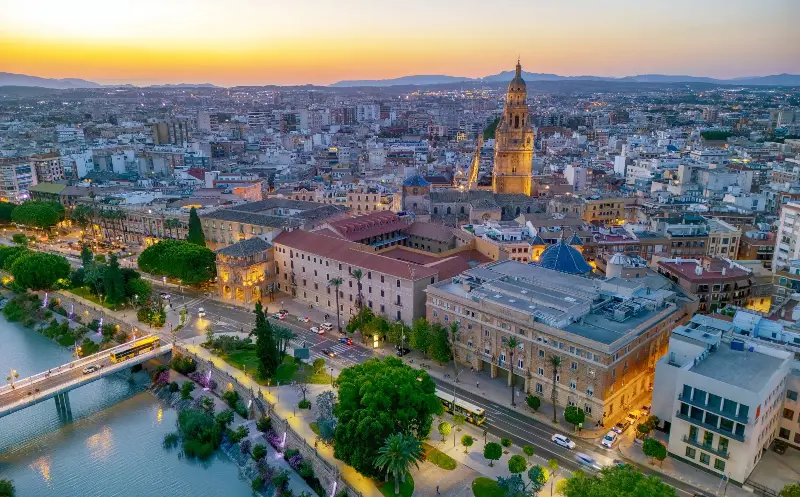
In a labyrinthine museum below the busy streets of Murcia, my amiable Spanish guide Antonio is showing me the robust ruins of this historic, atmospheric city. Are these ancient walls Roman, I ask him. No, he says. Medieval? Wrong again, he says. In fact, these battlements were built by the Moors.
The Moors founded Murcia in AD 825 and held it until 1266, when it finally fell to the Christian armies of Aragon and Castile. It’s been Christian ever since, but its Islamic roots remain. It’s not just archaeology – it’s something in the air. In the dark alleys of the old medina, I’m reminded of Morocco. Spain’s Moorish history is part of its raw magic, and here in Murcia that magic is omnipresent.
I first went to Spain in 1990 and fell hopelessly in love with this wild, sophisticated nation. Since then I’ve been all over, from Catalonia to Cantabria, from Asturias to Andalusia. But I’d never been to Murcia, and it seems I’m not alone. Murcia is actually two places – not just this big, bustling city, but also the rugged region (one of the 17 autonomous communities in modern Spain) surrounding it. The coast attracts some British sunbathers, but once you head inland you hardly see any tourists. If you’re keen to escape the crowds (and protesters) in tourist hotspots like Mallorca and Barcelona, Murcia is the place to go.
Over the next few days, we’ll be travelling all over the region of Murcia, from the craggy mountains in the north-west to the sun-bleached beaches in the south-east. But before we head off, Antonio wants to show me around his hometown.
The real Spain
Murcia isn’t the most spectacular of cities, but what it lacks in stunning sights it more than makes up for in lively street life. These streets are full of locals, with hardly a foreigner in sight. This is the real Spain – a stylish place where people of all ages eat and drink and socialise together, in shady alleyways lined with little independent shops and bars.
The city is an eclectic mix of modern and baroque buildings, and at its centre is one of the most arresting cathedrals in Spain. Built over 400 years, it’s an alluring blend of contrasting architectural styles, but the thing that makes it feel so special is that it’s still first and foremost a place of worship. There are no camera-clicking tourists here – simply devout Spaniards, heads bowed in silent prayer.
Next day, we drive way out west, along Murcia’s Ruta del Vino, to a remote vineyard called Bodega Balcona. The proprietor, Pepa Fernández, shows us round. Her father planted these grapes on land her grandmother had bought, she tells me proudly. Now she runs this place with her brothers. The soil is a fertile mix of clay and limestone, scorched by the summer sun and soothed by the winter snow.
We taste a range of her organic wines: subtle whites from the macabeo grape, complex reds from the monastrell. We feast on ripe olives, roasted almonds, chorizo and Manchego. Pepa’s nephew bakes the bread.
After all that cheese and sausage I’m not remotely hungry, but then we stop off in Bullas, a sleepy town in the middle of the Ruta del Vino, and I find my appetite again. Entretempos looks like a homely little wine bar, so I’m expecting a basic Menú del Día, nothing more, but this is one of the best meals I’ve eaten in years: white garlic soup, pork belly and sweet potatoes, washed down with a few more glasses of the local vino.
Eagles and orchards
We drive on, along the Valle de Ricote, the lush river valley that runs through Murcia and down into the Med. There are lots of pretty little towns along the way – Blanca, Archena, Abarán – but for me the highlight is the Ruta de las Norias, a leafy riverside footpath punctuated by weathered waterwheels.
Most of these splendid contraptions date back to the 19th century, but the irrigation channels they replenish date right back to the Moors. You can see why Murcia became known as “the orchard of Europe”, despite its arid climate. Tidy rows of fruit trees stretch out as far as the eye can see.
Next morning we drive up into the Sierra Espuña, Murcia’s biggest mountain range. Our guide Javier takes us on a bracing hike to the redundant snow wells near the summit. Packed with snow during the winter months, these eerie monoliths kept Murcia’s cities supplied with ice during the days before refrigeration – such a rare, valuable resource that the men who carried it downhill were frequently attacked by bandits.
Nature has reclaimed this hillside. Owls and eagles nest here nowadays. “Since I was a child, I was here all the time, hiking, biking, climbing, so it was always my dream to work here,” says Javi. “To work here is a great gift.”
On our last day we drive south, to the seaside town of Cabo de Palos. Veronica, from the local tourist board, takes us up to the top of the lighthouse – an antique landmark but still fully functional, warning seafarers away from this treacherous stretch of coast (there are hundreds of shipwrecks here – no wonder these clear waters are so popular with divers).
The view from the top sums up the best and worst of Spain. Below is La Manga, a sandy spit 13 miles long and barely 100 yards wide, dividing the broad salty lagoon of Mar Menor from the open sea beyond. In an ideal world, it’d be a lonely wilderness. Instead, it’s been disfigured by a long row of ugly high-rise hotels – a sad epitome of the crude commerce along Spain’s southern shore.
I feared this might be all that Murcia’s seaside had to offer – but just around the headland is one of the most beautiful beaches I’ve ever seen. Calblanque is a precious nature reserve, meticulously protected, and hidden by a ring of rocky hills. Standing on this windswept beach, you can’t see a single building, not one sign of human habitation (even the car park is out of sight). You’d never know La Manga is only a few miles away.
Hidden history
We wind up in Cartagena – Murcia’s second city, an important port for 3,000 years. The huge harbour contains every sort of vessel, from cruise ships to warships, luxury yachts to dinghies. Every era has left its mark, starting with the Carthaginians (after whom it’s named). The Roman relics are the most impressive – a vast theatre, built into the hillside, and a forum, once the centre of the city, now buried amid a maze of silent backstreets.
Driving back to the airport for my flight home, I wonder why Murcia isn’t more popular with British tourists. After all, it has a bit of everything – from seaside to countryside, fine wine to fine art. Compared with some other parts of Spain, it’s remarkably compact. From the coast to the mountains is only about an hour’s drive.
Maybe it’s because it’s one of Spain’s smaller, poorer regions. Maybe it’s because it doesn’t have the well-known attractions you find in busier, wealthier parts of the country. But like La Mancha and Extremadura (two other Spanish regions often overlooked by foreign tourists), it feels intimate and authentic. I’m sure that I’ll be back.
How to do it
Fly direct to Region of Murcia International Airport, midway between Murcia city (25km) and Cartagena (30km). Ryanair flies from Birmingham, Bournemouth, East Midlands, Glasgow, London Luton, London Stansted and Manchester. EasyJet flies from Bristol, London Gatwick and Manchester.
For an idyllic rural retreat, stay at Hotel Bajo El Cejo, a peaceful, comfortable hideaway in an old watermill in the foothills of the Sierra Espuña. Doubles from £74, including breakfast. In Murcia city, stay at the chic Hotel Murcia Rincón de Pepe, a modern four star in the heart of the old town. Doubles from £84, including breakfast. In Cartagena, stay at the AC Hotel Cartagena, a smart new build beside the Roman theatre, moments from the waterfront. Doubles from £115, room only.
William Cook travelled to Murcia as a guest of Tourism of the Region of Murcia.