



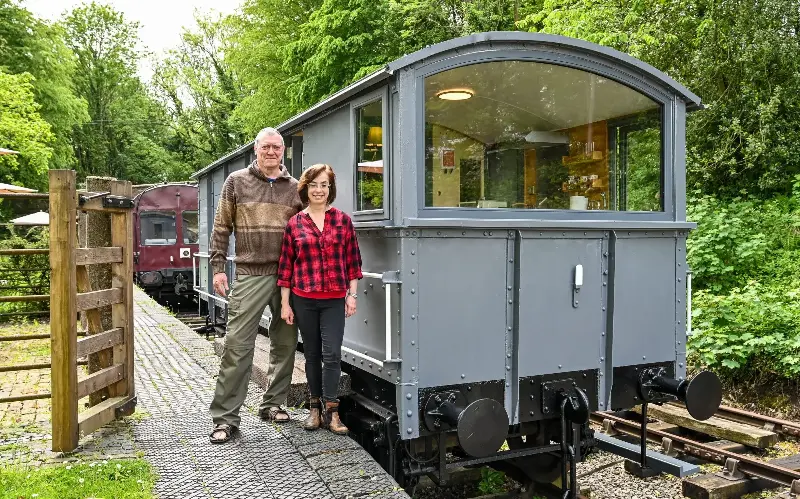
There’s always something sad about the closure of a railway station – and something utterly uplifting when they are rescued and given a new lease of life. In leafy Herefordshire, Rowden Mill Station was one of many to close in the 1950s and 1960s as cars gained ascendancy over trains. Now, it has had a complete makeover, offering stylish overnight accommodation in a number of original station buildings and, as of this summer, a 1947 brake van.
There are similar examples all over the country, testimony to the enduring British love affair with the culture of railways and the dedication of rail fans wanting to create new spaces, both for fellow enthusiasts and for visitors looking for somewhere out of the ordinary to sleep, eat and be merry. Here’s our pick of 10 abandoned stations that are now firmly back on track.
Rowden Mill
Herefordshire
Set on a quiet country lane in Herefordshire, the beautifully reimagined Rowden Mill Station, which operated between 1897 and 1952, is a great example of how Britain’s railway heritage can be given a 21st century twist. Husband-and-wife team Paul Kirwan and Cecilia Chavez-Brandon have been working on the site for several years and improving a restoration project that began in the 1980s.
They now welcome guests for stays in the original station house, the parcel office, a stately saloon carriage and, most recently, a repurposed brake van. Nearby attractions include the National Trust’s Brockhampton estate and the market town of Bromyard.
From £110 per night; rowdenmillstation.uk
Petworth
West Sussex
While Chichester, Goodwood and the golden sands of West Wittering are all celebrated attractions of West Sussex, the Old Railway Station at Petworth is one of the county’s most unusual guesthouses. The original station, constructed in the 1890s, operated as a stopping point on the London, Brighton and South Coast Railway until its closure to passenger trains in 1955.
The site has been skilfully converted to offer B&B stays in the original station house and a number of vintage Pullman carriages. The old waiting room is now a period piece café which is also open to non-guests for afternoon teas. A particularly agreeable option for visitors to the nearby South Downs.
From £175 per night; old-station.co.uk
Stoke Edith
Herefordshire
The very grand Lady Emily Foley of the Stoke Edith Estate was the driving force behind this pretty piece of railway heritage, as she was the one who, in 1861, ordered its construction for the convenience of family and guests visiting the estate. In its day, elegantly dressed Edwardian ladies and gentlemen would have graced the station’s platform.
It closed to passengers in 1965, one of many victims of the Beeching cuts, but anyone wanting to follow in their footsteps can arrange a self-catering stay in a building that bears all the hallmarks of a classic late-19th-century Great Western Railway station. The Booking Office contains three bedrooms, while the Waiting Room has two. In addition to a lovely patio area, the pleasures of Frome Valley and the River Wye are nearby.
For prices contact the property directly at stokeedithstation.co.uk.
Yarmouth
Isle of Wight
Darvilles of Windsor tea and a Beeching bacon roll are among the offerings at Off The Rails Yarmouth, located in what used to be Yarmouth Station on the Isle of Wight. Originally built as part of the Freshwater, Yarmouth and Newport Railway, the station was operational from 1888 until 1953.
After serving for a period as a youth club, the station was extensively renovated and extended; 2014 saw the opening of Off The Rails, which quickly established itself as a unique café and restaurant on the old Causeway railway line overlooking Yarmouth Marshes and the ancient woodland of Mill Copse.
Coalman’s full English breakfast, £16; offtherailsyarmouth.co.uk
Walham Green
London
This is definitely one to drink to – the conversion of Walham Green, the former London Underground station on the Fulham Road into a railway-themed JD Wetherspoon pub, complete with historic signage and ticket windows. Walham Green Station opened in 1880 when the District Railway was extended south from West Brompton to Putney Bridge.
The station was refashioned in 1910 and given a dramatic Edwardian Baroque façade. It was renamed Fulham Broadway Station in 1952 and closed in 2003, when the station entrance was incorporated into the new Fulham Broadway Retail Centre. Close to Chelsea Football Club’s Stamford Bridge stadium, the pub can get a little raucous on match days.
Burger, chips and a pint of lager, £9.75; jdwetherspoon.com
Snowdon Ranger
North Wales
If you have your sights set higher, the Old Snowdon Ranger Station guesthouse comes with some serious railway history – and, as the name suggests, great views of the highest mountain in Wales. The property’s life as a functioning station on the Welsh Highland Railway – originally the North Wales Narrow Gauge Railway – ran from 1878 until 1936.
These days, the lovely 19th-century stone building that served as the ticket office makes a great base for exploring the peaks and lakes of one of the most beautiful parts of Britain. It is also once again (on a seasonal basis) accessible by steam train, courtesy of a new Snowdon Ranger request stop on the restored line running close to the original station.
From £368 for seven nights; walescottageholidays.co.uk
Wall
Northumberland
How the Roman centurions who once stood guard at Hadrian’s Wall would have welcomed a night or two at the Old Signal Box, a beautifully converted structure that now provides a welcome holiday retreat – complete with underfloor heating – for visitors to this rugged part of northern England.
The original signal box was built in 1890 as part of Wall Station on the Border Counties Railway, which operated between 1858 and the mid-1950s and connected Northumberland with the Scottish county of Roxburghshire. The property offers panoramic views of the North Tyne Valley, easy access to both Newcastle and Carlisle, and close proximity to the Roman wall.
From £100 per night (minimum stay three nights); theoldsignalbox.co.uk
Kirkby Stephen, Dent, Ribblehead and Horton-in-Ribblesdale
Cumbria and North Yorkshire
Several of the once-abandoned stations along the wonderful Settle-Carlisle line in north-west England have been creatively repurposed to serve as holiday home rentals. These include the stations at Kirkby Stephen and Dent in Cumbria and Ribblehead and Horton-in-Ribblesdale in North Yorkshire, all of them offering access to nearby dales and characterful old villages.
With passenger numbers in decline, these vintage 19th-century stations were all closed for a period in the 1970s and 1980s when it looked as though the line would be shut down completely. In 1989, Michael Portillo, then secretary of state for transport, declared a reprieve for the line – the most scenic in England – which has subsequently gone from strength to strength. The revamped stations are lovely places to stay, and after the last train of the day guests have them all to themselves.
From £240 for a two-night stay; settle-carlisle.co.uk and settlecarlisletrust.org.uk
Melrose
Scottish Borders
Another victim of the Beeching cuts was the grand-looking Melrose Station, once a key stop on the Waverley Route running from Edinburgh to Carlisle. Opened in 1849, the station was designed in Jacobean style, the key reason for its preservation after the line was closed in 1969. Declared a Category A-listed building in 1981, the former station served for a while as a café and today houses the Monte Cassino Italian restaurant. The track has long gone, but the platform with station sign survives; rail lovers can travel here via Tweedbank, a one-and-a-half-mile river walk away.
Pizzas from £12.90; montecassinorestaurant.co.uk
Cookstown
Northern Ireland
This distinguished-looking building – which served as one of two stations in this modest-sized County Tyrone community – was originally opened by the Belfast and Ballymena Railway Company in 1856, and remained in operation until 1955. It is prized for its original Victorian construction, and is now the slightly unlikely location of Cookstown Hockey Club, whose players used to see trains running along the line right next to their pitch.
Further information: cookstownhockeyclub.com