



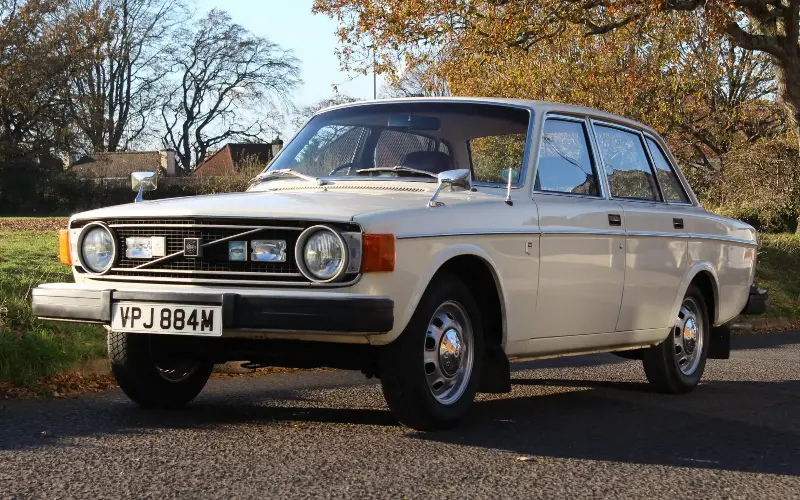
Sometimes the rarity of a once-familiar model is a considerable surprise. The 140 range was the first Volvo to sell more than a million units – and while some variants inevitably had a better survival rate than others, this is the only 144E still on the road.
Volvo began work on the eventual replacement for its 120 Amazon range in 1960, with the 144 making its bow in August 1966. UK sales of the car that was “created in Sweden – with all the care in the world” began in 1967. The Telegraph complained about the seatbelt positions but thought the 144 deserved “careful scrutiny both by rival manufacturers and discerning buyers”.
By 1969, there was a 2.0-litre engine instead of the earlier 1.8-litre unit, while for 1971 the 144 had a new grille and the option of Bosch D-Jetronic electronic fuel injection for the upmarket GL. In 1972, Thames Valley Police evaluated the cheaper, fuel-injected 144E as a patrol car; its chief constable told the press the marque had a reputation for “durability, reliability and stability”.
In late 1973, Volvo replaced the D-Jetronic with K-Jetronic fuel injection, which reduced the 144E’s power output from 124bhp to 115bhp. The top speed was 102mph, with 0-60mph in 12.5 seconds. Autocar thought the 144E had “rather heavy controls and [a] generally ponderous nature”, but noted “many good features”, including “a solidity of feel”.
Volvo placed heavy emphasis on the 140’s solidity, warning prospective buyers that: “One of the last things you should think about when you collect your brand new shining car is that sooner or later it will end up at the scrapyard.” A Swedish government survey had shown the 140 “to have a life expectancy of 14.2 years – substantially more than any of the other makes tested”.
The 144E also boasted a driver’s seat with “no less than six different ranges of adjustment” – a far more sensible feature than the Ford Granada Mk1 GXL’s frivolous vinyl roof. A Volvo dealer would have almost certainly pointed out the 144E’s major post-fuel crisis selling point of requiring only two-star petrol.
By 1974, a 144E cost £2,490.57. The only alternative for the motorist who wanted seating for five, a fuel-injected engine and to “Buy British” was the Triumph 2.5 PI Mk2 at £2,370. Unfortunately, the Triumph’s engine was not renowned for its reliability, while the 2.5 looked a tad flamboyant compared with the Volvo.
As for overseas rivals, the Citroën DS Pallas for £2,760 was too expensive and too complex. The Lancia 2000 IE at £2,696 did not appear as robust as the Volvo and was more for the motoring connoisseur than a chartered accountant. That left the £2,170 Peugeot 504 Ti, which was undeniably appealing; the 144E seemed even more sensible.
This example is one of the last of the 140 range, as in the summer of 1974 Volvo introduced the replacement 200-series after 1,251,371 units. The 144E’s first owner was the novelist Leslie Charteris, the creator of The Saint, who took delivery in May of that year. On the surface, Charteris was not quite the typically sober-minded Volvo buyer; The Telegraph’s obituary described him as a “tall, conventionally good-looking, sporty, champagne-swigging, cigarette holder-flourishing” bon viveur.
However, while such carryings on were far from sensible, Charteris did appreciate value for money. A 144E was ideal for an author who once said, “Everything I write is designed to be milked to the last drop of revenue.” Besides, while The Saint of the novels drove a fictional Hirondel sports car, the 1962-1969 television adaptation had Roger Moore pilot a series of Volvo P1800s in his eyebrow-raising adventures.
Charteris specified a “Grille with auxiliary headlights” to give his 144E a slightly louche air. He also ordered the rare factory option of air conditioning, which was perfectly suited to the author of The Saint; “What every Volvo owner needs to remain cool, calm and collected, whatever the atmospheric conditions.” When Charteris died in 1993, he left the 144E to his chauffeur, who put it into storage.
Today, this car is part of the Volvo Heritage Fleet. It is a fascinating reminder of how the 144E was ideal for the owner who was proud not to be a dedicated follower of automotive fashion. And who appreciated a boot so deep that “you can pack your cases handles-up”.
We use the fascinating howmanyleft.co.uk for figures of surviving examples but some cars present more of a challenge than others, so the figures are rarely authoritative. Some pre-1974 records were lost before the DVLA centralised the process, while some cars have their model type misnamed on the V5 registration documents. A further issue is the omission of the exact model name or generation, or distinction between saloon and estate body styles.