



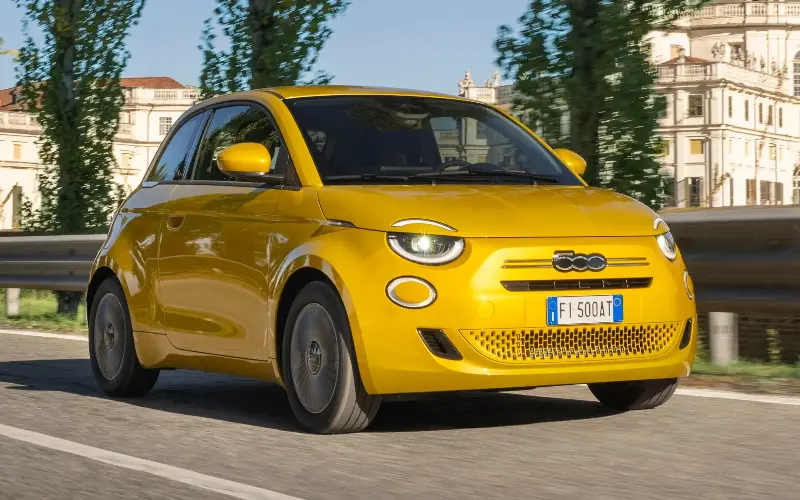
Then and now, did any car more accurately reflect our lives and times than Fiat’s Cinquecento (500)? Back in 1957, when Italy was struggling, Dante Giacosa’s Nuova 500 was small and slow but perfect beyond measure. It was economical to make, buy and run. It also looked fantastic (although you wouldn’t have wanted to crash in one), while building it at the giant Mirador plant in Turin created valuable jobs and by the time production ceased in 1975 more than 3.89 million had been made.
In some ways this new Fiat 500 Hybrid is a chip off the old block, made in Italy and replacing a Polish-built 500 Hybrid which ended production in 2024. It’s also something the motor industry has never attempted at scale, to reverse engineer a pure battery car into a petrol-powered model to suit market demand.
What a disaster
Fiat bet everything on its battery-powered city car, splurging time, money and resources on the 500e. At first it looked like a sound wager. With its compact dimensions and 199-mile range, the 500e proved a great success; according to Fiat, it was Europe’s best-selling electric city car and overall best-selling EV in key (but heavily-subsidised) European markets, including France and Germany. Well done Fiat, collect your Earthshot Prize – then head to the debtors’ prison.
Because while the 500e has been popular and is still winning awards, the market has been – and still is – entirely artificial; real demand is much lower. “When you look at the Cinquecento-sized EV market in Europe it is between 20,000 and 25,000 a year,” says Gaetano Thorel, the head of Fiat and Abarth in Europe, “and it is very much dependent on incentives.” Even Ford admits that it struggles to sell its EVs to people who don’t really want them and so it is with Fiat, which has had to stop production of the 500e and furlough workers to avoid oversupplying the market.
At the same time people still want petrol-engined Cinquecentos. In the UK for example, according to Fiat, more than a quarter of a million 500s have been sold in the decade between 2015 to 2025, more than 95 per cent of them hybrids or with a combustion engine. UK sales plummeted when the previous 500 Hybrid ceased production; from a 2015 peak of 44,509 annual sales, the UK total in 2025 was only 3,183.
Suicidal policy
“It felt like the death of Fiat,” says Thorel. “Like a suicide; we stopped production of a car which sold well over 100,000 a year.” There was also added pressure on all small city (A-segment) cars from legislation requiring expensive and complex emissions and safety systems, which makes them unprofitable to produce. Manufacturers have voted with their feet.
“If you look at the [sales] slide and the emission rules and the safety standards, they were squeezing the Cinquecento market to death,” says Olivier François, Fiat’s chief executive. “Prices were up 60 per cent in six years and volumes down 90 per cent. Europe lost a million city cars annually in the years following Covid and the market of 17 models fell to six.”
Something needed to be done – and it couldn’t be expensive. Thorel asked his engineers if it might be possible to reverse engineer the electric 500 into a mild hybrid petrol model. As Francesco Morosini, product manager for Cinquecento and Abarth, says: “I think the most challenging thing was to decide to do it in the first place,” but it still took six months to work out how to delete the large battery pack then add an engine, exhaust and fuel systems.
He says the decision to move to an all-electric Cinquecento was right at the time, but “the background was not moving as fast as we were moving… So we were deciding to invest in a technology which was not, in theory, the future”.
François adds: “It was clearly an engineering challenge, but challenge number two was the decision to invest in a hybrid when two years ago everyone was leaving the segment. Let’s just say it wasn’t the most popular idea.”
What’s it like?
The 999cc, mild-hybrid three-cylinder petrol engine provides a peak of 64bhp and 68lb ft of torque; the 0-62mph time of 16.2sec and a top speed of 97mph makes it one of the slowest new cars on sale. CO2 emissions of 119g/km and 53mpg economy could be better, while at roughly 1,064kg, it’s a bit heavy.
Like any other Cinquecento it’s utterly charming on the outside, cramped on the inside and perhaps with cheaper trim materials; the plastic door trims feel less lovely than the originals, for example. There’s plenty of room in the front, but the rear seats are difficult to access due to the two-door layout and, once in, they are cramped.
The Icon trim level provides 16in wheels, black cloth interior and rear parking sensors. Torino, celebrating Fiat’s home town, has special badging, with cloth and vinyl trim. The top La Prima adds 17in alloys, upgraded trim with leather upholstery, heated seats and a reversing camera.
The large instruments are easy to read but the touchscreen is a blizzard of apps, but reasonably easy to negotiate, with Apple Car Play and Android Auto as standard.
On the road
In town you seldom notice the engine’s lack of urge and the gearbox whizzes through its ratios. It was more than capable of keeping up with the speedy traffic in Turin, but the three-cylinder engine feels flat and the exhaust note lacks Fiat’s traditional zip.
While the ride can crunch through potholes and road joints, that’s been a trait of the 500 since it was first launched. The handling is nippy and the steering feels direct but lacks feel and is almost over assisted. The body rolls through faster turns, but that feels in keeping for a city car.
On a dual carriageway, the lack of power is only really noticeable during an ambitious overtake, otherwise the 500 holds its own up to 70mph. Grit your teeth and it will maintain 80mph, but you need to work the gearbox on inclines, to the detriment of fuel economy.
The Telegraph verdict
No one should criticise Fiat for this car; it tried mass-producing battery drivetrains and it didn’t work. This is its plan B, the automotive equivalent of a “break glass in emergency” panel.
It’s good for Fiat, good for Italy (it’s the first all-Italian Cinquecento since the original), but is it good for you?
It’s slow, but this is a car for your daughter, for the young and the old, for the tiny streets of Florence, or Paris, or York. It’s refreshingly cheap and still good looking; somewhere up there on his cloud, I reckon Giacosa will be nodding approval.
The facts
On test: Fiat 500 Hybrid
Body style: Two-door mild-hybrid city car
On sale: Spring 2026
How much? From £19,000 (estimated)
How fast? 96mph, 0-62mph in 16.2sec
How economical? 54.3mpg (WLTP Combined), 50mpg on test
Engine & gearbox: 999cc, three-cylinder turbo petrol plus integrated starter generator, six-speed manual gearbox, front-wheel drive
Maximum power/torque: 64bhp @ 3,200rpm/68lb ft @ 3,200rpm
CO2 emissions: 119g/km (WLTP Combined)
VED: £440 first year, then £195
Warranty: Three years/unlimited mileage
The rivals
Kia Picanto, from £15,495
Similar to the 500 Hybrid in drivetrain (62bhp, 1.0-litre triple with a five-speed manual gearbox) and in performance (90mph, 15.4sec 0-62mph and 54.3mpg), the Picanto is fun, cheap and capable, but not the most comfortable to drive.
Toyota Aygo X, from £17,145
It might look exactly like the 2022 original, but a late 2025 revamp includes a 1.5-litre three-cylinder-based hybrid drivetrain. With 114bhp, it delivers 107mph, 9.2sec 0-62mph and 76.3mpg, but it gets expensive in the upper trim levels.