



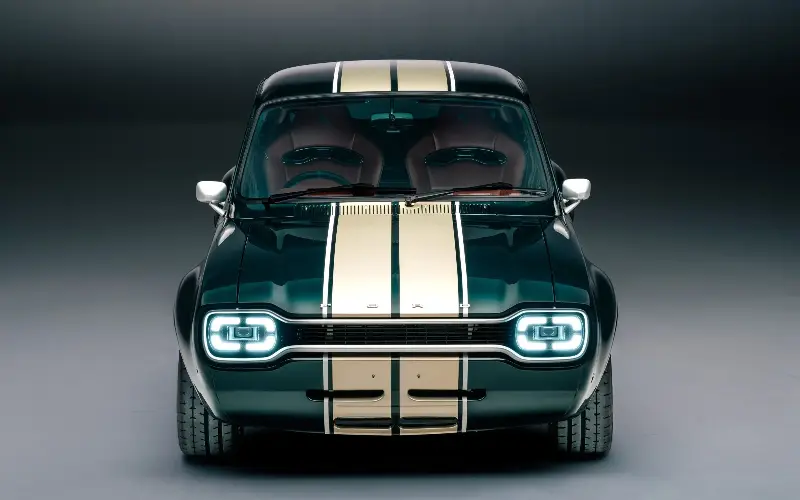
A newly built Ford Escort Mark 1 has been unveiled in London for the first time in almost 60 years.
The classic “boy racer car” of the Swinging Sixties is returning to the roads with a souped-up 2.1-litre engine delivering 325 horsepower – and it comes with a six-figure price tag.
Having been teased to the motoring public two years ago, the reborn classic was formally unveiled at the London Concours motoring show on Tuesday.
While its externals look like the classic early Escort, under the bonnet the Mark 1 RS benefits from innovations that boost its performance.
They include a “bespoke high-revving powertrain” that delivers the Boreham TEN-K engine’s 10,000rpm to a newly designed titanium rear axle.
No top speed is given, because the new cars are all about “driving enjoyment and engagement – feelings, not figures” in the words of a company spokesman.
The new, steel-body Escorts, limited to a production run of 150, are being built by the British firm Boreham Motorworks in partnership with Ford, drawing inspiration from the Alan Mann Racing Escort of 1968.
Iain Muir, Boreham’s chief executive, said: “What matters most to us is ensuring the car delivers what enthusiasts expect the moment they get behind the wheel.
WLightweight engineering, immediate response, usable, naturally aspirated performance and driver connection have guided every decision throughout development.
“With a programme target weight of 895kg, alongside the achievement of 330hp and a confirmed 10,000rpm capability, the character of the car is captured perfectly.”
Built from the original blueprints and assembled in Britain, the new Escort RS Mark 1 models will be given a starting price of £295,000.
The original model made its debut in 1967. Unlike some other modern reboots of classic cars, the new Escorts are being built from scratch rather than by refurbishing an original production model.
Buyers can select from two sub-models with different engines and gearboxes. Described as a “homage” to the original Alan Mann racing Escort, a twin-camshaft engine is a four-cylinder unit driving a four-speed gearbox and is capable of generating 177hp.
More adventurous drivers can opt for the Boreham TEN-K, a 2.1-litre unit generating 325hp.
A five-speed close-ratio dog-leg manual gearbox transmits the motor’s 10,000rpm to the titanium axle tubes, which Boreham describes as “maximising rigidity while minimising mass” and therefore enhancing performance.
Whichever engine option the buyer selects, the car comes with a stainless steel exhaust system that helps deliver “both performance and acoustic character”.
Each one of the new builds is being given a chassis number continuing from the original production run, enhancing the appeal to petrolheads.
The RS model – which stands for Rallye Sport – followed the stock Mark 1 with a more powerful engine and sprightlier handling.
Boreham confirmed that the new vehicles were being assembled at its headquarters in Newton Aycliffe, near Middlesbrough, with additional production work done at a site in Coventry.
While modern drivers may struggle with the new Escort RS Mark 1 – which comes with “no power steering, no ABS, no traction control and no brake servo [which reduces the force needed when pressing the brake]” – Boreham has previously said the absence of such features would enhance the “pure distilled driving pleasure” of the vehicle.
The Ford Escort had a production run that spanned four decades and ended in 2002. The marque also prompted Ford UK’s run of successful rally cars, culminating in the Escort RS Cosworth, a highly tuned development of the 1980s’ Escort Mark 5.