



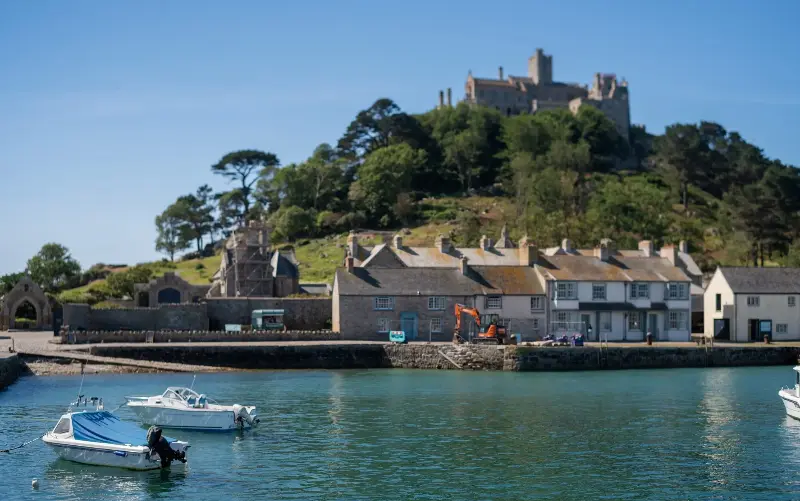
First came an amber warning of a storm, though there was only a moderate breeze then, with tree branches swaying and a few waves lapping the shore. But on January 8, Storm Goretti had St Michael’s Mount within its sights. The wind got up to 30, 40, 50 miles an hour. Within a couple of hours, wind speed on the island just off the south coast of Cornwall had reached a formidable 111 miles an hour. The families who live and work there put up storm boards on their homes and hunkered down that night, the wind howling around them.
By the time they emerged the next morning, ferocious gales had ravaged the island. More than 80 per cent of the island’s trees had been brought down. Camellias, azaleas and rhododendrons that filled parts of the island with colour each spring were crushed by the falling timbers.
Now, six months after one of the worst storms in St Michael’s Mount’s history, trauma is still palpable. “It was devastating,” says Darren Little, the island’s head gardener. “With a storm, you lose one or two trees. But this was like nothing we’d seen before. It wiped them out.”
Even now, more trees are being spotted that are beyond saving. But something else has been spotted too: opportunity. While the storm caused huge upheaval on the picturesque island – one of Cornwall’s biggest tourist attractions, whose castle has been home to the St Aubyn family for more than 350 years – it has also given the island a new lease of life. “We’re starting again,” says Little.
One change has been the ability to no longer worry about sometimes suffocating red tape. Before the storm, there were restrictions on taking down trees, even if they had grown too tall, darkening paths around the island. As Felix St Aubyn – the chief executive of St Aubyn Estates, which runs the island – says: “The scale of the tree loss has created a range of possibilities.”
In 1989 another storm had felled a number of trees, and they were replaced, as tradition dictated. “But this time,” says Little, “we saw the opportunity by not replacing them.”
Six months on from Storm Goretti, the island community is preparing for the future and rethinking what the landscape looks like. St Aubyn says: “The landscape is settling down and greening out, and so many new views have been created.” Wildflower meadows have been created where trees once grew. And nearby schools, woodturners and sculptors are being provided with fallen wood to create furniture and artwork.
Now St Michael’s Mount is again thronged with visitors, enchanted by the 12th-century castle and its chapel perched high on the island’s granite hill. At high tide, it can be reached only by boat; at low tide, visitors cross the sands to reach it. On the day The Telegraph visited, boat after boat brought visitors from the nearby town of Marazion to climb from the quayside and up the stone path to the top of the castle, past terraced gardens. Staff say there are even more visitors this summer. They had heard about Goretti and wanted to see how the Mount had coped.
Clues to what happened are all around: piles of logs, broken brickwork, forgotten ramparts exposed, tree trunks being carved into garden seats. But the garden terraces, full of Mediterranean flowers and succulents, were mercifully spared from the worst of Storm Goretti, protected by the castle building, while winds from the west carved their way through the pines, elms, holm oaks and sycamores.
With 350,000 visitors a year, tourism is the lifeblood of the island, and the first priority for Felix St Aubyn and his staff was to make it safe for visitors. Some trees seemed to have snapped in midair. The path leading to the castle and the lawn, strewn with broken trees, were cleared first. The island opens for the February half-term then closes until Easter, with the gardens opening in April. “We made those deadlines,” says Little.
Like so many people working on the island, Little comes from a family that has been based there for generations. Born and brought up on St Michael’s Mount, he left to work in horticulture elsewhere, returned in 2000 and has been head gardener for eight years. As an islander, he knows the history of the island well, and can chart how the different Lord St Levans – the heads of the St Aubyn family – have made different innovations there. For Felix St Aubyn, whose father, the current Lord St Levan, has handed over St Aubyn Estates to him, the storm was particularly tough, although he was thankful nobody on the island was hurt. He and his young family took over the castle only last year.
The Mount was first the site of a monastery and was given to the Benedictine monks of Mont-Saint-Michel – another tidal island, in Normandy – by Edward the Confessor and attracted pilgrims through the Middle Ages. After years of mixed fortunes, affected by the Reformation and the English Civil War, it eventually passed in 1659 into the ownership of Colonel St John Aubyn. In 1954 Francis St Aubyn, the third Lord St Levan, gave most of the island to the National Trust plus a fund for its upkeep. It was agreed the St Aubyn family would still live in the castle and run its visitor business.
Different St Aubyns have left their mark on the island. Until the Victorian era there were no trees on the Mount, but the family planted dozens of them. When wild storms struck in 1989 and trees came down, they were replaced – a decision, explains Little, tracing back to a prevalent belief across Britain that what exists must be conserved and, if damaged, replaced.
“With a conservation area, you can’t take down trees,” he explains, referring to laws that prohibit the cutting, lopping and severe pruning of trees with trunks more than 75mm in diameter. Asking for permission to do so can often lead to the imposition of a tree preservation order, and the law also gives local authorities the power to impose hefty fines of up to £20,000 if trees are removed. As the Mount is a conservation area, that was the deal.
“We could never have got rid of 100 trees,” he says, with 127 so far lost in the storm. “But now this is a fresh start, a blank canvas. We are able to go back now to views that haven’t been seen across the sea to the mainland for generations – really lovely views.”
A wildflower meadow of poppies, nasturtiums and borage grows where trees used to be. Little and his team are deciding which new ones should be planted, and where: ones that can withstand severe storms – which are predicted to become more frequent – and can cope with salty sea spray and shallow soil, and also won’t grow too tall.
The shortlist is now down to 30 species. Metrosideros, which needs plenty of sunlight to produce vibrant red blooms, is a strong contender.
Meanwhile, the property manager Henry Mathews is focused on Storm Goretti’s impact on the castle. Miraculously there was little damage, save for a chimney that had to be taken down. The biggest problem involved an underground tram route, used for 100 years to deliver goods from the island’s quayside to the castle. Trees crashed down, damaging the tunnel’s brickwork.
But more than repairs, Storm Goretti has inspired a burst of creativity in the area. Schools have been given wood from the felled trees to make tabletops and other items; woodturners and sculptors have been in touch requesting logs, keen to carve furniture and pieces of art that will also be souvenirs of one of the most remarkable moments in the history of St Michael’s Mount. While Little – with his focus on reviving the fortunes of his beloved gardens – has been keen to see the fallen wood gone, there’s talk on the island of the commercial opportunities that St Michael’s itself could enjoy with a range of items for sale in its shop made from the trees brought down by Goretti. Some wood has been kept back and may yet be turned into works of art to be sold there.
For all the grief that Storm Goretti brought, the response was quick and practical. But it has also been highly imaginative. As Felix St Aubyn says, the storm has produced a vision “to create a landscape that is resilient, beautiful and worthy of the Mount and all who love it”.
Goretti might have been nothing but a disaster. Instead, six months on, it has become a vital turning point – a moment for reinventing the future.