



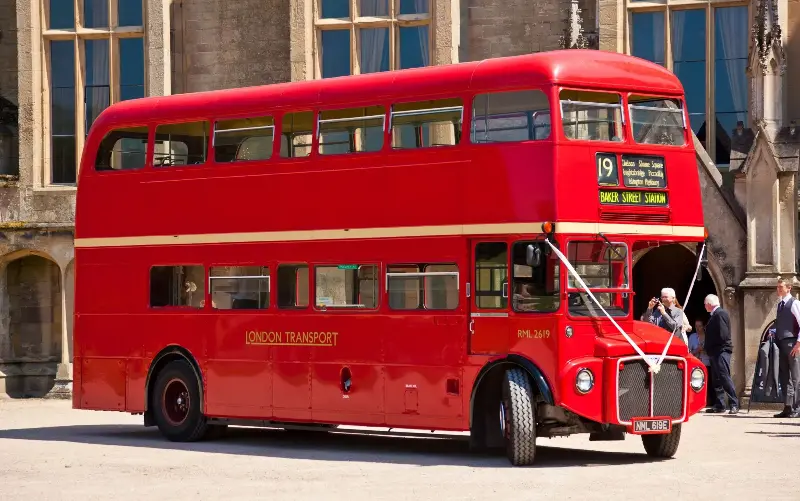
The updated Routemaster bus is bidding goodbye to London after fewer than two decades in service. Officially the “New Bus For London”, and unofficially the “Boris Bus”, it was meant to channel the suave shape of its predecessor and featured natty design touches and a comfortable ride.
It became a symbol of 2020s London, as the original Routemaster did half a century before. But the new Northern Ireland-built buses are now to be replaced. Here we list ten icons of British public transport that have been more successful at changing the way we travel.
1. The AEC Routemaster (1954)
Chances are you’ve been on at least one bright red Routemaster in your life – probably for a birthday party or a wedding. We still love them, which is why we consider them perfect transport for vintage-themed celebrations. The 1954 AEC Routemaster transformed travel in London. This lightweight, speedy bus had a solid build, and its most noteworthy feature was the open platform at the back for easy disembarkation in traffic. Conductors kept everything in order. Double-deckers are pretty unusual, but not unique to London. You can find them in Berlin and Skopje too.
2. The Austin FX4 (1958)
The Austin FX4 is the quintessential version of the Hackney carriage, or London black cab, as we tend to call them. Although there are copycat electric versions on London’s streets today, it was the FX4 that became a design icon and symbol of the city. The FX4 was on the streets from the 1950s to the late 1990s, its curvy profile thrilling tourists and locals alike, but fell foul of the dreaded – you guessed it – low-emissions legislation. Another associated design icon are the green cab shelters where licenced taxi drivers can grab a bacon butty and a brew; around a dozen survive.
3. The InterCity 125 (1975)
Giving Sir Kenneth Grange a job on this project turned it from mere train into railway icon. His nose for the InterCity 125 train made it into a modern-day Mallard. The sleek shape, plus the blue and yellow design (hence its nickname, the “Flying Banana”), was all about bringing British Rail into the modern age. And although lovers of steam- and loco-hauled trains were disappointed at first, we quickly learned to love this fast and comfortable train. The High Speed Train, to give it its full name, sped us to Penzance, Cardiff and Edinburgh while we lounged in the type of plush, soft seating today’s travellers can only dream about. Pity the BR cheese and pickle sandwiches weren’t quite as well-engineered.
4. Saunders-Roe Nautical 4 (1968)
Christopher Cockerell and Saunders Roe pioneered the hovercraft on the Isle of Wight, and the English island is synonymous with the only form of public transport that wears a giant skirt. The hovercraft puffed itself up and pulled away across the Solent in the 1960s, and today the Isle of Wight is the only place in the world that still has a regularly scheduled public hovercraft service – from Southsea to Ryde on Hoverspeed’s T12000. The dreams of the hovercraft men in the 1960s were much bigger – and so were the craft, with the SR.N4 being the largest model, carrying up to 60 cars and 418 passengers across the Channel. It remained in service until the year 2000.
5. British Airways Helicopters (1964)
British Airways did helicopters? Yes they did. Another huge fad in the 1960s, helicopters were considered the future of transport. BA ferried oil workers to rigs in them and there was also an intriguing Airlink connecting service between Gatwick and Heathrow Airports before the M25 was built, and when travelling by road between London’s two biggest airports would have been a huge faff. But the most famous route was between Penzance and the Isles of Scilly. The Sikorsky S-61N helicopter was the most emblematic of the Cornish route. Today there is a different helicopter company – Penzance Helicopters – flying the Leonardo AW139 to the Isles. This Yeovil-built helicopter also flies the Royal family around.
6. English Electric Balloon (1934)
Blackpool never gave up on its trams when all of Britain’s other towns and cities were ripping up their tramways – wrong-headed decisions that would be entirely regretted and result in huge bills to reinstate those lines 50 years later. But Blackpool loved its trams, and none more than the English Electric Balloon, an art deco Bobby dazzler that ferried punters to the Pleasure Beach from 1934 and still looks great today. Built in Preston, the same company would turn out the Lightning interceptor jet for the RAF in the 1950s.
7. MV Royal Iris of the Mersey (1959)
Gerry And The Pacemakers’ tribute to the Mersey Ferry became an anthem for Liverpool and its lesser-known twin across the river, Birkenhead. What’s incredible to think is that the boat you can take today, the Royal Iris, was diligently sailing across the river back when that song was released. In fact, the 67-year-old ferry will be sailing for its final time ever on March 29. After that, it will be replaced by a new ship, the Royal Daffodil, built at Merseyside’s Cammell Laird yard. The Liverpool Overhead Railway, which ran along the city’s Mersey docks until the 1950s, is Liverpool’s other – much missed – transport icon.
8. Glasgow Subway (1896)
The “Clockwork Orange” is a delightful toy town underground railway that makes you feel like Gulliver with its small size. Or is it too much Buckfast giving you hallucinations? Its orange trim (hence the nickname) and circular loop route around the west of Glasgow makes it a peculiar and enjoyable ride (but it will shuck you around a bit). Recent attempts to drag the historic system into the modern age include restoring ageing stations, procuring new trains, putting in platform screen doors and, as of this month, introducing the ability to pay as you go on debit cards.
9. Britten-Norman Islander (1965)
You might think Concorde or the Comet should be here, but the humble Britten-Norman Islander is, at 60, a venerable workhorse which is still landing on short, far-from-perfect runways worldwide. Loganair operates it around Orkney and Hebridean Air Services fly it in the Western Isles. Aurigny bought the Trislander, which has an extra propeller, for Guernsey-based services. A British success story now made again in Britain at Bempton on the Isle of Wight, it is exported to all corners of the world and flies in Belize, Antigua, Brazil and even Vanuatu.
10. Birmingham Maglev (1984)
The problem of how to travel between Birmingham Airport and the National Exhibition Centre and Birmingham International Railway Station was solved when the new airport terminal opened in 1984 with the world’s first regular public Maglev service. This incredible achievement could have been the start of a golden age of British transport tech, but instead we left it to China and Japan to pick up the baton. The futuristic cars ran on magnets but ended up dumped in a garden, replaced by a more prosaic shuttle. One is now at Railworld in Peterborough where you can go and have a look inside.