



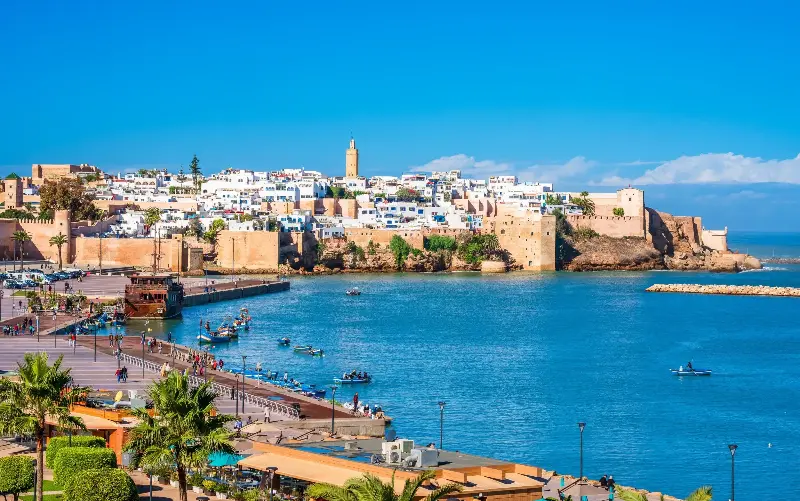
Since my first visit to the Kingdom’s capital, I’ve been curious about why Rabat is often overlooked in favour of Morocco’s better-known cities – Marrakech and Fes.
It’s not for want of culture: as one of Morocco’s four Imperial cities, Rabat boasts an impressive number of well-preserved historic sites, including the ancient eighth-century Chellah Necropolis and Kasbah of the Udayas, a 12th-century fortress with earthen rampart walls that turn a kaleidoscope of pinks at sunset.
Rabat is Morocco’s most cosmopolitan, leafy and well-organised city, with a modern façade that offers a glimpse into the ambitious future that the country’s leaders are striving for. Alongside labyrinth alleys, white-washed Medina walls and souk stalls more organised than those of Marrakech, you’ll find immaculate urban planning, and zwin (beautiful) green spaces.
A rabati (local) friend, Mounaime el Khaldi, summed up his city perfectly: “Rabat is a city that feels balanced and liveable, with clean spaces, a slower pace, coastal beauty, and a quiet confidence. People have a natural elegance; the way they dress, speak, and carry themselves is simple, classy, and respectful.” Part of the French legacy, I wonder.
After superseding Fes as the capital in 1912, Rabat underwent an extensive transformation during the French Protectorate years (1912-1956). A stroll along Boulevard Mohammed V today reveals some of the architectural gems from this era, including the Central Post Office, the parliament buildings, and the Art Deco Rabat-Ville railway station.
And this year, the kingdom’s capital will unveil a slew of futuristic architectural feats and luxury hotels. The new Grand Theatre, with sleek curves and fluid lines inspired by the river it sits along, opened in April, featuring an auditorium that can seat 1,800 and an open-air amphitheatre that can seat up to 7,000. It represents a significant leap for the country’s fast-evolving art and culture movement.
A week before, the Crown Prince of Morocco opened the Mohammed VI Tower, now Morocco’s tallest tower, rising 820ft (250m) into the city’s otherwise low-rise skyline.
The tower, named after King Mohammed VI of Morocco (the current king), is home to residences, offices, a Waldorf Astoria hotel and the Mohammed VI Tower Observatory.
Pages and plates
In the same month, Rabat assumed its role as UNESCO World Book Capital, with an opening ceremony planned during the city’s International Book Fair (May 1-10). Literary enthusiasts can enjoy a series of book-themed events throughout the year, including public readings, mobile libraries, tributes to Ibn Battuta, Morocco’s 14th-century travel writer, and literacy initiatives.
Of all the cities in Morocco, Rabat is the one I identify with most. Across Morocco, I look like a tourist and am treated as one. However, in Rabat, it’s more international and easier to blend in: “It’s a different mentality in Rabat, more open-minded. In the souks, artisan makers are less sales-y and genuinely happy to show you the process without pressure.
“We have a high standard of hospitality, beautiful beaches, old Mosques, surfing waves, and great street food – try a maakouda, spicy potato fritter sandwich, in the Medina,” Tarik Zrilida, a local surfboard shaper, tells me.
An elegant city with boulevards that wouldn’t feel out of place in Paris, Rabat is also easy to move around owing to its beachfront promenades, pedestrianised streets, riverside walkways, and a modern tramway system.
As the King’s primary residence, Rabat is the royal capital, and is safe and impeccably clean as a result. Observing the Changing of the Guard at the Mohammed V Mausoleum transports me to Buckingham Palace, with horseback guards in red-and-white uniforms evoking a sense of familiarity.
Past meets present
Inside the marble Mausoleum, an extraordinary number of zellige (mosaic tiles), intricate details, and sizeable marble tombs of King Mohammed V and his two sons, the late King Hassan II and Prince Abdallah serve as an exquisite display of Islamic architecture.
One of my favourite places is the Kasbah of the Udayas, where you should wiggle through cobbled streets to take in the panoramic view of the ocean and beach below, busiest at sunset. The Andalusian Gardens, within the Kasbah, evoke memories of reading The Secret Garden by Frances Hodgson Burnett.
Behind the rampart walls, turrets and arched doorways, a citrus-filled walled garden bursts into life with colourful bougainvillea and roses. Geometrically designed pathways lined with lavender and rosemary, and towering date palms provide shade and composition for photos.
Wander through the northern arch of the gardens to enjoy a mint tea and river views at legendary Café Maure. The Bou Regreg River creates a natural divide between Rabat and the neighbouring city of Salé, flowing into the Atlantic Ocean. This Atlantic breeze brings Rabat’s cooler coastal climate, milder than the soaring heat of inland cities.
My curiosity led me to conclude that Rabat being “overlooked” was a choice; a question of strategy and timing. Now, easier to access – thanks to numerous new flights – the city’s appeal to international travellers is being further boosted by its raft of new hotels.
It feels like only now the city is ready to present itself, in its best light, welcoming people who will appreciate Rabat for what it is: an easy, elegant, and relaxed city that combines Morocco’s rich history with an exciting future.
Where to stay
Located in a restored 18th-century palace, Four Seasons Kasr Al Bahr offers ocean-front views, a spa, and fine dining. It’s perfect for those wanting to connect to the city’s royal roots and coastal location.
Those with a head for heights can choose from 55 suites with panoramic city views upon checking into the Waldorf Astoria Rabat Salé. The property’s spa spans two floors, and its flagship restaurant was created under the vision of Alain Ducasse, a Michelin-starred chef.
Situated in the heart of the the heart of the Medina, Euphoriad – a former residence of the Pasha of Rabat – has been converted into a stylish, charming boutique hotel. Eight rooms blend history and elegance with contemporary touches, including a rooftop pool and a marble hammam spa.
About our expert
Sally Kirby is a British freelance journalist based in Morocco, with more than 20 years of experience in African travel as a writer and trip planner. Creator of Lonely Planet and DK Eyewitness guidebooks, Sally has also had her writing and photography featured in Time Out, Adventure.com, and The i Paper.