



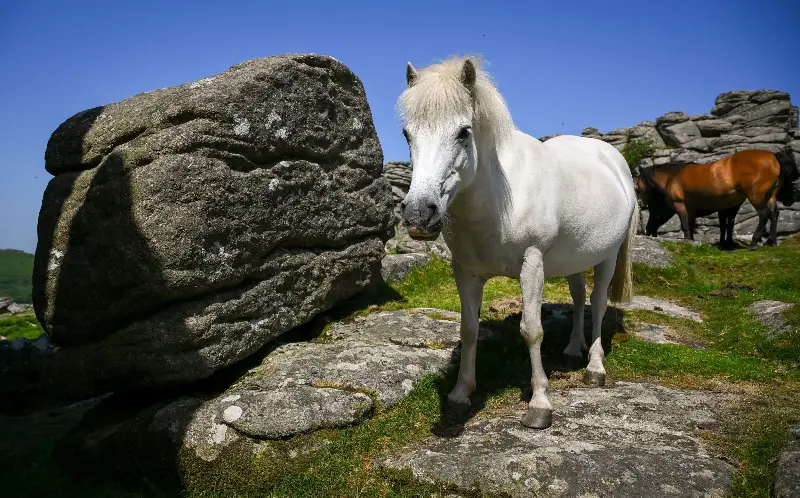
Dartmoor’s ponies have been saved after Natural England officials backed down on a scheme that had put them at risk of culling.
The endangered semi-wild ponies are the responsibility of the area’s commoners – farmers whose animals live on the moorland – and have roamed Dartmoor for more than 3,500 years.
Yet their future was put in peril when they were set to be included in a scheme to restrict the amount of livestock farmers were able to graze on the land.
There were fears the ponies would be culled to make more room for commercial cattle-grazing.
Now, Natural England has said the ponies can continue to be excluded from the scheme.
The previous proposals had asked Commoners to cull their livestock by 75 per cent, and campaigners feared that could mean as many as 93 per cent of the 1,000 ponies would be removed.
Campaigners were concerned most ponies rounded up during the annual October “drifts” would be culled. The drifts involve farmers rounding ponies up into pens for health checks.
The ponies had been expected to be included for the first time in restrictions set out by the Department for Environment, Food and Rural Affairs (Defra) and Natural England.
The scheme has restricted the amount of livestock Dartmoor’s Commoners are allowed to graze since 1994.
But after Natural England’s about-turn, the ponies will be removed from stocking rate calculations, meaning farmers do not face a choice between keeping ponies and maintaining sheep or cattle.
Marian Spain, the chief executive of Natural England, said: “Natural England has always been clear that Dartmoor’s ponies play a central role in shaping the landscape and supporting nature, and we want to see them continue to do so.
“The government policy changes announced today will enable us to work with farmers to secure the agreements we need to recover nature on Dartmoor.
“We will continue to work with the Dartmoor Land Use Managers Group and other local groups on the new framework to ensure a healthy, sustainable future for Dartmoor.”
There are now fewer than 1,000 Dartmoor hill ponies, down from around 7,000 in 1999, according to the Dartmoor Hill Pony Association.
Uniquely adapted to the moor’s marshy terrain, the breed was added to the Rare Breed Survival Trust watchlist in 2023. They are one of England’s last semi-wild pony herds, with others in nearby Exmoor, and in the New Forest.
A petition to protect Dartmoor’s ponies from the plans had gained more than 17,000 signatures.
Sarah-Jane Norris, a campaigner who began the petition, wrote: “Natural England is failing Dartmoor. Dartmoor’s semi-wild hill ponies are recognised as rare and endangered, and should be protected as such.
“Reducing pony numbers further means that the population will no longer be genetically viable and will effectively become extinct.”
Phil Stocker, chairman of the Dartmoor Land Use Management Group (DLUMG) said: “This announcement gives pony keepers the reassurance they need that Dartmoor’s native pony populations are a valued and essential part of the ecology and culture of Dartmoor.
“It aligns fully with the DLUMG’s work, where we are running trials to build the evidence that well-managed ponies, cattle and sheep can improve habitat condition and benefit nature more widely.”
Charlotte Faulkner, the chairman of the Dartmoor Hill Pony Association, said: “We would like to thank the secretary of state for listening to over 220,000 people who care about the future of the semi-wild Dartmoor hill pony herds.
“This will support Dartmoor’s biodiversity, culture and tourism, keeping Dartmoor as we know and love it for generations to come.”