



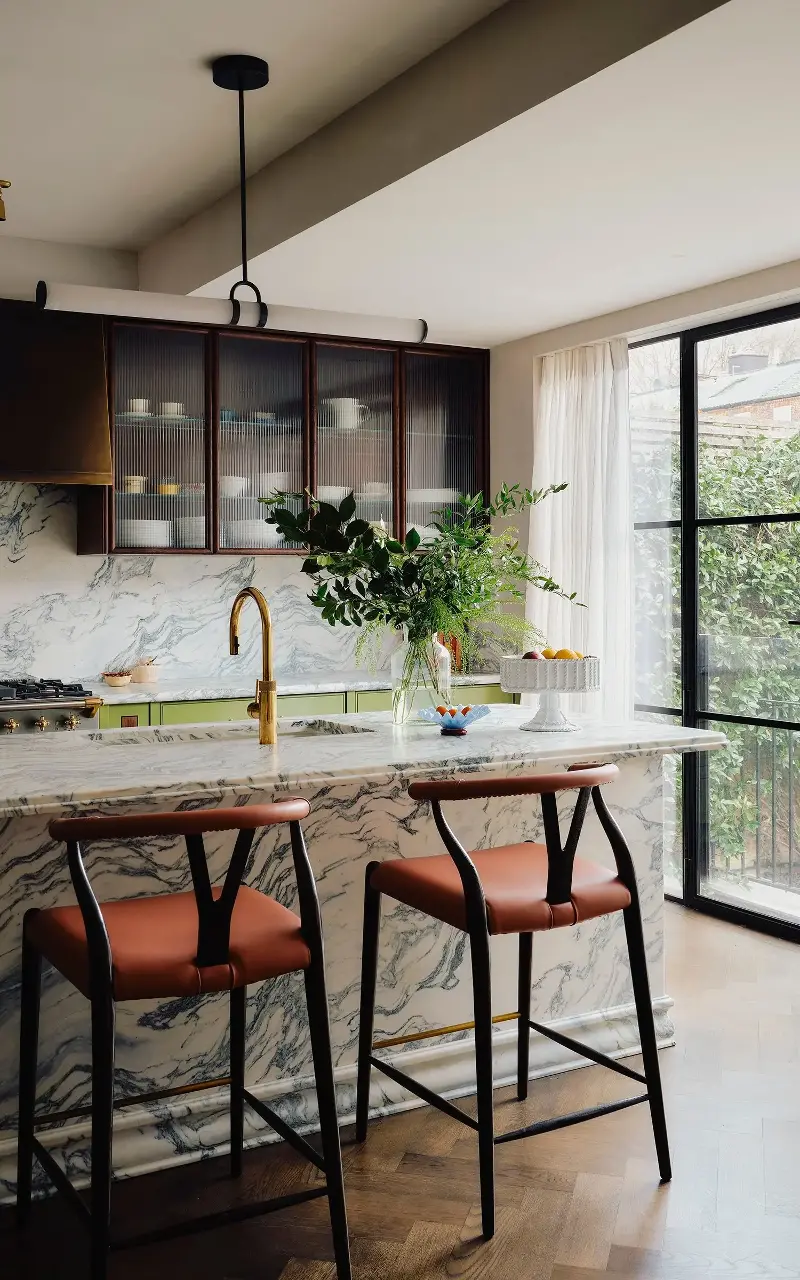
“The kitchen is always a social hub, so it’s important it works for you as a family, as well as when you are hosting. It should be expressive, practical and entirely personal,” says Isobel Hussey, a designer at 202 Design, who oversaw the transformation of a characterless kitchen in Chelsea, London, into a striking, richly layered room.
The mid-terrace house, built around the late 1960s, is owned by a couple with two teenage children, and the brief was clear. “They wanted a lively, characterful kitchen with a statement island and a palette of different materials, that could function equally well for everyday family life and frequent entertaining. Quirky, but not quaint,” says Hussey.
Completed in late 2024, after a six-month design-to-installation process, the kitchen was designed in collaboration with London-based firm Studio Duggan, which is known for creating dramatic yet liveable spaces.
“We regularly collaborate with them on projects that call for more technical, specialised solutions,” says Hussey. “Our aim was to create a kitchen that worked functionally and aesthetically, as well as aligning with the house’s wider scheme.”
Rethinking the space
Structurally, little changed in the kitchen, but the transformation is still significant. “The original kitchen wasn’t terrible, but it wasn’t the clients’ style. The room felt heavy and lacked personality, so it was about reworking the layout and rethinking the feel of the space, rather than making major structural alterations,” says Hussey.
The kitchen opens directly from the hallway and leads out onto a courtyard, which allows natural light to flow through the space; however, previous design choices had muted its impact.
“From the outset, we wanted to remove the tall cabinets on the back wall, along with the extractor housing over the original island, which immediately brightened and opened up the room,” says Hussey.
The high-gloss finish on the cabinetry, in a green colour called Sauge, by paint brand Argile, further enhances the effect, subtly reflecting light throughout.
Artificial lighting was also reconsidered. Oversized pendants were replaced with more refined fixtures, including the Esme Single Stem Pendant from Heathfield & Co, while discreet LED strips beneath the wall cabinets provide task lighting.
“It’s about layering light, so it works for different times of the day, from busy weekday mornings to relaxed evenings,” says Hussey.
Functional foundations
The success of any kitchen lies in how it intuitively supports daily life. “So, first and foremost, you need to work out the practicalities, how the space will be used and by whom,” notes Hussey. “We created specific zones for cooking, preparation and cleaning. The clients also wanted a generous breakfast bar, somewhere to sit away from the working area.”
The cooking zone was moved to the back wall and the sink relocated to the island. “Not everyone is comfortable with a hob on an island because of the potential cooking splatters,” notes Hussey.
“The clients also preferred a Lacanche Range Cooker [this one is brass and stainless steel], and it is more practical to have that against the back wall.”
The sink is flanked by the dishwasher and the bin for efficiency, while spices, utensils and cookware are all stored within easy reach of the hob, with deeper pan drawers beneath. The tall green cabinets accommodate bulk storage, including a pantry for dry goods, a fridge-freezer, and a breakfast cupboard with an internal work surface and sockets for appliances.
Attention to detail
Cabinetry plays a central role in defining the kitchen’s character, balancing visual impact with carefully considered functionality. “In a kitchen, one of the things you strive for is symmetry and balanced proportions,” says Hussey. There are four dark-stained oak wall cabinets on either side of the extractor housing that reach up to the ceiling.
They are positioned 550mm above the worktop, a height that was chosen for optimum comfort and accessibility. “Any lower and you are likely to obscure your view of the worktop; any higher and the shelves become difficult to reach. It is often these smaller details that elevate a kitchen from purely functional to something that feels ergonomically considered,” she notes.
Reeded glass panels on the wall cabinets slightly obscure the everyday crockery and mugs within, adding texture. “Solid doors would feel considerably heavier and wouldn’t provide an opportunity for additional mood lighting.” Rather than adding handles to the wall cabinets, which risked looking cumbersome and distracting from the design, Hussey opted for recessed handles integrated into the cabinetry frame.
A palette led by stone
Although the clients were always drawn to green, the exact tone was dictated by the Arabescato Verde marble, sourced from Italy, which became the room’s visual anchor.
“It’s an unbelievably beautiful block of marble,” says Hussey: the clients selected it remotely, via video, in a leap of faith that paid off.
The honed marble extends across the worktop and up the walls, but the kitchen’s focal point is the island. From one side, it appears as a monolithic slab of stone, complete with carefully considered skirting detail.
On the working side, there is integrated storage, as well as the bin, dishwasher and sockets. “It was a real labour of love working out where the stone should end and the cabinetry begin, but it allows the island to be sculptural and practical,” explains Hussey.
There is, inevitably, a trade-off. Natural marble is heat resistant but porous, and prone to staining. “But you can’t replicate the depth of natural stone. We think the patina that develops on natural marble will reflect the memories made in the kitchen over the years, and the owners agreed.”
The green tones of the marble and the base cabinetry are contrasted with a mix of oak and brass; the unlacquered brass tap is by Quooker, and the handles on the base cabinets are by Corston. Pink bar stools from Julien Chichester bring a playful note without unsettling the room’s overall harmony.
“It is a classic contemporary space that feels timeless and personal. It was always going to be a statement kitchen, but we wanted it to be one that meets the needs of the people using it,” says Hussey, noting that the owners are thrilled with the result.
“Think about how you are going to use a kitchen, use quality materials and don’t be afraid of colour or mixing materials,” is her advice.
“Go with your instincts, that’s what brings a space to life and becomes a true reflection of you.”