



It’s tempting to be snarky about the art of Anish Kapoor, the subject of this spirited, and spiritual, new exhibition at London’s Hayward Gallery. His abstract sculptures – some sleek, others crimson and glistening like entrails – can be hammy. His paintings, which often depict ambiguous vulva-like shapes that seem to smoke or leak, are a misstep. (Stick to the sculpture, Anish!)
Yet this beautifully presented show is, for the most part, zinging. With grand, otherworldly forms, Kapoor revives the old Romantic concept of the sublime, and inscribes himself indelibly in the chronicle of British art.
The first room calls to mind Julia Donaldson’s children’s book A Squash and a Squeeze, and provides excitement. A vast inflated red-PVC membrane almost entirely fills the space, like a gigantic, overripe tomato, or an errant bouncy castle. Titled All of Nothing (2026), it harks back to Marsyas (2002), Kapoor’s impressive installation inside Tate Modern’s Turbine Hall (which turned me on to contemporary art’s capacity for grandeur). Brilliantly, Kapoor – who had a survey at the Hayward back in 1998 – establishes a relationship between his pliable sculpture and the gallery’s rigid architecture, so that we seem to be looking at the building’s innards surrounded by its bones.
Elsewhere, Kapoor’s creations become more carnal, and things get messy. Heaps of wet-looking silicone and paint – which, for the artist, have connotations of “ritual sacrifice” – resemble piles of butchered flesh. Upon first encountering them, you’d be forgiven for thinking you had stepped into a painting by Francis Bacon – or an abattoir. Three of these incarnadine flesh-blobs, mounted on a white wall, are seemingly shrink-wrapped, like oversized luggage at an airport. They border on the silly.
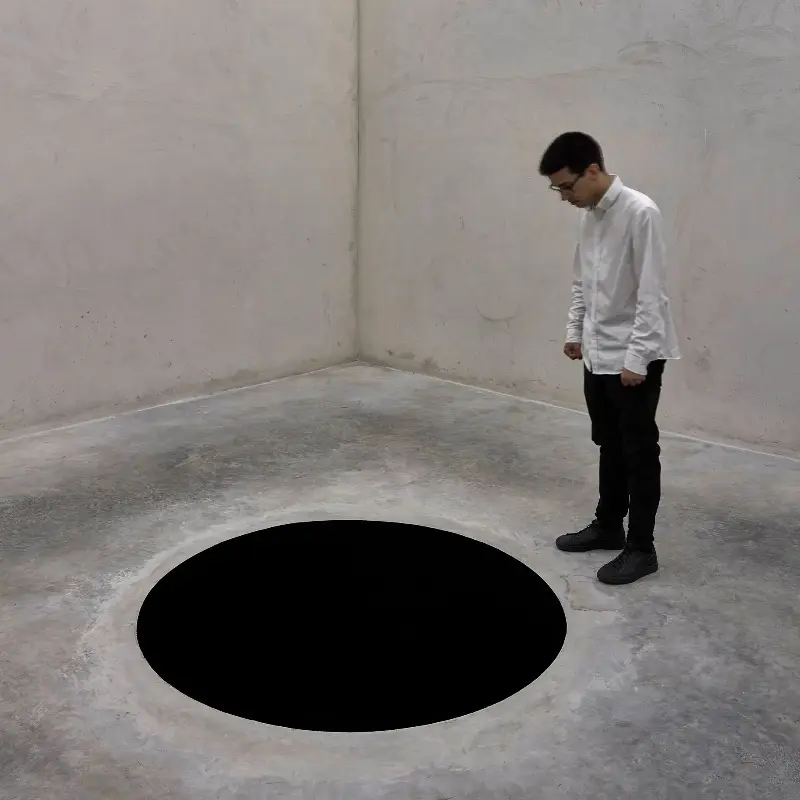
When he isn’t, as it were, painting the gallery red, Kapoor’s preferred mode is precision-made immaculateness. One room presents a series of painted fibreglass “voids” in the walls and floor, the interiors of which are so profoundly dark that it’s impossible to tell whether, in fact, they’re flat. (They’re not.) The eye-melting visual tricksiness, which could be tacky, is classy and svelte.
Two sinuous stainless-steel sculptures sited separately on the gallery’s outdoor terraces look as if they’re made from the same stuff as the liquid-metal villain in Terminator 2: Judgment Day. (The title of one is appropriately apocalyptic: Tsunami.) Related to Cloud Gate (2004), Kapoor’s famous public sculpture in Chicago, they invert London’s skyline in their curving mirrored surfaces, and make space seem molten.
Ha Makom (2026), a huge new installation like a glowing rock formation, which may have been inspired by a sacred sandstone monolith in Australia, is both pristine and very red – its contours and crevices are coated with an intense, velvety-looking crimson pigment – and combines different tendencies in Kapoor’s work. It could be a film set, a spaceport, or a remote ancient temple.
Either way, thanks to Kapoor’s manipulation of scale and chromatic intensity, it’s charismatic. With work such as this, Kapoor silences those who characterise his ambitious aesthetic quest, striving for metaphysical effects, as out of step with our ironic and cynical times.
From June 16 until Oct 18. Tickets: southbankcentre.co.uk/whats-on/anish-kapoor