



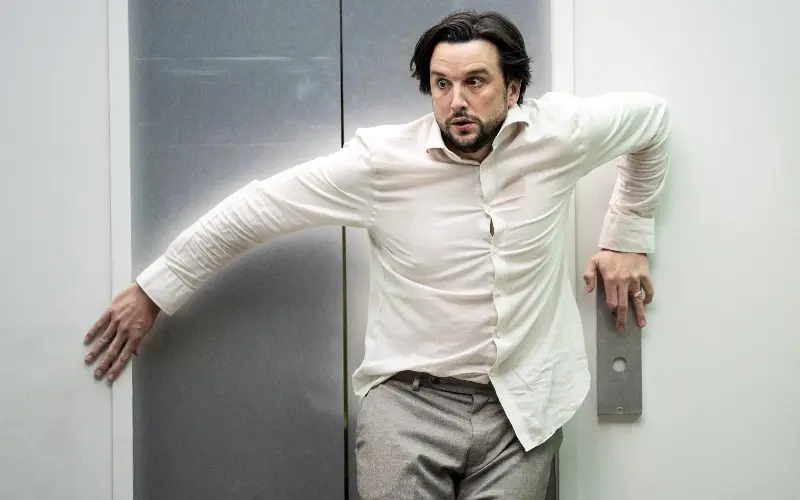
Gluck’s great opera of 1762 tells the story of Orpheus’s search in the underworld for his lost love, Eurydice. It is a taut, tense tale which culminates in one of the greatest of all arias, Che farò senza Euridice?, famously sung by Kathleen Ferrier among others. Gluck himself expanded the work for later performances, before Berlioz reconceived it in the 19th century – so we surely cannot object to English Touring Opera adapting the piece once again for today’s audiences. Leo Grant adds new music and electronics to Jenny Ogilvie’s contemporary staging: the result is flawed but fascinating.
The set design by Noemi Daboczi places us in a modern grey office where Che farò plays in the background. As the hard-working staff depart (they form a tiny chorus throughout), Orpheus (William Morgan) is left alone, desperately mourning his lost Eurydice and yearning to find her. The pert, bright Amor (Rosie Lomas) pops up, eager to help, and guides him into the underworld via the office lift. Joseph Hornsby’s lighting combines with video to create a gloomy atmosphere, but when we get to Hades it seems more like a three-star hotel.
Leo Grant’s sensitive re-scoring respects Gluck’s original, while adding ominous electronic groans and swirls, as the furies first reject Orpheus, and then the blessed spirits admit him. A solo flute soars in the beautiful Dance of the Blessed Spirits, but more strings are needed to give due heft to the powerful Dance of the Furies.
Gluck’s original Orpheus was an alto castrato and, although he later rewrote it for tenor, sadly too much of the part lies above the comfortable range of Morgan, a fine tenor. His anguish is vivid, but it too often tips into vocal strain. When he finally reaches Eurydice (Galina Averina) and follows the command of the gods not to look at her, even while she forcefully questions the motive for his restraint, the tension is stretched to breaking point.
After the fatal glimpse, Eurydice does not die but stomps off in a strop. Orpheus’s Che farò lament is desolate, and Grant’s additions lift Gluck’s lyricism into swirling dissonance. It is left to Amor to repair things (in the bustling trio which is one of several numbers imported from Gluck’s later 1774 version) and there remains a somewhat inconclusive reunion in the office.
Throughout, Ogilvie’s intricate direction is striking and ritualistic, thoughtful in its reframing of human relationships. The show will not to be to all tastes, but George Robarts’s strong new English translation and Iwan Davies’s crisp conducting of his tiny ensemble help to project it as a vividly original take on a timeless story, renewing the relationship between past and present.
Touring until Nov 20. Details: englishtouringopera.org.uk