



I stood on the beach, waves lapping my feet, looking out at the endless blue stretching into the distance. On the very edge of the horizon I could see the outline of a boat, hovering on the almost imperceptible line between water and sky. But I was more than 2,000 miles from the ocean.
Minnesota might be landlocked, but it has 44,926 total miles of shoreline – more than California’s famously epic coast. The state is known as “The Land of 10,000 Lakes” – though it is in fact 11,842, to be precise.
Minnesotans seize every chance to get out on the state’s plentiful bodies of water, whether for swimming, kayaking, boating, fishing or lounging by the shore. Ask a Minnesotan their favourite lake and you’ll be peppered with opinions: Gull Lake is a favourite for watersports, Lake Vermillion for its plethora of islands, Cherokee Lake for its remote and pristine nature, while Square Lake is loved for its accessible beaches.
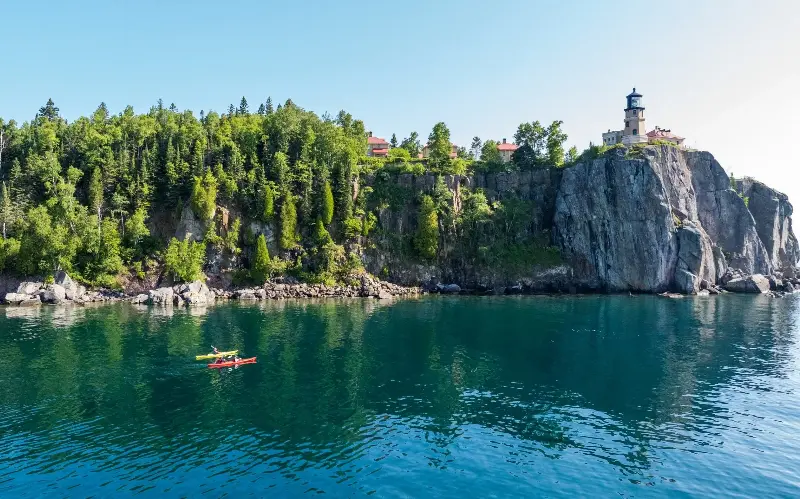
The lake house cabin is a fixture too – going “up north” is shorthand for those families who spend as many weekends as possible in their rural boltholes. So, on a sunny early summer’s day, I joined the exodus of city residents from Minneapolis heading up north to experience the most magnificent of them all, Lake Superior.
It is a two-hour drive north from Minneapolis to the first glimpse of the lake at the port city of Duluth. The indigenous Ojibwe people called Superior “The Great Sea”, and the world’s largest freshwater lake is certainly a force to be reckoned with – it is the final resting place of 350 shipwrecks, including several popular diving sites.
Duluth’s Northern Waters Smokehaus served as a road-trip stock-up stop, where I stashed sandwiches for the drive and smoked fish for dinner (try the lake trout, to taste a local favourite). Up the road, a row of warehouses-turned-breweries beckoned and, after sampling tasters from the plethora of venues along the road, I left with cans of Wild State cider and Ursa Minor beer.
Highway 61, the same road Duluth native Bob Dylan named his iconic album after, hugs the lake shore, passing small-town main streets trapped in time and signs for roadside restaurants. You can’t see the kitschy sign for Betty’s Pies and not stop, so I secured slices of mixed berry crumble before heading to Tettegouche State Park where we pitched a tent for two.
The park’s boardwalk trail alternated between forest canopy and sudden openings to see the lake, all carpeted with a fragrant blanket of pine needles mixing with the slightly sharp wind. The view from a cliffside lookout showed echoes of tiny inlets repeating along the coast, blue water contrasted against the basalt stone and mixture of dark conifers and bright birch trees.
I hiked down to the pebble beach, waves gently lapping the colourful rocks. It was a calm day, but I could see evidence of Lake Superior’s powerful waves in the enormous tree trunks of driftwood washed ashore. In the autumn and winter, waves can reach 15ft to 20ft tall, pounding against the cliffs I’d just stood upon.
The 300-mile Superior Hiking Trail skirts the lake, tracking from Duluth to the Canadian border, and I joined a segment winding inland to see some of the cascading rivers feeding both Superior and the smaller lakes in the park. As I stared out at Micmac Lake, completely surrounded by thick pine forest, an osprey swooped just over my head on its flight path to the water. Just moments later I spotted a moose track in the mud, its hoof mark bigger than the span of my hand.
My preference is to sleep as close as possible to nature, hence the tent – though you do have to take precautions here to make sure nature doesn’t get too close to you. Campsites come with metal lockers kitted out with padlocks, while everything edible or even scented products (such as toothpaste) goes inside to thwart creatures ranging from greedy raccoons to hungry black bears. Minnesota’s bears are smaller and shyer than their grizzly relatives out west, but visitors who prefer to sleep indoors can find rustic and cosy lodges on the shore of Superior, as well as beside the smaller lakes dotted throughout the state.
Indoor and outdoor accommodation alike have firepits to spend long evenings stargazing and practising the art of the perfectly toasted marshmallow (my preference is deeply golden, only a tiny bit of char).
Even Minnesota’s major cities centre around lakes. Minneapolis alone has more than 20, with the Grand Rounds National Scenic Byway, a 50-mile cycling and walking trail, connecting many of the city’s shores and green spaces.
Back in the city, I cycled a segment of the path to experience the metropolitan side of lake life. First stop: Isles Buns & Coffee (yes, the queue for the giant cinnamon roll is worth it), before cycling to the city’s Chain of Lakes and its thousands of acres of public parkland.
Lake of the Isles was serene in the morning light, paddle boarders and kayakers navigating the canals. Its paved paths launched into the scenic byway circuit, criss-crossing the neighbouring waterways. I stopped at the farm-to-table Wise Acre for lunch before reaching Lake Nokomis, named for a character in Henry Wadsworth Longfellow’s poem, The Song of Hiawatha. I took a quick dip at the sandy beach, popular with families and windsurfers on opposite weather days. Not unlike a plunge in the Atlantic, it was chilly but refreshing, trading the sea salt for freshwater.
I parked my bike at Bde Maka Ska, meaning “White Earth Lake” in the Indigenous Dakota language, just in time for sunset, watching the sky turn orange and frame sailboats against the skyscrapers of downtown Minneapolis. The shore was brimming with life: I spotted fellow sunset watchers picnicking and I could hear the call of loons, the resident great water divers which are, fittingly, the official bird of this state of lakes.
Essentials
British Airways, Virgin Atlantic and Delta Air Lines all fly direct from London Heathrow to Minneapolis St Paul International Airport.
On the north shore of Lake Superior, the 1920s-era Naniboujou Lodge offers two-night stays from $766 (£572), half board, including dinner, bed and breakfast.
In Minneapolis, the warehouse-chic Hewing Hotel has rooms from $261 (£195).