



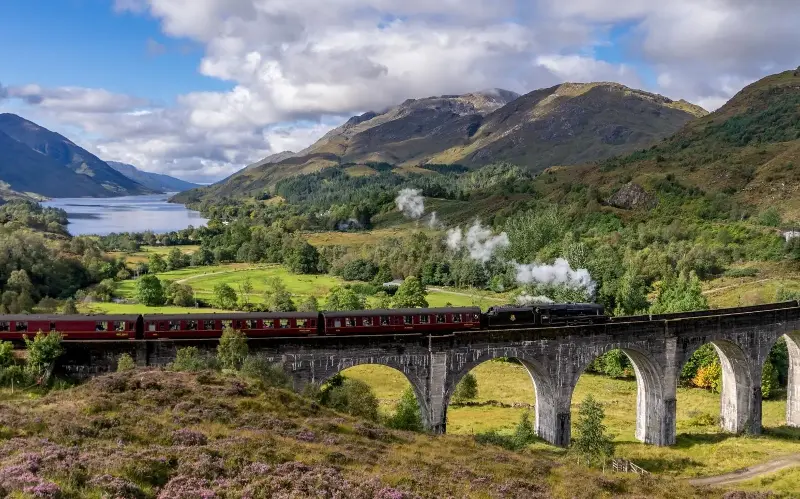
Merlin’s beard! Where’s Harry Potter with his magic wand when you need him? For the famous “Hogwarts Express” steam train, so familiar to Potter and pals, appears to have been stopped in its tracks.
A long-running dispute over the safety of its door control system has resulted in the suspension of all services of the train – which operates on the spectacular West Highland Line and was meant to resume for the summer season on April 1.
The “Hogwarts Express” – or, to give it its real name, the Jacobite – is instantly familiar to all fans of the popular children’s books and has featured in many of the films, most memorably huffing and puffing its way over the spectacular Glenfinnan Viaduct.
So what now for Potter devotees wanting to experience the thrill of travelling over that viaduct, along what is universally acclaimed to be the most scenic railway line in Britain?
Clearly, the suspension of the Jacobite service is a blow. But the good news is that there are other trains that ply the West Highland Line. These range from the state-operated ScotRail services to the super-luxurious Royal Scotsman. True, these are not steam-hauled, but they offer the opportunity to cover not only the stunning stretch from Fort William to Mallaig, but also the much longer run starting in Glasgow. Much of the route is also covered by the legendary Caledonian Sleeper.
It’s the same scenery – a heady mix of mountains, moors, lochs and craggy coastline – and the same railway line, complete with remote stations and glimpses of red deer and golden eagles.
It is possible that the dispute over the Jacobite will be resolved in time for services to resume this summer. But that is not certain.
In the meantime, other options offer a range of alternative perspectives and possibilities. Hogwarts Express or not, the spellbinding magic of a train journey in this very special part of the world is still just a wave of a wand away. Here are a few pointers.
What’s so special about the West Highland Line?
The 164-mile stretch of track known as the West Highland Line was built in stages between 1889 and 1901, with the aim of providing a link between Glasgow and remote Highland communities, and to encourage tourism to the region and the islands beyond.
It was an ambitious project across some of the most geographically challenging terrain in Scotland. The line featured sharp curves, steep gradients, long tunnels and concrete bridges, the most spectacular of which is the 21-arch Glenfinnan Viaduct, one of the great structural triumphs of the late Victorian age.
The original line ran from Glasgow to Fort William, at the base of Ben Nevis, with the extension to the fishing port of Mallaig following. In later years, a branch line linking to the coastal town of Oban was also incorporated.
In Scottish Gaelic, the West Highland Line is known, rather splendidly, as Rathad Iarainn nan Eilean – the “Iron Road to the Isles”.
Behind the Jacobite dispute
The cause of the suspension of services of the Jacobite is the legal requirement for all trains moving at speeds of over 25mph to be fitted with centrally locking doors, as opposed to the “slam-door” variety of the vintage Mark 1 carriages dating back to the 1950s and so beloved of heritage train fans.
It is not a new requirement. The ruling, designed to conform to more rigorous health and safety standards, was initially issued in 1999, with lengthy exemptions offered to operators providing private journeys on heritage and steam trains, such as the Jacobite.
In March 2021, the Office of Rail and Road (ORR) decided to end the exemptions, giving operators two years to fit central locking systems to their trains – something which most of them, albeit reluctantly, did.
West Coast Railways (WCR), Britain’s largest steam train operator and the company behind the Jacobite, resisted the change on the grounds that, in its experience, the Mark 1 carriages had a perfectly good safety record and were popular with passengers. In 2024, it challenged the ORR in court but lost the case.
As a result, WCR last year ran the Jacobite with more modern Mark 2 carriages, with centrally locking doors and an air-conditioning system that had to be powered by a diesel engine added to the back of the train.
This arrangement proved less popular with passengers, who prefer the older-style carriages ventilated with open windows, and much more expensive.
The current suspension has been triggered by WCR on the grounds of cost – even carrying 750 passengers a day, the company says it cannot make money using the more modern, energy-hungry carriages. It has asked the ORR to allow it to return temporarily to running the Jacobite with the older “slam-door” carriages, while agreeing in principle to refit them with centrally locking doors. It estimates the cost of the refit across its 120 older carriages to be in the region of £5m.
It is unclear when the ORR will issue its ruling or whether it will grant a new exemption, but WCR is hopeful that the Jacobite, which has been plying the 41-mile route to Mallaig since 1984, could return to the tracks within weeks.
Highlights along the route
Leaving Glasgow, the train travels alongside the River Clyde before a lovely stretch offering views of Loch Long to the left and Loch Lomond to the right.
At Crianlarich, the train divides, with one part heading west to Oban and the other north to Fort William. An early highlight on this latter stretch is the “Horseshoe Curve”, affording views of the peak of Ben Dorain and the snaking train itself, followed shortly by the wild remoteness of Rannoch Moor, where the train appears to float over a peat bog before beginning the ascent to Corrour, at 1,350ft the highest railway station in Britain, as featured in the 1996 film Trainspotting.
Britain’s highest mountain, Ben Nevis, dominates the approach to Fort William, where you can break the journey to climb it, should you so wish.
After Fort William, the train enters the 41-mile stretch to Mallaig covered by the Jacobite. The magnificent Glenfinnan Viaduct is the star of the show here, but there is much more besides: the stunning lochs of Eil, Shiel and Ailort, and Arisaig, Britain’s westernmost station, where the train meets the Atlantic Ocean and where views of craggy coastline and sandy coves are complemented by glimpses of the islands of Rum and Eigg. It is hard not to feel a warm glow on the final stretch into the fishing port of Mallaig, gateway to the Isle of Skye.
What are the alternatives?
ScotRail
The state-run Scottish train operator offers three services a day between Glasgow and Mallaig (two on Sundays), a journey of over five hours. There is generally an extra service between Fort William and Mallaig. The trains are nothing fancy, but they are perfectly comfortable, with an on-board trolley service for basic snacks.
From £25.60 one-way; scotrail.co.uk
Caledonian Sleeper
This overnight service between London and Fort William is a magnificent way to take in the spectacular views of the West Highlands, with the journey north offering the chance to wake to glorious views and the journey south enabling enjoyment of them from the comfort of the Club Car. It runs every day except Saturday.
Cabin berths (one-way) from £210; seats from £54; sleeper.scot
Midland Pullman
Although this is clearly not a train with Scottish roots, it is a charter service offering leather-seated comfort, fine dining and a nostalgic nod to the high-speed, luxury diesel-electric train that, in the 1960s, ran between London and Manchester. Brought back to life by Locomotive Services Ltd, its reimagined form has several outings along the West Highland Line, varying in duration from one to three days, with departure points including Durham and Leicester.
One-day trips from £245pp (First Class); £465 (Pullman Dining); three days from £510/£900pp; midlandpullman.com
Belmond Royal Scotsman
This is at the very top end of luxury train options – think Edwardian-style grandeur, mahogany-clad furnishings and formal attire in the dining car. The train, which also has an on-board spa, offers a number of itineraries taking in the West Highlands. Deep pockets are required.
A three-night Western Scenic Highlights tour costs from £10,350pp in a double en-suite cabin; belmond.com