



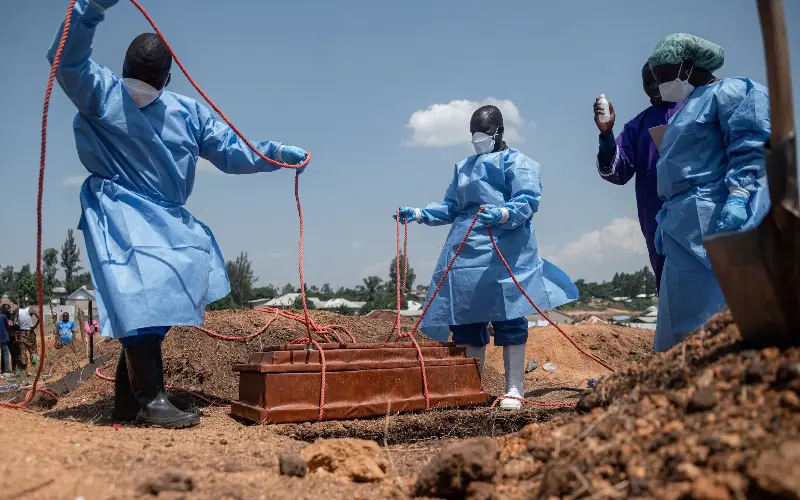
The Ebola outbreak in Congo is still growing and has a 70 per cent chance of spreading into neighbouring South Sudan, new modelling has predicted.
Preparing for the deadly haemorrhagic fever to reach a country with some of the weakest healthcare in the world should now be a priority, researchers said.
The outbreak is centred in Ituri province of the Democratic Republic of Congo (DRC), but has already spread into Uganda and now has a 69.3 per cent chance of reaching South Sudan, according to the peer-reviewed modelling in the Lancet medical journal.
Researchers found a far smaller chance of the Ebolavirus spreading to other neighbouring countries, with just an 8.6 per cent chance of getting to Rwanda and 2 per cent chance of reaching Burundi.
The findings were published as the World Heath Organization (WHO) said the outbreak was still outpacing response efforts in the DRC.
Kinshasa on Wednesday said the number of confirmed cases of the rare Bundibugyo strain had reached 1,118, including 291 deaths.
WHO researchers modelled three scenarios of increasing severity for the Lancet paper, and said the daily tally of cases and deaths was so far most closely tracking the medium scenario.
That would see around 8,200 cases by September.
The researchers concluded: “Spillover is no longer hypothetical: as of June 22, 2026, DR Congo has 1048 confirmed cases and 267 deaths and Uganda has reported 20 confirmed cases, two confirmed deaths, and one probable death,15 and the estimated probability of importation into South Sudan remains 69·3 per cent.”
France has this week seen an imported case of a doctor who returned infected from treating patients in the DRC.
French authorities said the patient had been admitted to a specialist treatment facility, and was in a stable condition, with the broader risk to the population described as low.
The virus is thought to have been spreading undetected for at least six weeks and possibly longer, before an outbreak was formally declared in mid-May.
A lack of testing kits that could detect the Bundibugyo strain meant health workers at first struggled to determine an outbreak was underway.
There have also been early indications that the telltale haemorrhaging symptoms seen in the more common Zaire strain have been less frequent in this outbreak, making it easier for medics to confuse the signs with other diseases.
Long-running conflict in north-eastern DRC has added to the difficulties of trying to stop the spread.
“Despite the good progress we have made, we still face major challenges, and the outbreak is continuing to outpace the response,” WHO director-general Tedros Adhanom Ghebreyesus said earlier this week.
The WHO’s Abdirahman Mahamud said health workers continued to face “abduction threats, crimes and being in the wrong place at the wrong time”, citing seven incidents in which they had been targeted.
Protect yourself and your family by learning more about Global Health Security