



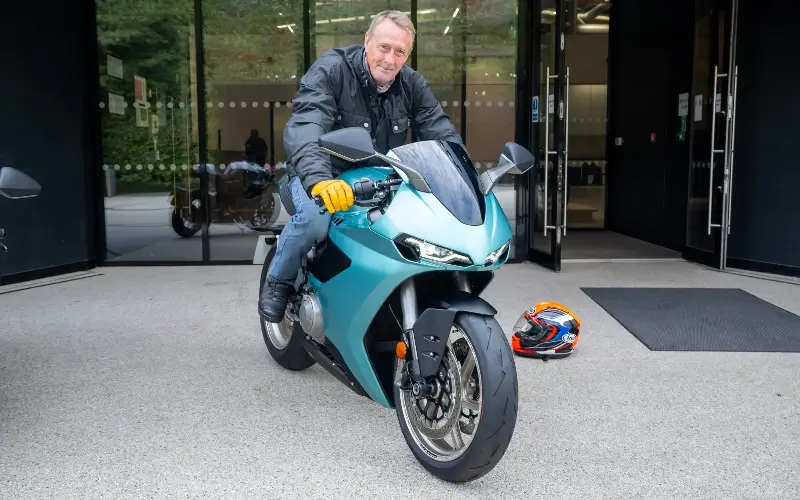
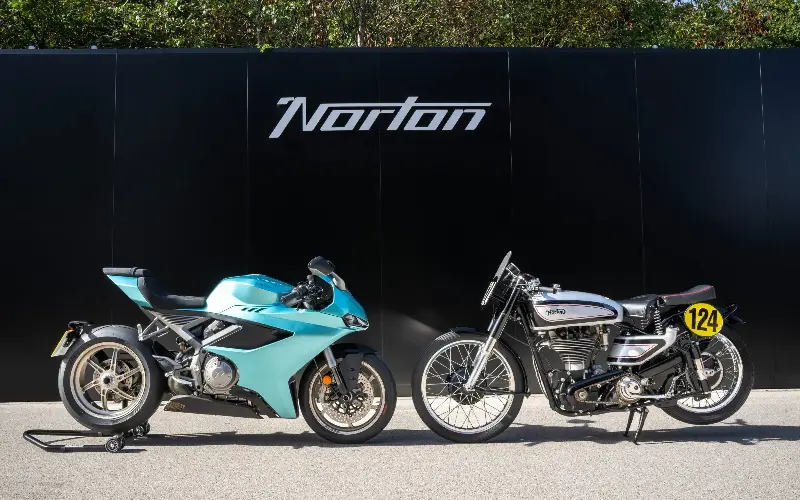
The most illustrious version of the famed Norton “Manx” racing motorcycle was a single-cylinder 350cc or 500cc engine fitted in a special frame named Featherbed that gave superlative handling. From its launch in 1947 to 1963, when the last machine left the Norton factory at Bracebridge Street in central Birmingham, the Manx reigned supreme. On the Isle of Man mountain course, it won seven Senior TT victories consecutively between 1947 and 1954.
While few could ride this off-the-peg racer to its absolute limits, those that could were among the sport’s greatest – Geoff Duke, Derek Minter, Ray Amm, John Surtees, Phil Read and Mike Hailwood, who gave the Norton its last Senior TT IoM victory in 1961. It was also used by Barry Sheene for what turned out to be his last race, the Lennox Cup at Goodwood in 2002 – he died of cancer only six months later.
And now the hallowed name is back. But unlike its inspirational namesake, Norton wants to employ the Manx racer’s name to appeal to well-heeled road-riders who might also explore its potential on a racing circuit.
Racing pedigree
Introduced this summer, the Manx R comes in three versions: Manx R at £20,250 with manually adjustable suspension; the £24,750 Apex with semi-active suspension, as shown in the pictures; and the similarly suspended Signature with carbon-fibre wheels and panels for £38,750.
The market for race-replica machines is exclusive – and expensive. Norton wants to appeal to well-heeled enthusiasts who revere MotoGP and World Superbike machinery, but has aimed its new superbike primarily at road use.
State-of-the-art racing bikes are fast enough to tug your arms from their sockets. Their engineering is of the highest order, though, with screaming engines giving power outputs of more than 200bhp and special frames which deflect, feeding back to the rider about how far he can push the front end through a corner before grip expires. Electronics and advanced software wring out every last horsepower, while electronically adjustable suspension alters the springing and damping many times a second.
Tuned for torque
The Norton has been tuned for torque rather than outright power, but don’t go thinking this makes it any less serious. Its physically tiny 72-degree, 1.2-litre V4 engine produces a peak output of 206bhp and 96lb ft which, with an all-up weight of 203kg, gives a power-to-weight ratio of 1,014bhp/tonne and a top speed of more than 200mph. That’s more than most supercars.
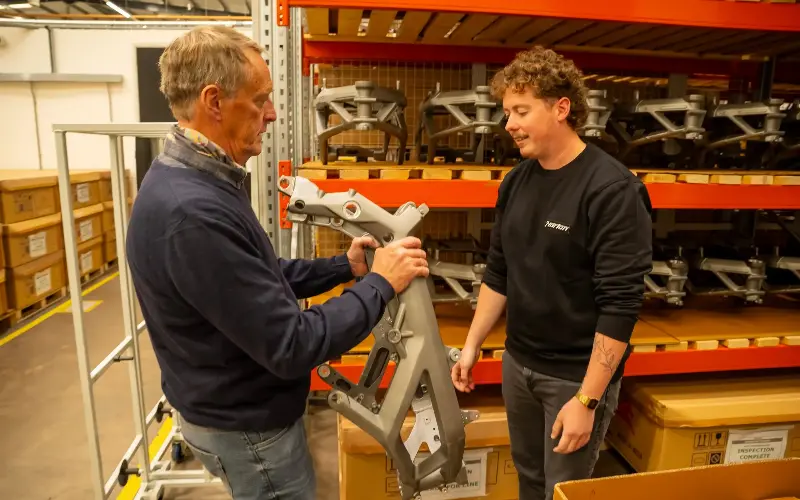
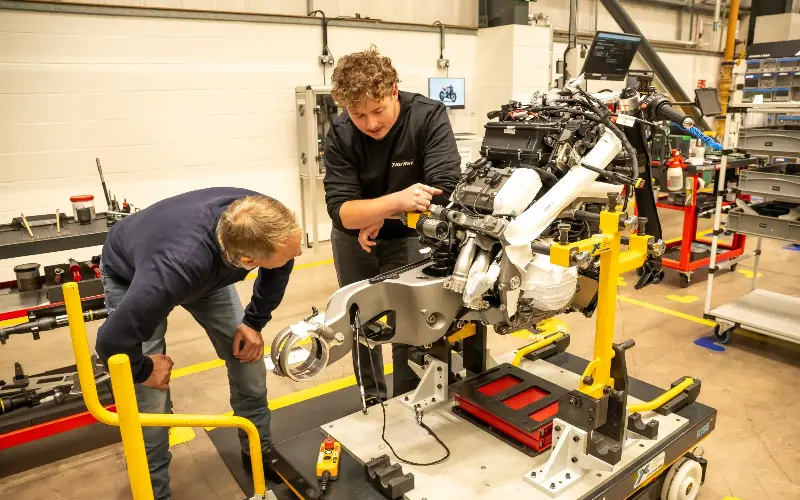
Brian Gillen, Norton’s chief technical officer, says that the Manx R has “one of the most advanced electronic platforms in production today”. Think traction control with lean-angle sensing, wheelie control, launch control and cruise control that adapts to corners. The brakes are also Brembo’s most advanced calipers with Bosch’s latest anti-lock system.
The Manx R is based around a cast aluminium frame precision machine with computer-aided tooling, then welded in a jig and double checked before meticulous assembly, with full traceability of each component. It’s state-of-the-art but with a hand-built authenticity.
What it feels like to ride
It’s also gorgeous and sleek, with narrow, evil-eye headlights and no visible fasteners for the bodywork panels. The riding position is pretty extreme for a road bike, however. With your knees feeling as though they’re brushing your ears and with no screen, it feels as though you are going to topple over the front if you dare touch the brakes.
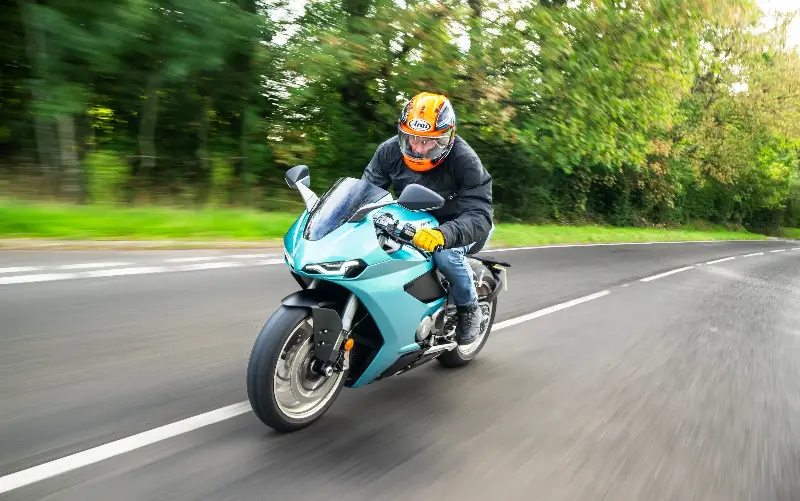
Finding neutral in the heavy six-speed gearbox is something of an art; the gear-lever and rear brake pedal are dainty for those with large feet. There’s a clever multi-function start/riding mode button and the V4 clatters into life. It’s noisy and sounds different from convention since the exhaust exits from underneath the engine.
Blip the twist grip and the engine revs don’t whizz up the digital touchscreen bar graph, it simply clatters purposefully up and down. It sounds more gruff than an insane race bike.
The clutch is light, but difficult to find a biting point, and it’s a nervous business manoeuvring around the gravel car park.
On the open road
With fairly extreme rake and trail (the angle of the steering head, and the difference between where the steering axis hits the ground and the contact patch of the front tyre respectively), the Norton feels fast to turn and a bit twitchy at first. At low speeds you feel as though the front is going to fold underneath you and it takes time and familiarity to relax and trust the machine.
Similarly on a roundabout, you pitch the Manx R in and around it goes. Part of that staccato progress is the slightly uncertain fuelling at small throttle openings, although you get used to it with more speed and confidence. That’s when you start to understand how little effort you require to get the front end going where you want.
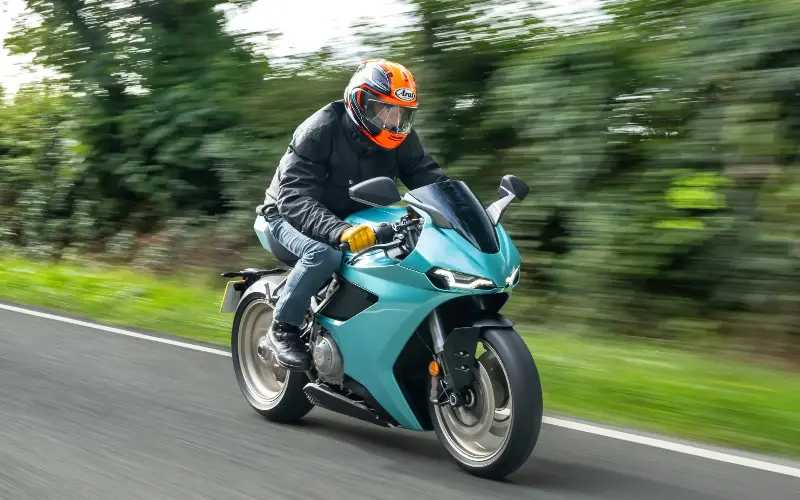
An open road gives some idea just how fast this machine is. No need to change down, the V4 pounces up the rev counter, changing its note to a crackling wail as it climbs. Blink and you’re at the speed limit, maybe a bit over, but the torque can waft you along, seldom requiring a lower gear to overtake.
It feels like flying close to the ground. Roads become a series of corners, such is your speed between them. It’s exhilarating beyond description, and exciting more than words, although thankfully the brakes are immensely powerful yet with a sensitive and progressive lever.
Nor is the ride particularly harsh, even in the more extreme Sport mode, although the tyres near the limits of grip on a broken surface and you can feel the subtlety of the traction control’s steadying hand.
The Telegraph verdict
You can point to the sheer impossibility of the Manx R, its ludicrous performance and top speed, all reined in with advanced electronics. It is an amazing machine and a stake in the ground for Norton’s intentions.
And yet that blistering performance can be a goading presence, not simply a temptation. Even the price, while reasonable against its peers, is still an insane amount to pay for a toy.
As Skinner says: “No one actually needs a Norton.” But then the Manx R is so beautiful even standing still, while the redolent name on the tank is hard to resist.
Was I sorry to hand back the keys? Not really. I’d find it hard to resist the visceral thrill of crouching over the tank, flying through space and time, not a care in the world. Even several days later I could still hear that crackling exhaust and sense the tugging performance. Faster, ever faster…