



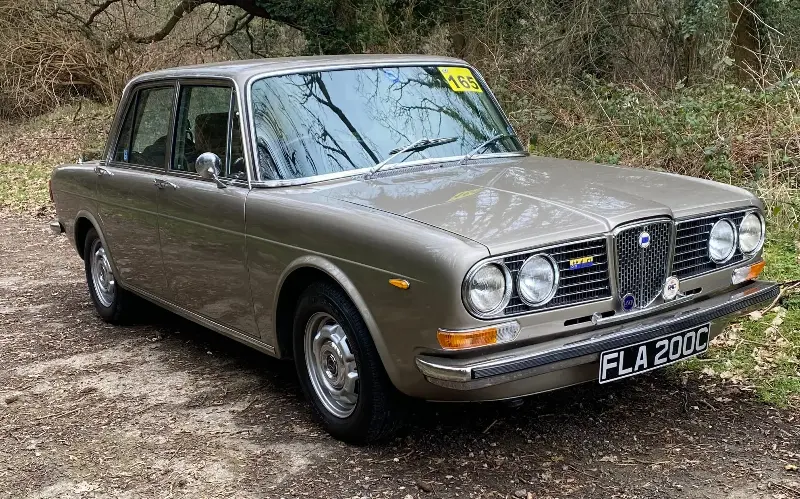
In 1972, a Lancia 2000 i.e. Berlina was not a car with mass appeal. Its styling harked back to the 1960s; it was front-wheel drive when its UK rivals still favoured a traditional rear-wheel-drive layout; and it shunned fancy wheels and other frivolities. The typical owner would have preferred La Traviata and watched Fellini films on BBC2 rather than partake of popular culture. The 2000 was also the final independently designed Lancia, and Ian Brookes’s Berlina is believed to be one of only two remaining on the road in the UK.
The 2000 is the final incarnation of the Flavia, which debuted in 1960. It was ready for launch in 1969, the year Lancia’s owners, the Pesenti family, sold the famous marque to Fiat. Lancia was then 40bn lira (£27.7m) in debt and Fiat was initially unkeen to put the 2000 into production, because of its high projected build costs.
Eventually, the 2000 debuted in 1971, as Lancia needed a flagship saloon after the demise of the 2.8-litre Flaminia the previous year. It resembled the earlier Flavia, with a modified grille, a longer boot and a splendid Art Deco facia with square instruments. Power was from a 1,991cc four-cylinder twin-overhead camshaft engine and, as a break with the past, Lancia badged it as the 2000, rather than Flavia 2000.
In Italy, the 2000 appealed to lawyers and business owners with aspirations to the nobility and who looked down, albeit in a most gracious way, at the Alfa Romeo 2000 Berlina and the Fiat 132. Quattoroute magazine thought “instead of a four-cylinder, it feels like a perfectly balanced six-cylinder under the hood” and “you can easily talk without fear of being disturbed by the engine noise”.
The first versions had Solex carburettors, but in 1972 Lancia introduced the 2000 i.e. with Bosch D-Jetronic fuel injection and a five-speed gearbox. The power output was 125bhp and the top speed was 115mph, with 0-60mph in 10.4sec. Your friendly local Lancia dealer could also tell you that the 2000 was the first Italian car with electronic fuel injection.
The UK concessionaire described the 2000 i.e. as “motoring at its most luxurious”, featuring as it did tinted glass, electric windows, power-assisted steering, velour upholstery, a hand throttle and even curtains for the rear window. It claimed the sole modest aspect of the Lancia 2000 was the price; connoisseurs believed that £2,398.90 for the i.e. Berlina in 1972 was remarkably low for a car with such an illustrious name.
However, by the standards of its rivals, the 2000 i.e. Berlina was an expensive proposition. The Triumph 2.5 PI Mk2, the only UK-built fuel-injected saloon at that time, cost £1,899, while the Citroën DS21 EFI was £2,271 and the Peugeot 504 Injection a mere £1,750. The Alfa Romeo 2000 Berlina, the Lancia’s nearest Italian competitor, was £2,030; from Germany, the BMW 2000 cost £2,125 and the Audi 100GL was a bargain at £1,814.
To further put the 2000 i.e. Berlina’s price in context, 54 years ago a Rover P6 3500S was £2,090 and the Ford Granada Mk1 3000 GXL cost £2,031, but a Lancia enthusiast would accept no substitutes. Autocar thought the 2000 i.e. “that rare thing today – a car completely devoid of any tasteless vulgarity”.
Production of the 2000 ended in 1974 after 14,319 examples, with 8,844 in fuel-injected form, although sales continued until 1975. The replacement Gamma debuted in 1976, but it was the Beta of 1972 that anticipated Lancia’s future; the famous shield badge combined with less innovative Fiat engineering.
Today, the Berlina’s rarity is because of various factors: its high original price, how the four-door 2000 tended to be neglected compared with its coupé stablemate and Lancia’s less-than-effective corrosion protection. This car represents the final days of Lancia’s independent designs in the aftermath of the Fiat takeover. Brookes regards his 2000 i.e. as “a well-tailored Italian suit. It is not especially sporting, but it is a really well-sorted, comfortable car with a good ride and it feels surprisingly quiet”.
And perhaps the most surprising description of the 2000 i.e. Berlina was from Autocar which, for the benefit of readers unfamiliar with the Lancia, wrote: “One could say it is a sort of Italian Wolseley – hastily adding that ‘Italian’ is here a synonym for ‘appreciably faster’ and ‘zestful.’”
However, Brookes prefers to compare his Lancia with “the hand-built quality of a Rolls-Royce” – as opposed to a staid Wolseley.
We use the fascinating howmanyleft.co.uk for figures of surviving examples but some cars present more of a challenge than others, so the figures are rarely authoritative. Some pre-1974 records were lost before the DVLA centralised the process, while some cars have their model type misnamed on the V5 registration documents. A further issue is the omission of the exact model name or generation, or distinction between saloon and estate bodystyles.