



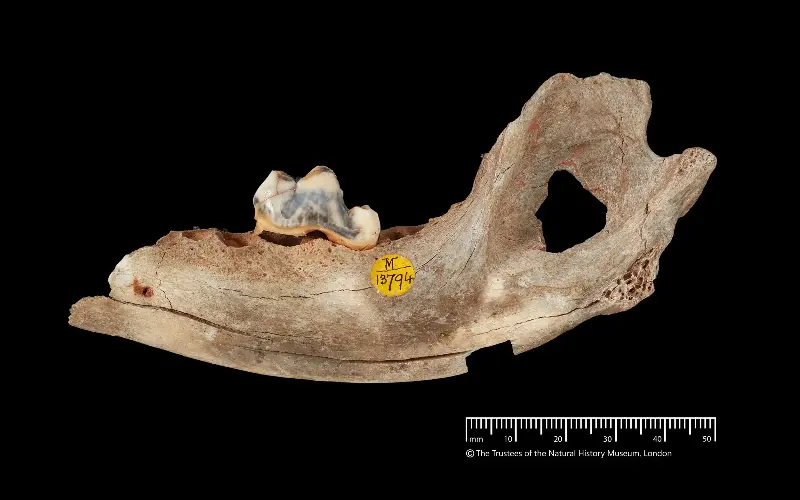
The world’s oldest pet dog remains have been found in the UK.
The jawbone of a dog dating from 14,000 years ago has been discovered at Gough’s Cave in Somerset, pre-dating the previous earliest known canine by thousands of years.
Dietary analysis of the dog’s remains suggested they were already domesticated at this stage.
By measuring carbon and nitrogen isotopes preserved in bone collagen, scientists at the University of York were able to reconstruct what these animals ate.
They found that domestic dogs consumed a diet rich in fish, which they were unlikely to have caught themselves, suggesting they were being fed by people.
The shared diet suggests humans and dogs were living alongside one another during the last Ice Age when food was scarce, meaning there must have been a good reason for hunter-gatherers to keep the creatures alive.

The study, published in the journal Nature, analysed the whole genomes from ancient bone samples found in the UK and Turkey, finding that the dogs were a common ancestor of all European breeds.
“This means that by 15,000 years ago, dogs with very different ancestries already existed across Eurasia, from Somerset to Siberia,” said Dr Lachie Scarsbrook, the co-author of the study from Ludwig Maximilian University of Munich.
“This raises the possibility that domestication occurred during the last Ice Age, more than 10,000 years before the appearance of any other domestic plants or animals.”
Dr Scarsbrook suggested the animals could have acted as guard dogs or might have been used for hunting.
Researchers across 17 institutions including the Natural History Museum took samples from skeletal remains found at archaeological sites in Cheddar Gorge and Pinarbasi, Turkey, dating to the Late Upper Palaeolithic period, long before the advent of farming.
Using genetic modelling, they were able to reconstruct the genomes of the remains and compare them with more than 1,000 modern and ancient canines.
They found that the bones belonged to early dogs, pushing back previously confirmed evidence of the earliest domesticated dogs in Russia and Finland by more than 5,000 years.
Previous studies relying on small DNA fragments and skeletal measurements have claimed to have found ancient dogs, based on the shape of their skulls, only to discover they were in fact wolves, which are genetically distinct.
However, by modelling the genome, the scientists had the “smoking gun” to determine beyond doubt that these belonged to canines.

Interestingly, when they compared the bones to those of wolves found in the same cave, there was a “chasm” between their DNA, suggesting they were already clearly two distinct species on their own revolutionary paths.
According to Dr Scarsbrook, this suggests that dogs must have first diverged from wolves thousands of years earlier than previously thought.
Distinctive markings on the bones also provide clues as to the early human rituals involving dogs, and some of the first evidence of interactions between groups of hunter-gatherers.
A hole in the dog’s mandible appears to have been made with a precision tool, suggesting a ritualistic use of the animal’s skeleton, possibly for jewellery.
Found alongside the remains of Magdalenian hunter-gatherers, who dominated Western Europe during the last Ice Age, the animal remains appear to have been treated in a similar fashion to how they treated other humans, whose skulls they turned into drinking vessels.
They were the only remains in the cave that suggested this special treatment, showing the relationship with man’s best friend may have been special, even thousands of years ago.
The remains in Gough’s Cave, first recovered in the 1920s, date to 14,300 years ago, while those in the Turkish cave were even older, at 15,800 years old.
Despite the remains being discovered about 3,000 miles apart, the researchers said their DNA was a closer match than to any other dog over the past 16,000 years, suggesting that they had a recent common ancestor that had spread across Eurasia.
The scientists suggested that wolves evolved into dogs in the last Ice Age as both wolves and humans were pushed further south into a smaller territory, forcing them to live in close proximity, which may have served as an evolutionary catalyst.

Whereas the Magdalenians are not thought to have had any crossover with ancient Anatolians, their shared dog breeds suggest another group of early hunter-gatherers, the Epigravettians, may have traded between the two groups.
While the British and Turkish dogs were found to be a common ancestor of all European breeds, they are a different evolutionary branch to Asian dogs, such as huskies and dingos.
Dr William Marsh, postdoctoral researcher at the Natural History Museum and co-first author of the study, said: “The genetic identification of two Palaeolithic dogs from Gough’s Cave and Pinarbasi represents a step-change in our understanding of the earliest dogs.
“These specimens allowed us to identify additional ancient dogs from sites in Germany, Italy and Switzerland, which clearly show that dogs were already widely dispersed across Europe and Turkey by at least 14,000 years ago.”