



Michael O’Leary’s aviation empire has found its latest efficiency cut. Ryanair bosses have just deployed their characteristic ruthlessness, cutting a whole 40 seconds from the pre-departure safety briefings. The economical edit will take the briefing from three-and-a-half minutes to just under three minutes.
While it might help with turnaround (the process of getting planes back in the air within 25 minutes), it hasn’t been universally popular with cabin crew, some of whom have complained on social media that the shorter version has left them struggling to keep up. Are their grumbles justified?
Here’s the truth about the pre-flight safety demonstration from those who know it best.
What is the safety demonstration?
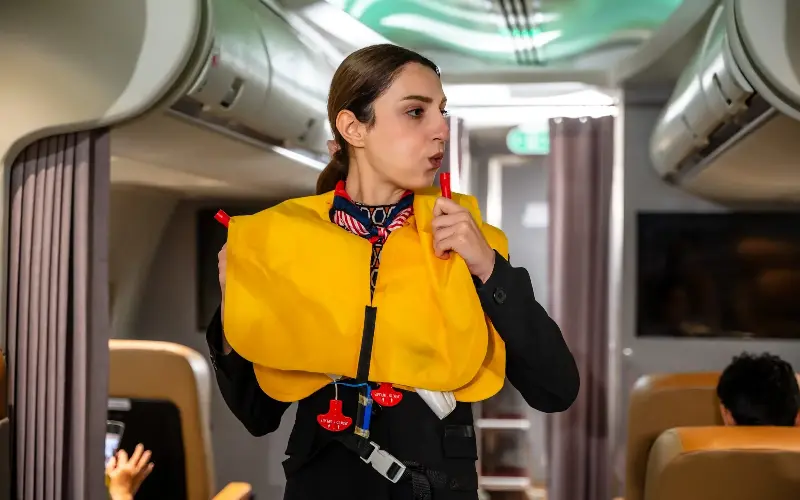
Unless you fly exclusively with full-service carriers (who tend to use videos instead), you’re almost certainly familiar with the safety demonstration: a pre-flight ritual in which solemn-looking cabin crew point out the emergency exits and demonstrate how to use the oxygen masks and life jacket, with moves that look a little like a slowed-down version of the Macarena.
It might always look pretty similar, even to frequent flyers, but the requirements of a safety demonstration are constantly being tweaked and updated, shaped by recommendations from the International Civil Aviation Organization, which are then picked up by domestic aviation watchdogs like the Civil Aviation Authority. They set the rules for exactly what needs to go in the briefing and how much discretion airlines have to adapt it.
In the case of Ryanair, the safety demonstration is accompanied by a pre-recorded audio which has become famous for its archaic posh Dublin accent (“take orf” is a passenger favourite).
Is the safety briefing really so important?
The view from aviation professionals tends to be pretty unambiguous on this one: yes. “It’s just a few minutes of people’s time and it can literally save lives,” says Ally Murphy, former flight attendant with Virgin Atlantic and now host of The Red Eye Podcast.
“On my podcast, I spoke with one of the passengers who was on US Airways Flight 1549 [the 2009 flight which famously experienced a bird strike during take off and was heroically landed in the Hudson River by its captain, Chesley ‘Sully’ Sullenberger]. He said that he always pays attention to the safety demo now, and will make sure that those around him are also listening so it doesn’t cost precious seconds in the event of an actual emergency.”
Indeed, much of the information included within the safety briefing is based on what has happened in historic aviation emergencies. It’s intended to ensure you don’t make the same mistakes that passengers have made in the past, and thus strengthen your chances of escaping from an emergency situation alive.
The part about not inflating your life jacket while in the plane? That was one of the recommendations from Ethiopian Airlines Flight 961, which made an emergency landing at sea after a hijacking in 1996. Some passengers inflated their life jackets while still on board, making it more difficult for everyone to get out – not least as the plane was filling with water – and contributing to the eventual death toll (125 of the 175 people on board were killed).
The comprehensive instructions on exactly when to tug the oxygen mask and how to put it on? These were revised and strengthened after a Southwest Airlines flight in the US suffered an engine failure back in 2018, with videos showing that many of the passengers still didn’t know how to fit their oxygen masks correctly.
Can I just ignore the safety demonstration?
While plenty of people choose to ignore the safety demonstration, the cabin crew would rather you didn’t. It isn’t just that the briefing contains vital information – it’s also that performing the demo for a plane full of people who are steadfastly ignoring you is, unsurprisingly, something most cabin crew find pretty demoralising.
Even if you’re not going to watch, at the very least try to avoid talking (those around may be trying to follow it, even if you’re not).
“Back when I was flying we would actually ‘shush’ people during the demo, but I don’t think the crew have much hope of keeping passengers’ attention nowadays,” says Lee Cobaj, a former flight attendant and now Telegraph Travel destination expert.
Then there’s the debate around whether headphones should be banned during the safety demonstration. Once upon a time, some airlines used to request that any such devices be removed ahead of the demonstration. These days, not so much.
Is the safety demonstration difficult to perform?
As you’ve probably gathered from watching it, the safety demo isn’t a particularly complicated routine to master. But given the importance of the underlying information, there is zero room for mistakes: if a portion is missed or done incorrectly, the crew member in question will likely have to perform the entire routine again.
As you’d expect, the safety demonstration is covered pretty comprehensively in airline training – though there are a few clever tricks which nervous new starters employ to ensure they don’t lose their place.
“One thing you can do is to make sure you’re in a position where you can see your other colleagues doing it – e.g. not right at the front – so you can copy them if you need to,” says former flight attendant Ally Murphy.
Other potential pitfalls include making sure that all of the demonstration kit is ready beforehand and the oxygen masks have been untangled, as well as ensuring that you’ve mastered putting the life jacket on over your hair – which, for most cabin crew with long hair, will be swept up into an immaculate obstacle. “It’s quite tricky to get right if you have your hair in an updo,” says Ms Murphy.
Do cabin crew dislike doing the safety demonstration?
In reality, the safety demonstration is always going to be part of the job – and most flight attendants have long made their peace with that fact. But that doesn’t mean they wouldn’t rather have a safety video doing some of the work instead.
“Given the choice, no-one is going to choose having to stand in the aisle, where you can be gawped at by passengers or even filmed sometimes,” says Lee Cobaj. “Pre-take-off is a particularly busy time, and there are plenty of other things that we could be doing during that time to make sure everything is ready for departure.”
Of course, given the costs involved in creating even the most basic video safety briefings – not least installing video screens in the first place – the chances of the Ryanairs of this world pivoting to that option are pretty small. Though at least the Ryanair crew can look on the bright side: they’ll be gawped at (or, indeed, ignored) for 40 seconds less from now on.