



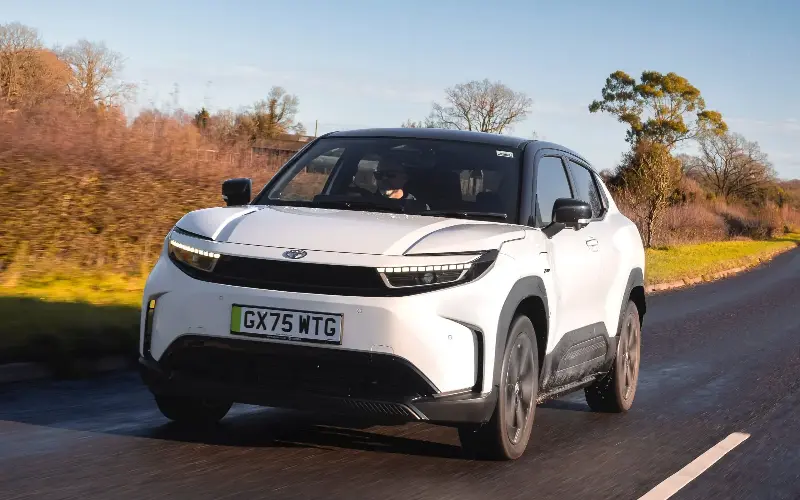
Suffice to say that Toyota’s first foray into the world of electric vehicles (EVs) has not been a rollicking success. The bZ4X was not a bad EV, but its overly conservative battery management system rendered its real-world range below par, which dented its reputation even after Toyota had come up with a fix.
For this second bite of the cherry, Toyota is going head-to-head with cars such as the Ford Puma Gen-E and the Hyundai Kona Electric, as well as the achingly cool Renault 4.
It has a recent history of sharing technology with Suzuki, not a bad idea given that small cars are Suzuki’s home ground. The resulting Urban Cruiser shares much with Suzuki’s new e-Vitara. But can it help Toyota shake off its wobbly entry into EVs?
Pros
- Smooth to drive
- Long warranty
- Should be reliable
Cons
- Low range for its battery size
- Poor rapid-charging speeds
- Tiny boot
Under the skin
A choice of two lithium iron phosphate (LFP) batteries is offered, rather than the more conventional nickel-manganese-cobalt (NMC). LFP batteries are less energy dense than NMC ones, so it should come as no surprise that despite its 49kWh (gross) capacity, the smaller of the two can only achieve a fairly middling 213 miles of range officially – which will probably equate to between 150 and 170 miles in the real world.
The 61kWh (gross) unit fares better, at 265 miles, but this is still quite some way off the 319-mile range of the larger-battery Kona Electric.
What’s more, the Urban Cruiser’s fairly paltry charging speed of 67kW means that topping up from 10 per cent to 80 per cent takes a not-inconsiderable 45 minutes. And in that time you will gain only 159 miles of range; a Kona would take five minutes less to gain 32 miles more.
Inside job
It’s better news inside. There are some cheap materials, but a mix of textures and patterns means even these feel tactile and, as a result, the Urban Cruiser avoids feeling plain.
Toyota said it had kept some physical buttons for extra convenience (rather than relying solely on a fiddly touchscreen) and that’s true, but the cursory row of piano key switches below the touchscreen only operates the bare minimum of climate control functions. To turn on the heated seats, for example, you must find your way into the climate control menu – a pain when the screen is creaking into life on a cold morning.
And creak it does; the software is sometimes slow to respond, while some of the menu options are difficult to decipher. For instance, the option to turn off the speed limit warning system is listed only as TSR (for traffic sign recognition).
There’s no shortcut to turn off any of the nannying advanced driver assistance systems “aids” either, which means a long-winded excursion into the menus to do so each time you start the car.
Space and outward vision are good in the front; the seating position is quite high for such a small car. And if you’re wondering about the Urban Cruiser’s quirky, hunched-forward looks from the outside, the reason becomes clear once you’re within: the tops of the windscreen pillars have been pushed forward to increase headroom, and because they are more steeply raked than most, you get a better view at junctions and roundabouts.
In the back, the slightly raised seats provide children with a better view forwards, but the Urban Cruiser feels narrow. Taller adults may find that the result is restrictive headroom due to the proximity of the top of the door aperture. Thankfully, Toyota’s engineers have carved a niche into the door trims to accommodate passengers’ elbows.
The 310-litre luggage compartment isn’t much compared with rivals. It gets worse, though, because that volume is with the sliding rear seats in their forward-most position. Slide rearwards to allow adults to sit more comfortably, there’s only 238 litres. That’s less than in a tiny Kia Picanto city car.
Fit and finish are as impeccable as you’d hope from a Toyota, with no nasty rattles to be ironed out (although other journalists did report some mild creakiness from their examples).
On the road
To drive, the Urban Cruiser feels sensible and level-headed. The ride is a particular strong point. It is composed and comfortable, sophisticated even over trickier road surfaces and, at higher speeds, has the feel of a larger, weightier car than it actually is. The electric motor feels peppy, too.
Toyota has fitted an ingenious stability control system that brakes the inner wheels to try to make the Urban Cruiser feel more agile, but one wonders why. The slightly distant, over-assisted steering means this is never going to be a car you’ll want to drive hard. That’s forgivable though – given its remit, few if any owners will ever prefer the long way home.
The Telegraph verdict
It’s priced competitively compared with its most obvious rival, the Hyundai Kona, but even so it’s hard to escape the feeling that this isn’t the car Toyota needed it to be.
Pleasant though it is to drive, the Urban Cruiser’s relatively slow charging speeds and poor packaging mean it feels like another fumbled ball.
The facts
On test: Toyota Urban Cruiser 61kWh front-wheel drive
Body style: five-door SUV
On sale: now
How much? £33,495 (Design), £35,745 (Excel)
How fast? 93mph, 0-62mph in 8.7sec
How economical? 4.1mpkWh (WLTP Combined)
Electric powertrain: AC permanent magnet synchronous motor with 61kWh (gross) battery, 67kW on-board charger, type 2/combined charging system socket
Electric range: 265 miles
Maximum power/torque: 172bhp/142lb ft
CO2 emissions: 0g/km (tailpipe), 18g/km (well-to-wheel)
VED: £10 first year, then £195
Warranty: three years/60,000 miles (service-activated extended warranty up to 10 years/100,000 miles)
Spare wheel as standard: no (not available)
The rivals
Hyundai Kona Electric 65kWh Advance
215bhp, 319 miles, £35,000 on the road
Still one of our favourite EVs due to the down-to-earth, matter-of-fact way it goes about its business. It isn’t sharp and exciting to drive, but it is extremely comfortable, surprisingly spacious and as easy to use as they come, with an interior that eschews the current trend for touchpads in favour of proper physical buttons.
Renault 4 E-Tech 150 Techno
148bhp, 245 miles, £28,000 on the road
Next to the dumpy Urban Cruiser, the ultra-retro 4 looks preposterously cool – and that impression continues inside, the much plusher interior making the Toyota look rather drab. It won’t go as far on a charge, but the 4 will charge more quickly.