



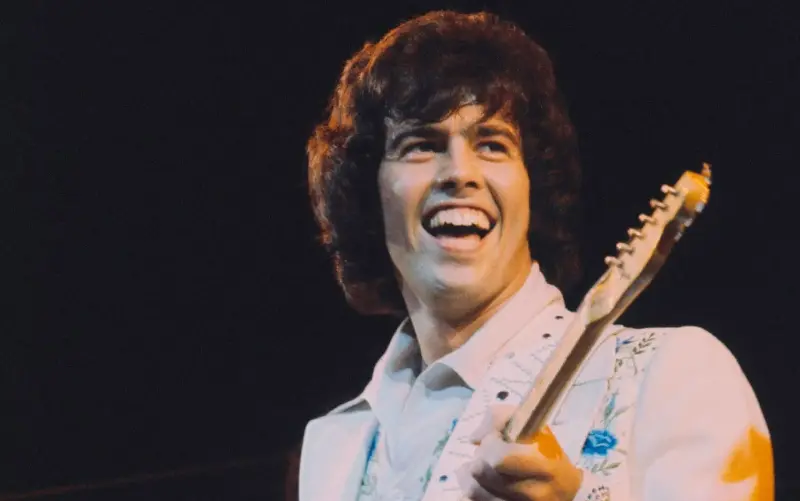
Alan Osmond, who has died aged 76, was the prime creative force of the Osmonds, the musical family who won teenage hearts in the 1970s; he wrote or co-wrote and produced several of their biggest hits, most notably Crazy Horses, a global Top Ten hit – and one of the first green pop singles, with its warning of the environmental damage wrought by “gas-guzzlers”.
Until then, they had been the archetypal boy band, playing what they were told, but Alan’s brother Merrill recalled: “Now we wanted to freak out and make our own music. We were rehearsing in a basement one day when Wayne started playing this heavy rock riff. I came up with a melody and Alan got the chords. Within an hour, we had the song.”
Alan Ralph Osmond was born on June 22 1949 into a Mormon family in Ogden, Utah, the son of George, a postal worker, and Olive. He was the third of nine children; when the first two, Virl and Tom, were born with severely impaired hearing, George and Olive were warned that any future offspring might be similarly afflicted, but “sensing a divine message”, they went ahead. Their other seven children were unaffected.
The Osmond Brothers – initially Alan, Wayne, Merrill and Jay – began as a barbershop quartet in 1958, as well as singing at their church, then a few years later they moved to California in search of wider fame. “My father hocked everything he had to buy us the tools [musical instruments],” Alan recalled.
They began performing at Disneyland in Anaheim, and between fights at a boxing venue. They were spotted by Jay Emerson Williams, father of the singer Andy, and became regulars on The Andy Williams Show on NBC, as well as on the Western series The Travels Of Jaimie McPheeters (which starred Charles Bronson and a 12-year-old Kurt Russell) and The Jerry Lewis Show.
Alan served for a time in the California Army National Guard as an artillery unit clerk – known to his comrades as “the Mormon Dream”.
The Osmonds released a string of records during the 1960s without conspicuous success, then in 1971 One Bad Apple, written by George Jackson, topped the Billboard Hot 100; the Jackson 5 (no relation) had turned it down in favour of recording ABC. It made the Osmonds superstars, with scenes to match Beatlemania.
It was the stand-out track on their third album, Osmonds, which saw the four brothers joined by Donny on vocals for the first time; he would go on to pursue a parallel solo career, most famously with his global smash Puppy Love, Paul Anka’s paean to young hearts.
Having reigned as the crown princes of bubblegum, in 1972 the Osmonds shifted direction with their fifth album, Phase III, writing more of their own material and exploring a rockier sound, as on Down by the Lazy River, written by Alan and Wayne.
The Osmonds-as-rockers era reached its apotheosis with the Crazy Horses album and single a few months later, produced by Alan with Michael Lloyd. The new direction brought the band a new, male audience, and at one concert the boys found themselves on stage in front of a crowd of raucous lads. Alan turned to the band and hissed: “Cut Puppy Love!”
The youngest Osmonds, Marie, born in 1959, and Jimmy, born in 1963, both went on to have successful careers, and Marie teamed up with Donny as a successful country duo.
The Osmonds carried on touring and recording, partly due to the bad deals signed by their father. In 1987 Alan was diagnosed with multiple sclerosis, but continued performing until 2007, when ill health forced his retirement, along with Wayne, after the band had celebrated their 50th anniversary. There have been several one-off reunions since. In 2024, Alan published a memoir, One Way Ticket.
Wayne Osmond died in 2025. Alan, who had had a brief relationship with Karen Carpenter in his younger days, is survived by his wife Suzanne, whom he married in 1974 when she was a cheerleader at Brigham Young University, and by their eight sons, several of whom joined various Osmonds iterations over the years.
Alan Osmond, born June 22 1949, died April 20 2026