



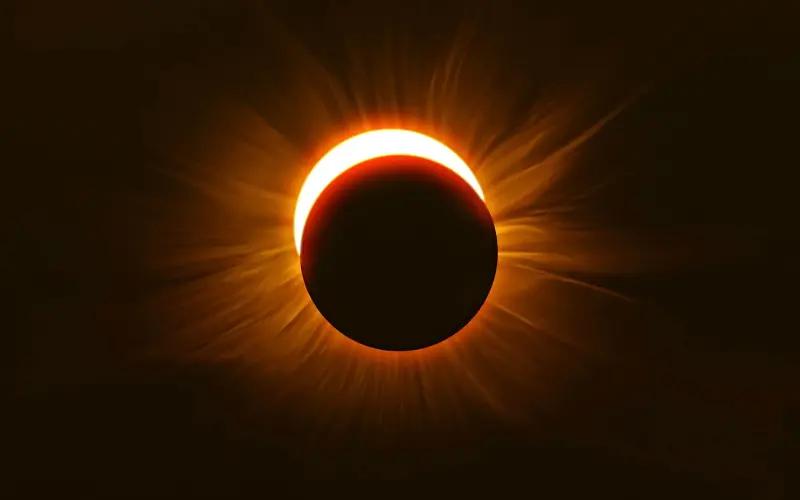
In less than a fortnight, Britain will be plunged into daytime darkness as the moon passes in front of the sun, blocking its light and casting a shadow across the nation.
The partial eclipse will take place on August 12 and leave only a tenth of the sun visible, meaning it’s the most dramatic solar eclipse that the UK has seen since 1999. While the last partial eclipse in Britain took place in March 2025, only 30 to 40 per cent of the sun was obscured.
Here’s everything you need to know.
Skip to:
- Where to see the best view of the eclipse
- When to watch it – and how long it will last
- Viewing events to enjoy
- What to expect
- How to watch the eclipse safely
- Why it’s worth watching this eclipse
Where to see the best view of the eclipse
The whole of the UK will be able to see the moon pass directly in front of the sun, covering at least 90 per cent of its surface. This is the most coverage seen from the UK in 27 years, when people in Cornwall and Devon enjoyed a total solar eclipse.
However, some locations will experience more darkness than others. In general, more of the sun will be covered the further south-west you are.
This means the best eclipse viewing spot is the southwestern tip of Ireland, where there will be 97.5 per cent coverage, while Cornwall and Pembrokeshire will lose sight of 95 per cent and 94 per cent of the sun, respectively.
In London, the maximum coverage is expected to be around 90 per cent.
Whichever part of the country you are in, the best views will be available from higher vantage points and those which offer unobstructed views of the horizon. The eclipse will take place as the sun is setting, and will therefore be low in the sky.
Parts of Europe, including Greenland, Iceland and northern Spain will see a total eclipse, while France, Belgium, Switzerland and northern Italy, will experience between 88 and 95 per cent coverage.
When to watch it – and how long it will last
The eclipse will take place on Wednesday August 12 and last around 1 hour and 50 minutes.
The moon will begin to creep in front of the sun from 6.08pm in Edinburgh, spreading across the rest of the UK in the following 10 minutes, reaching Cornwall at 6.18pm.
The point of maximum coverage – which lasts up to 2 minutes and 18 seconds – will be around an hour later, at 7.05pm in Edinburgh, 7.10 in Manchester, 7.12pm in London and 7.16pm in Cornwall.
The eclipse will end between 8pm and 8.10pm, as the moon moves off the sun’s disk.
Viewing events to enjoy
There are a number of events happening across the country where members of the public are invited to gather and mark the occasion together. The Royal Observatory Greenwich in London is hosting an eclipse viewing session from 4pm with members of the Flamsteed Astronomy Society on hand to answer any questions about the eclipse.
The Observatory Science Centre & Museum in Sussex is holding an event from 5pm, where eclipse glasses will be on offer and attendees can look through its solar telescopes. Tickets are required for these events.
Keele University is inviting people to watch from its campus, where eclipse glasses and solar telescopes are also available, while the Eddington Astronomical Society has organised a free, informal eclipse viewing event with free solar glasses available, along with solar telescopes.
If you can’t make it along in-person, The Royal Observatory Greenwich is live streaming the eclipse using one of its telescopes, hosted by astronomer Dr Greg Brown.
There’s a risk clouds could obscure part or all of the eclipse, in which case events would be cancelled, so it’s worth checking the forecast and event pages before heading along.
What to expect
The moon covering 90 per cent of the sun will make a noticeable difference in the light levels and temperature, according to Royal Museums Greenwich.
The sky won’t become totally dark but it will look like a cloudy day or later in the evening than it actually is, while the temperature may feel slightly cooler.
How to watch the eclipse safely
While it’s tempting to look up at the sky to enjoy the eclipse, looking directly at the sun – even when it’s almost entirely covered by the moon – can damage your eyes.
In response to the darkness caused by the eclipse, your pupil will dilate to allow more light to get into your eye. As the pupil usually shrinks when you look up to the sky, much more UV light enters the eye. This can damage your retina (the layer of nerve tissue lining the back of the inner eye) which may lead to permanent vision loss.
To watch safely, pick up solar eclipse viewing glasses – available online or in some museums for around £3 – before looking up at the eclipse. Ensure the safety certification ISO 12312-2 or ISO 12312-2:2015 is printed on the eclipse glasses, which means they will block out the sun’s harmful rays. Unfortunately, your normal sunglasses won’t be sufficient, as they don’t offer this level of UV protection.
Another option is creating a pinhole projection. Experts recommend this as the safest and cheapest way to see the eclipse. Simply make a hole in a piece of card and hold it up to the sun, with a spare piece of paper behind the card. A miniature version of the eclipse will be projected onto the paper.
Why it’s worth watching this eclipse
If you miss the partial solar eclipse on August 12, you’ll be waiting nearly a year until the next one in the UK – and it’s much less impressive. It will take place on August 2 2027 but, at the maximum, only 45 per cent of the sun will be in shadow.
The next total solar eclipse won’t occur in the UK until 23 September 2090, according to Royal Museums Greenwich, so it’s worth putting a reminder in your calendar for August 12, to avoid a 64-year wait.