



The Government has invited bids to be the first UK Town of Culture in 2028. We’re still at the “expressions of interest” phase but, given the attention garnered by the City of Culture scheme (launched in 2013, with Bradford the most recent – 2025 – incumbent), a fair number of places are talking about competing.
Three finalists – one small town, one medium and one large – will be chosen. The winner will be crowned UK Town of Culture and receive a £3m prize to spend on delivering their bid. The two runners-up will each receive £250,000.
So which of our largest towns already has plenty to offer visitors, and which could really do with a bit of funding? I’ve run the rule over the UK’s 25 most populous towns – all of which are in England – and given each a mark out of 10 based on the quality of their architecture, attractions, culture, dining and all-round appeal.
25. Watford
Population: 102,246 (2021)
My rating: 0.5/10
Gateway to London or last exit to the humdrum? In 1992, Watford sacrificed its town centre to one of the UK’s biggest shopping spaces, the Harlequin Centre, which later became an Intu, then Atria Watford, but is now wearing the clown’s name once again following concerted local campaigning.
Logistics were always a force here. The former market town grew when the Grand Junction Canal opened, bringing breweries, paper mills and printworks. Surprisingly, perhaps, there is a heritage trail for what remains of oldish Watford, including the Art Deco town hall, Assembly Halls (or “The Colosseum”), library, Monmouth House and Bedford Almshouses.
The one tourist-grabbing attraction is Warner Bros Studios’ Making of Harry Potter Tour (from £58.50 per person) at Leavesden, north of the town, though some people would much prefer a quiet stroll in Cassiobury Park.
Secret sight
The Watford Hornet, a stainless steel and bronze statue that celebrates the town’s football team.
24. Crawley
Population: 118,493
My rating: 0.5/10
A New Town that evolved out of a linear development on the London-Brighton road, Crawley exploded in the last century from a village-sized townlet of 4,000 to around 120,000 today.
Very few of its modern constructions are noteworthy. The Church of St Edward the Confessor and St Alban’s Church are sleek but humble concrete blocks. St Mary’s has an eye-catching wall broken up by shards of coloured glass. Pevsner liked the bandstand when it was relocated from the buried former village near Gatwick Airport to Queen’s Square, inside the shopping centre (a tiny, symbolic rus in urbe reference point), but it’s now tucked away in the less contrastive Memorial Gardens.
Crawley has a functional, manufactured quality and some of its boxy housing will appeal to the more avid clan of psycho-geographers who can glean artistry in a slab of reinforced concrete and social daring in a communal garden.
Secret sight
Ifield Water Mill, a 19th-century weatherboarded watermill on the western edge of town.
23. Luton
Population: 225,262
My rating: 1/10
When Luton Airport expanded on the back of the no-frills boom three decades ago, there were hopes tourists might come. Luton Town’s promotion to the Premier League in 2023, for the first time since the league’s inception in 1992, was another prompt for renaissance rumours. In 2024, they went down.
Luton has brushed with greatness before. In the Domesday Book, it is shown as the largest royal manor in Bedfordshire. In the 14th century, its church, St Mary’s, was the largest in the county. In 1826, the first hat factory opened, kicking off a topper-cocking boom era. Vauxhall Motors opened in 1905. It closed last year and now that airport is the best-known thing about the town, along with “the biggest one-day carnival in the UK”.
For the other 364 days, there’s a museum with a single famous exhibit: the medieval bronze Wenlock jug (which was nicked, and mercifully recovered, in 2012) but not much else.
Secret sight
Wrest Park, a Grade I-listed country house to the north of Luton.
22. Oldham
Population: 242,003
My rating: 1.5/10
Most Mancunians would laugh with derision if you suggested a day out in Oldham, but it has one or two quirky draws.
The Coliseum Theatre, saved from closure in 2024 after a high-profile campaign, launched the careers of many Coronation Street stars, as well as Bernard Cribbins, Olivia Cooke and Millie Gibson. Local football team Oldham Athletic were pioneers in the adoption of artificial turf in English football at their Boundary Park stadium in 1986. The team also pioneered extreme decline; the Latics were the first – and remain the only – former Premier League club to be relegated to the National League (tier 5).
A few parks provide room to breathe, but you could – just about – claim Oldham as a Peak District town. Saddleworth, in the borough, is highly regarded as a place to live and ramble. The new GM Ringway cuts through the Chew Valley, a great spot for views of Manchester.
Secret sight
George Street Chapel, a beautifully restored Methodist chapel turned events venue.
21. Basildon
Population: 115,955
My rating: 2/10
Formerly a Plotlands backwater with poor agricultural land, Basildon was made a “Mark One” New Town in 1949, with the Rt Hon Lewis Silkin – Clement Atlee’s town and country planning minister – declaring: “Basildon will become a city which people from all over the world will want to visit.” Neither are true, but fans of modern architecture will enjoy a mooch.
The highlights are: St Martin’s Church, consecrated in 1962; brutalist Brooke House, designed by Sir Basil Spence and Anthony B Davies, with Arup as the structural engineers; East Square, a sunken open-air public plaza, accessed by a monumental staircase and curved ramp which were listed in 1998; John Poole’s wire-and-aluminium Man Aspires (aka “The Treble Clef”); Maurice Lambert’s Mother and Child bronze and fountain; the newer Cats Cradle Pussiwillow III Clock; and the Barstable School building, by the Finnish-British architect Cyril Mardall.
Secret sight
The Haven Plotlands House museum.
20. Basingstoke
Population: 107,642
My rating: 2/10
Hampshire might have been a key byway between mercantile London and the maritime empire, but little old Basingestoches, later Old Basing, was bypassed until the Second World War.
As you’d expect of a modern town, this one has modern buildings. Plant (formerly Mountbatten House) is a large, Grade II-listed, 1970s office building with landscaping by acclaimed garden designer James Russell. It’s affectionately known as “The Hanging Gardens of Basingstoke”. The building and gardens won a RIBA award in 1979 and were both separately listed by English Heritage in 2015.
Basing View’s Churchill Plaza, Matrix House, Snamprogetti House and View Point are all worth a silver-tinted photo. Away from the mirror glass and concrete, the best thing hereabouts is the Hampshire Downs, where Gaskell settled after many years in Manchester.
Secret sight
Eastrop Park, with its boating lake.
19. Telford
Population: 156,896
My rating: 2.5/10
Devoid of cities, Shropshire has Telford, a polycentric New Town (originally called Dawley) that honours in its name the 19th-century “Colossus of Roads” but is very much a 20th-century creation.
Often unflatteringly, but fairly, compared with Shrewsbury – around 15 miles to the west and one of the UK’s loveliest old market towns, its local appeal rests on shops and amenities. But nearby are the Wrekin, a gorgeous little lump of woodland, the Unesco-listed Ironbridge Gorge, the Shropshire Hills and the Severn.
Frankly, all of its visitable sights and attractions, bar the town park, are satellites of Telford, and Visit Telford makes no bones about this, though it does claim Buildwas Abbey – more than five miles out of town – as in it. A useful base, for sure; a leisurely stopover for Wales-bound holidaymakers, not really.
Secret sight
Sunnycroft, a National Trust property in neighbouring Wellington.
18. Middlesbrough
Population: 148,215
My rating: 2.5/10
A port, a railway centre, and a sometime coal, iron ore and heavy engineering superpower, Middlesbrough lost any semblance of the village it once was more than a century ago and in recent times has demolished the workshops and wharves that made it rich.
The Italianate-style 1846 town hall, Queen’s Terrace and the French baroque former National and Provincial bank are little islands of heritage. Industrial tourism fans can still enjoy a few sites – the 1911 Tees Transporter Bridge, for example, is the longest survivor of its kind in the world. But the main attractions here are fading ruins and hidden archaeological riches – including the buried vestiges of the Victorian town.
Sydney Harbour Bridge was designed here. Middlesbrough has made other places wealthy and/or beautiful, but hasn’t been fairly rewarded for the effort.
Secret sight
The Captain Cook Birthplace Museum.
17. Northampton
Population: 249,093
My rating: 3/10
Northampton was declared a shire by Alfred the Great. Saxons fought to remain there, but the Normans came anyway. Simon de Senlis, Earl of Northampton, constructed a castle and, after joining the first crusade to the Holy Land, built the Holy Sepulchre – one of four medieval round churches still standing in England.
Northampton found its feet as an economic hub through shoemaking, exporting footwear to Flanders and by 1401 having its own guild. In 1841, according to the census, there were 1,821 cobblers in the county. The local museum is home to one of the largest collections of shoes “and shoe heritage” in the world, and the football team is nicknamed the “Cobblers”.
Northampton’s best-known author, Alan Moore, has said: “We are the biggest town in Europe but most people are seemingly unaware that we are here.”
Secret sight
The Crucifixion by Graham Sutherland and Madonna and Child by Henry Moore, both at St Matthew’s Church.
16. Slough
Population: 143,184
My rating: 3.5/10
“Come friendly bombs and fall on Slough – it isn’t fit for humans now,” smeared Betjeman. Later, he expressed regret over penning such venomous lines.
Tourist attractions are not numerous. The Curve is a stylish multi-use venue, with a museum and library housed inside. Black Park and Langley Country Park are very pleasant. But, to adopt Unesco’s terminology, this is a town to visit for intangible heritage. Slough was home to the first zebra crossing and wheelie bin. It is the location of the world’s second-largest data centre hub.
The massive trading estate has a history as a motor repair depot for army vehicles in wartime, then a site for refitting military trucks, cars and motorcycles for civilian use. This was replaced by the largest trading estate in Europe with a single owner, covering more than 450 acres. Mars is one of the long-standing big names. The Mars Bar was invented in Slough in 1932.
Secret sight
Slough railway station, one of the town’s finest buildings.
15. Reading
Population: 174,200
My rating: 4/10
Thanks to the M4 and GWR, this ancient town is a commuter magnet. Thanks to Heathrow, it’s ringed by corporate HQs. You can definitely live well and earn well, but is work so central to life that it leaves no room for leisure?
I actually think Reading deserves more time than most people give it. The shopping area is lively and feels proper – nice facades, broad paved area – and you can eat well along the Kennet and elsewhere, though chains predominate. The three big attractions – Reading Abbey Ruins, Reading Museum and the Museum of Rural Life – are worth a whirl. Reading Gaol, empty, is evocative and the Banksy works well at the site. The Roseate is a great-value boutique hotel.
The problem for Reading is that the Thames Valley is awash with tourist-friendly options, from Bray (food) to Windsor (heritage) to Cookham (art) – but, is that really a problem?
Secret sight
The Ure Museum of Greek Archaeology at the university.
14. Swindon
Population: 224,942
My rating: 4.5/10
Once a small market town, in the 1840s Isambard Kingdom Brunel made Swindon the site of the Great Western Railway engine and repair shed on the London-Bristol line, changing its fortunes forever.
Rail lovers rate Steam, its award-winning railway museum, as highly as the one at York and gather in numbers to ogle GWR locomotives. Others come to attend innovative events – last year the museum hosted wellbeing, jazz age and beer festivals.
The town has a fair number of green spaces – the Old Town Gardens with its Victorian bandstand are lovely – and some off-beat arts venues, including the Swindon Museum and Art Gallery, which has one of the best collections of 20th-century British art outside London. Palladian House at Lydiard Park, and the iron-age hillfort at Liddington Castle, are other draws.
Secret sight
13. Warrington
Population: 174,970
My rating: 5/10
The Los Angeles of Cheshire? Scoff not. Ancient Warrington – the Romans had military installations on both sides of the Mersey ford – has more motorways than anywhere else in the country. A sometime New Town, it fully embraced the vision of James Drake, the road builder behind the M6, and was a logistics hub long before everywhere became a logistics hub.
For visitors, its tourism offerings are subtle, but must-sees include the Cromwell statue and rebuilt Warrington Academy behind him (once a Nonconformist temple of learning); the Barley Mow pub, built in 1561; the bridge, site of Civil War ructions; the footpaths along the river and the Ship and Sankey canals. The new market hall on Time Square is lively. Centre for Cities’ January 2026 report claimed Warrington was a “southern economy in the north” and the region’s most prosperous town.
Secret sight
RAF Burtonwood Heritage Centre, and the new Bolt of Lightning monument.
12. Huddersfield
Population: 141,692
My rating: 5.5/10
This is a handsome market town, with the gritstone houses and old warehouses so characteristic of the West Riding.
A short history trail provides a great introduction to the key buildings, but Huddersfield prides itself on a richly layered past that connects radical traditions to the Sex Pistols (who played their last gig here). Every year there’s a programme of guided walks that covers themes like textiles, Caribbean culture, builder Joseph Kaye and local nature.
Being here is a bit like being in Halifax or Hebden Bridge in the Calder Valley, but without the crowds drawn by TV shows (though nearby Holmfirth still attracts a few Last of the Summer Wine fans).
Secret sight
The George Hotel (now a Radisson) – where the rugby schism was declared in 1895.
11. Bolton
Population: 184,073
My rating: 6/10
We sometimes imagine cotton booms further back than they were. Bolton’s peak production year was 1929, when 216 cotton mills and 26 bleaching works were operating. There were also mining and chemicals industries, heavy engineering, tanning, and paper and rope making. But today it is a typical post-industrial town, with a lot of dead mills, windy spaces and underused facilities.
The listed market hall has been successfully repurposed as a shopping and eating space – though chain restaurants will never replace the perfume and vitality of fish and fresh veg.
In English Journey (1934), JB Priestley wrote of Bolton: “The ugliness is so complete that it is almost exhilarating. It challenges you to live there.” Too harsh, too Yorkshire. But it is a ghost of former greatness.
Secret sight
The Ye Olde Man and Scythe, where the Earl of Derby (whose family once owned the pub) was killed in 1651.
10. Blackburn
Population: 154,922
My rating: 6/10
Elevated to the status of cathedral in 1926, its centennial year, Blackburn’s biggest place of worship is a curious combination of Georgian nave and Modernist lantern tower and spire. This year is another big birthday, and the diocese has planned some fascinating events, including knitted wartime scenes (“the longest yarn”) and immersive light-and-sound artwork.
More than 200 chimneys once pricked the Blackburn clouds during this city’s cloth-making apogee. A heritage-themed walking trail would take in the Cotton Exchange, opened in 1865; the Old Bank – where millworkers rose up over reduced wages and hours in 1878; and Richmond Terrace, where prominent mill owner John Baynes resided.
Blackburn hosts a fabulous Festival of Making every year (July 4-5 this year), which includes exhibitions and talks covering all manner of crafts. King George’s Hall, the town’s main entertainment venue, is set to reopen in autumn following a much-needed refurbishment.
Secret sight
The Prism Contemporary independent gallery.
9. Stockport
Population: 117,935
My rating: 6.5/10
Second towns and cities are overlooked, spurned, forgotten. Stockport’s viaduct – a symbol of bypassability – is its most arresting visual attraction. Lowry drew and painted it several times. It plays a key role in Tony Richardson’s 1961 film A Taste of Honey. It also provides a vantage point for surveying other architectural highlights, such as the brutalist Stopford House, built in 1975 (the police station in Life on Mars) and the gorgeous Art Deco Plaza cinema and theatre.
Down on the ground, the nicest area is Underbank, a retail and leisure strip built during the 19th century, with independent shops and bars. Nearby, Crowther Street is another of Lowry’s subjects, the stairs winding upwards between low terraces.
A sign on the A6 suggests visitors might go six and a half miles north to Manchester or 182.5 miles south to London. But there’s plenty to see and do right here.
Secret sight
The former Strawberry Studios, as used by Joy Division, at 3 Waterloo Road.
8. Poole
Population: 140,977
My rating: 6.5/10
Harry Redknapp or Thomas Hardy? Jurassic Coast or Millionaires’ Row? The Wessex Coast’s des-res hotspot is a tale of two towns. It has Europe’s largest natural harbour, which looks gorgeous from the air. The quaint historic quayside and old town are where a lot of attractions are concentrated, including Poole Museum (where you can learn about the town’s original geezers: pirates, smugglers and bootleggers), some beautiful old buildings and a tourist information centre that can tell you all about the excellent self-guided walks, such as the Cockle Trail.
Nature conservation tussles with property development, but the latter does well. Sandbanks and Salterns Marina (one of the most expensive places to moor a boat on the south coast) have flashy reputations, but the popular grabs here are Brownsea Open Air Theatre and Poole Park.
Secret sight
The sculpture of Robert Baden-Powell.
7. Bournemouth
Population: 196,455
My rating: 7/10
From up on the clifftops, you get a sweeping, stirring view of the shimmering bay and seven miles of golden sand, with the chalk stacks of the Isle of Wight and the Isle of Purbeck in the distance.
Bournemouth was built as a health resort in the late-Georgian era, somewhere for wealthy people to convalesce. Pine trees were planted everywhere – and still stand, providing the town with a verdant canopy. Hotels, theatres and galleries followed.
Writers liked this setting, including Mary Shelley, who’s buried in St Peter’s Church. All fabulous, but the Romanticism has to vie with Mammon – JP Morgan, Nationwide and Liverpool Victoria have offices here – and a nighttime economy propped up by stag and hen-dos.
In 2022, Bournemouth got its first five-star hotel, The Nici. It also has a branch of the Ivy restaurant franchise. One Telegraph writer promised “a day out in Britain’s mightiest seaside town” (2019). Another, more recently, claimed: “Bournemouth has squandered its advantage” (2024).
Secret sight
Russell-Coates Art Gallery and Museum.
6. Worthing
Population: 113,094
My rating: 7/10
Worthing is Morecambe with cash, as evidenced by the fair state of repair of its historic buildings (like other Sussex seaside towns, Worthing has its share of grand Regency architecture), its well-maintained Art Deco pier, its booming food scene, flash leisure centre and the 10-year waiting list for beach huts.
The town is no longer a retirement enclave, and the lively weekend buzz, annual festival and arty enclaves point to hipster recreation rather than hip replacements. Once viewed as Brighton’s drab half-brother, Worthing is now more of a smug slightly older sister.
Secret sight
A Blue Plaque trail takes in one of the oldest working cinemas in the UK – the Dome – plus four bronze sculptures by Elizabeth Frink, known as the Frink Heads.
5. Gateshead
Population: 196,151
My rating: 7.5/10
A lot of Gateshead is taken up by estates. In the middle of them is Saltwell Park, which is gorgeous, with its Grade II-listed mansion – once the home of stained-glass magnate William Wailes – and cool little Prism Coffee, turning out barista-quality brews.
Down by the Tyne are the two big star attractions – the world-class Baltic Centre for Contemporary Art and the Glasshouse International Centre for Music (formerly the Sage), home of the Royal Northern Sinfonia – and, of course, those famous bridges.
The nine-mile riverside Tyne Derwent Way also takes in the Dunston Staiths, St Mary’s Heritage Centre (based at the former St Mary’s Church, which dates from the 12th century) and the MetroCentre, plus the sculpture trail in Gateshead Riverside Park. Close to the old High Level Bridge entrance are hip wine and beer bars and a lovely old wedge-shaped pub, The Central.
Secret sight
The Vane Gallery.
4. Rochdale
Population: 111,261
My rating: 8/10
Catch the tram or the train from Manchester and you get a powerful sense of Rochdale’s rurality. Old buildings dot the centre. A Grade II-listed domestic workshop. A cloth merchant’s home later used as an ironmonger’s and a bank. Drake Street has handsome houses. On Spotland Road, Pioneer Street and Equitable Street are rows of terraces built by the Rochdale Society of Equitable Pioneers in the 1860s. The Pioneers Museum on Toad Lane is excellent.
Rochdale town hall is one of the most stunning civic buildings in Europe. From outside it’s craggy, vaulting Victorian Gothic Revival on a grand scale, with gargoyles, finials, shields and crockets and a 190ft clock tower. Inside is the Great Hall, with a hammerbeam roof and churchy windows, and an entrance lobby inspired by Córdoba’s Mezquita. The mayor’s dining room is decorated with floral painted paper, its martlet bird motif clear after a century of nicotine was wiped away as part of a four-year, £20m restoration – using cotton buds.
Secret sight
The Whitworth Heritage Museum.
3. Ipswich
Population: 139,700
My rating: 8.5/10
Conservation here has been slapdash, but Ipswich still has some lovely old streets – Silent Street, Star Lane, Franciscan Way, leading to Grey Friars Road – plus 13 medieval churches, including St Mary-le-Tower, recently redesignated as a minster. Other fine old spots include Wolsey’s Gate, the Tooley’s Court almshouses, half-timbered Curson Lodge, pargeted Ancient House, an opulent town hall and gorgeous Cornhill, the main square.
Christchurch Park is lovely, and its museum/mansion is world-class, highlighting the town’s extraordinary maritime heritage. You can enjoy the wonders of old Ipswich while eating and drinking. Arcade Tavern and the Spread Eagle are two of England’s greatest boozers. Isaacs on the Quay is a harbour-front tavern carved out of an old maltings. Salthouse, nearby, is a great hotel and restaurant. Ipswich even has a postmodern landmark in the Willis Building.
Secret sight
The Blackfriars monastery ruins.
2. Cheltenham
Population: 118,836
My rating: 9/10
The poshest of our 25 towns (Poole is more about money than class), Cheltenham is brim-full of fetching assets, from the refined residences of the Suffolks and Tivoli area to the gracious Montpellier district.
In the 19th century, Montpellier Spa was one of a handful of places where the well-heeled gathered to take the town’s mineral waters. Montpellier Gardens and neighbouring Imperial Gardens provide green spaces and are used as festival sites. Jazz, science, music and literature have their own dedicated quality showcases.
The Promenade, an avenue built in the 1820s, is grand and airy. Cafés, bistros, delis and restaurants abound. The museum, The Wilson, is known for its Arts & Crafts collection, but is also strong on Flemish art.
Secret sight
Holst Victorian House.
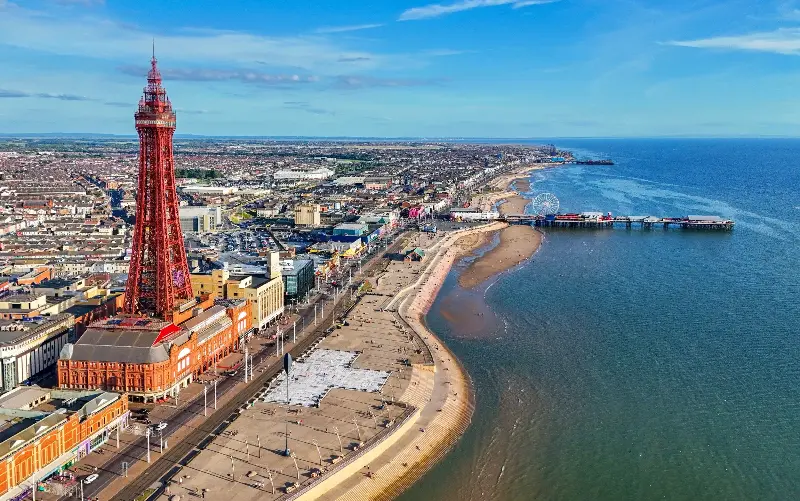
1. Blackpool
Population: 141,100
My rating: 9.5/10
Popular but spurned, rich and dirt poor, Blackpool is, and always was, all things to all people.
The town evolved out of an unplanned sell-off of land by various lords of the manor, and was destined to be chaotic. The Golden Mile and Pleasure Beach are latter-day versions of the free-for-all fête that once took over the strand.
As the new Showtown museum reveals, the modern seaside mass-market holiday was invented here, as was much of the light entertainment and comedy that dominated the small screen for decades.
You can eat well (the Wok Inn is superb), drink well and party well here but neither the prom in a gale nor the back streets after dark are for the faint-hearted. It’s a UK one-off. An obligatory stop once every decade if you want to know your nation and yourself.
Secret sight
The Grundy Art Gallery.