



It’s a soft spring day in a meadow underneath the famous pair of listed Victorian viaducts near Chapel-en-le-Frith, Derbyshire. Wrens, chiffchaffs and robins chat away, vivid yellow celandines cover the ground. “It’s significant for wildlife down here,” says Jason Adshead, a parish councillor and member of the local biodiversity group. “We’ve have dipper and kingfishers, we’ve seen otter, bats and owls here, too.”
And yet, in a few weeks’ time, there will be a notable omission from this bucolic scene in Derbyshire’s High Peak. Many swifts use the arches of the Chapel Milton viaduct to nest after their long migration from Africa, pairs darting to the exact same cavity each year to breed. Except, in early May this year, some will arrive to find them concreted over by Network Rail.
“We found nine nesting pairs of swifts just in this area, and four on that pillar,” says Adshead, 56, looking up at the arch 100 feet above him. “When Network Rail first said they were going to do this £7.5m refit of the viaducts, we were [initially] fully behind their efforts.
“At their engagement session, they said they wanted to work constructively with the local community, so we invited them to attend the site and see the swift locations first hand last year.”
But, Network Rail’s contractor declined, Adshead alleges, and they carried on with the refurbishment on the strength of their own ecological surveys and reports, filling the voids in the arches that support the freight train line above. And in February this year, three of the nesting sites were filled with mortar at the side of a stitch repair designed to address the structural issues.
Meanwhile, there is an ongoing and separate British Transport Police (BTP) investigation under the jurisdiction of its wildlife crime team, responding to an allegation of disturbance of nesting birds during the refurbishment works. The Telegraph has approached BTP for comment.
“They’re blocking the very nesting sites they know are used – because we told them where they were,” says Adshead. “It’s heartbreaking for us, but it’ll be devastating for these birds who won’t be able to breed.
“And if anyone thinks this is just a story of three pairs of swifts in Chapel-en-le-Frith, it’s not; you can guarantee what’s going on here happens across the country in any structure like this. It’s the principle of the thing.”
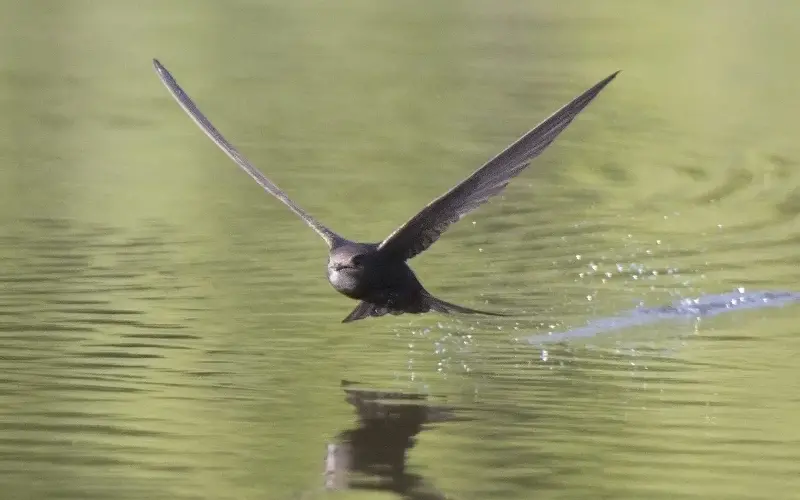
Adshead has a point. This dispute is emblematic of a wider problem across the country. The swift breeding population has undergone a 68 per cent decline in just 30 years according to the latest research by the British Trust for Ornithology, and they’re now on the “red list” of Birds of Conservation Concern in the UK – the only country in continental Europe where swifts are so at risk. The loss of suitable nesting sites – these birds nest in small gaps high up on buildings – due to demolition or inconsiderate renovation is widely thought to be the main driver for the numbers now being at fewer than 40,000 pairs.
Adshead says he actually stood with a Network Rail employee last year who directly witnessed swifts entering and exiting these nesting holes. Yet when The Telegraph spoke to Network Rail, a spokesman stated: “To be completely clear, no holes were blocked where there was evidence of nesting birds.”
Network Rail says they instructed contractors to carry out ecological surveys during nesting season when it would have been clear whether nests were present – but as swift expert, campaigner and author Hannah Bourne-Taylor points out, it wouldn’t have been that obvious in any case. “It’s not like they have twiggy nests. They don’t make nests like we might imagine, as they only collect light nesting materials that they can catch in the air.”
She adds: “Imagine being the Network Rail swifts right now. They have flown non-stop for nine months, crossed the Sahara Desert twice, and are coming from the Congo Basin to the only ground they will ever intentionally touch. All Network Rail need to do is simply unblock their homes and welcome these incredible birds home.”
Indeed, after the issue was highlighted by the likes of Deborah Meaden and Baroness Jenny Jones, Network Rail earlier this week admitted that “with agreement from High Peak Borough Council, we are now planning to install RSPB-approved swift bird boxes on the viaduct, to provide additional nesting opportunities”.
Adshead scoffs at the notion. “You think they can get through planning and install swift bird boxes up there in just two weeks? I spotted swifts on May 2 last year, so they’ve not got long.
“But the argument that they had to fill these particular tiny cavities to repair the structural fracture in the masonry is ridiculous. Look at these arches. We’re talking about nesting holes that are a few centimetres wide in a structure that has dozens and dozens of similar holes left unblocked. It just doesn’t add up.”
Bourne-Taylor points out that even if Network Rail did put boxes up exactly where the previous holes were, it probably wouldn’t make much difference to the fortunes of those six birds.
“The birds can remember the specific shape of that specific location, and so it’s incredibly unlikely that those six individual swifts this year would take to that alternative,” she says.
“In fact there’s a fairly good chance they might kill themselves trying to get in. I don’t want to say swift boxes per se aren’t good as a compromise for the overall swift colony but they won’t contribute to the breeding population numbers for this year.
“As I say, all Network Rail have to do is unblock three little holes, and we know where they are. It’s that easy – but I’ve come to realise that nothing is straightforward when it comes to the pretty simple ways in which companies, industry and government could be mitigating against swift decline.”
Indeed, Bourne-Taylor has been a key figure in the “swift brick” campaign that has turned into something of a fiasco for Labour. In opposition, they supported a motion to mandate a £34 swift brick to be installed in every new building to offer a permanent, secure, cavity-nesting habitat.
It had unanimous support from the nature conservation sector, and cross-party support with members of every party from the Greens to Reform advocating for it. Yet last year, as part of their efforts to speed up its housing plans, Labour rejected an amendment to make the bricks mandatory for new buildings, instead introducing them into planning guidance, meaning there is no legal obligation for their use.
Meanwhile, Scotland passed primary legislation to mandate swift bricks earlier this year.
“It’s now extremely unlikely that swift bricks will be installed on the national scale that is so clearly, urgently necessary,” says Bourne-Taylor. “If they cannot breed, swifts have no chance of stabilising their rapidly declining population.”
A spokesman for the Ministry of Housing, Communities and Local Government (MHCLG) tells The Telegraph that the Government recognises that swift bricks are a vital means of addressing the long-term decline of the breeding swift population.
But actually installing them is still mired in delay. The National Planning Policy Framework consultation ended last month and did include a requirement that all developments have swift bricks, unless compelling technical reasons would prevent their use or make them ineffective.
“We are currently analysing the feedback received and will publish our response in due course,” says a MHCLG spokesman.
Not, though, in time for the thousands of birds about to make their remarkable return, only to find their habitats have disappeared.
Jason Adshead looks up at the viaducts one last time before picking up some of the construction materials left strewn on the bank underneath the arches.
“Honestly, we didn’t come down here to disrupt Network Rail,” he says. “We just wanted to share with them what we knew,” he says. “These holes are, honestly, the size of a Creme Egg, and we wanted to be working with them, not be at loggerheads.”
“But, like much of what happens in this country at the moment, it doesn’t feel like ordinary people are listened to.”