



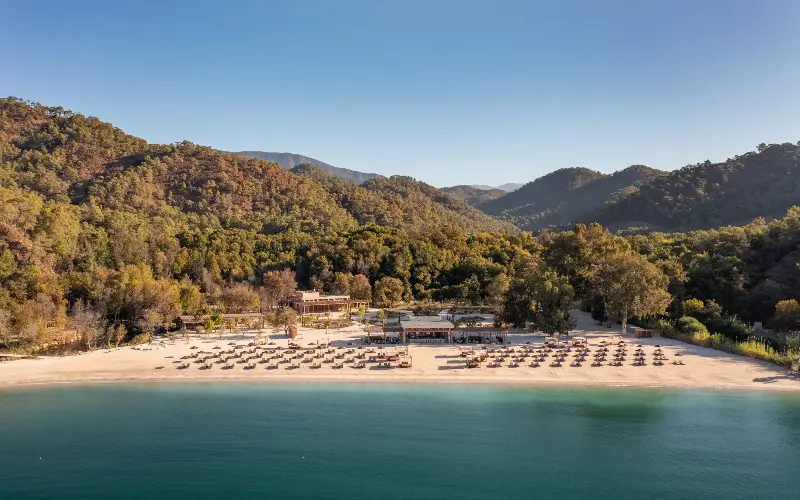
I’m not sure how many times I’ve driven past the small turning to Günlüklü Bay, off the road from Dalaman airport to Fethiye, but it’s probably dozens. Like every other tourist in this part of Turkey, I whip along the main roads between the big draws: Göcek, Dalyan, Kalkan, Olu Deniz, without ever really stopping to discover what lies between them. So, I was unaware of Günlüklü – a sheltered, undeveloped shingle bay, backed by the dense green foliage of the rare sweetgum trees that make up the Günlüklü forest (also a national park).
This time, however, I wasn’t driving past it, chiefly because the beach, or, to be more accurate, 80 per cent of it, has been bought by hotel brand Ahãma and developed into Ahãma Living – one of the new breed of ultra-high-end, barefoot-luxury resorts starting to pop up along the Turkish coast. My taxi dropped me off at the gate to the national park where I was met by a rather handsome porter, clothed head to toe in taupe linen, and trundled by golf cart through the shady woodland.
Sixty villas are dotted among the trees, although I saw little sign of them, and when I arrived at the open-sided reception pavilion, all pale stone with more linen-clad staff wafting around, I felt as if I had walked onto the set of the next White Lotus series. Across the sand, the open-air beach bar looks out over restaurant tables and a scattering of lounge chairs to the cabanas beyond, filled with couples who look to be straight off the front cover of “Oligarchs Today”. Behind, the forest canopy swathes the surrounding mountains in a deep, velvety green.
I’ve been to some of Turkey’s most upscale hotels – and the bar has been reset in recent years – but Ahãma is something new entirely, heralding the arrival of “quiet luxury”. My cabana (read: suite) was surrounded by intricately planted gardens; wafts of grass, great sprays of pink gaura, like dozens of butterflies on needle-thin stems. Inside I found a Japanese take on a Maldivian villa: the bed in the centre of the room, floor-to-ceiling windows, everything in shades of off-white.
Ahãma’s USP is that the majority of its activities – yoga in the cliff-side pavilion, sound healing, primal movement in the stone circle on the beach, Qi Gong and Tai Chi – are included. I decided to try a sound therapy session and wandered through the trees to the Sound Temple, an octagonal building specially designed to intensify the experience. My session was so popular that the ground-floor spaces were already taken, so I clambered up a ladder to the mezzanine.
What followed was an extraordinary 45 minutes. It was almost overwhelming at times; reminiscent of a 1960s episode of Star Trek at others, with crystal and Tibetan singing bowls, rain sticks and gongs. This is part of Ahãma’s wellness offering, which extends to biohacking and longevity treatments, offered in the health centre tucked away behind the forest pool. There’s a vibe here, one I’ve not encountered in Turkey before: the embodiment of the “health is wealth” mantra that’s increasingly seeping into high-end travel.
Thankfully, there are plenty of less intensive ways to restore body and mind, too. One morning I forced myself out of bed early for a spot of shinrin-yoku (forest bathing); shafts of sunlight filtering down between the trees, with red squirrels skittering past and swifts and curlews wheeling in and out of the canopy. On another afternoon, I took a paddle board out into the bay just as the sun was beginning to set, the sky flaming apricot and rose-pink against the lush green headlands. The sea was luminous; cerulean blue, flat like a sheet of glass. Afterwards I sat sipping a cold beer while catching the last of the sun.
Happily, the focus on wellness doesn’t mean there’s a monastic attitude to food. Four restaurants offer everything from elevated fine dining with a Japanese twist at Ege Umi to Mexican dishes at Mezkla on the beach. My favourite was Ay, a golf cart ride along the sand from reception, where freshly caught fish, seafood and nose-to-tail meats were slow-cooked in the embers of an open fire and served with mezze dishes rich in fresh herbs and local olive oil. Breakfasts – a smorgasbord of everything from homemade granola, rich with honey, to buttery eggs Benedict – are ordered à la carte.
It’s impossible not to love Ahãma, but, for me, it doesn’t come without a few qualms. The beach – once beloved by locals and visitors – is now almost entirely the preserve of the hotel. Twenty per cent or so is still public, but there’s little space, loungers cost £25pp for the day and Ahãma owns the beach bar there, too. A quick glance at TripAdvisor showed almost universal disappointment and anger at the small wedge of beach remaining for the public, and it left me feeling more than a little conflicted.
That aside (and if your bank balance allows), there’s no denying Ahãma is a cut above anywhere else in Turkey right now, with the first Relais & Châteaux property in Turkey now realising that form of barefoot luxury is hard to pull off. Utterly beautiful and ruinously expensive, Ahãma is proof that while the devil might have all the best tunes, the super-rich got the beaches.
Annabelle Thorpe travelled as a guest of Ahãma, which offers double rooms from £550, B&B, and easyJet, which flies from London Gatwick to Dalaman from £82 return.