



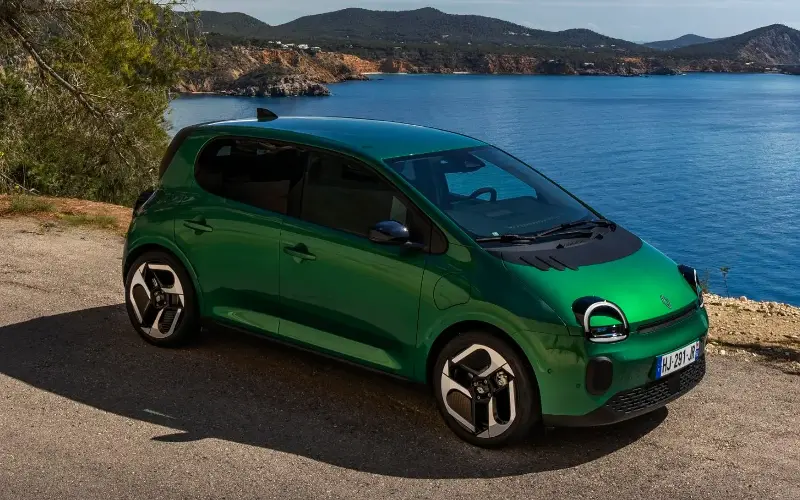
The original Twingo of 1992 was in effect a shrunken Espace people carrier, its monospace (one box) design making it very practical and spacious for such a tiny car. Renault sold 2.6 million, although it never came to the UK. The far less memorable second and third generations were sold here but the original remains the more impressive design and commands the greatest affection. As it has with modern interpretations of the 4 and 5, Renault has reinvented another of its seminal models for the electric age.
Stringent safety and emissions legislation has largely wiped out small cars, making them uneconomic to build. The Ford Ka and Fiesta, Volkswagen Up, Peugeot/Citroën C1/107, as well as the second and third-generation Twingos, have all gone. The demand for small cars remains, but few manufacturers have the courage to persist.
Battery power has got cheaper, which helps, particularly the tougher but less energy-dense Lithium Iron Phosphate (LFP) chemistry. But to make money a firm still has to be clever, share parts to reduce cost and then sell them by the bucketload.
Under the skin
This new Twingo E-Tech, for example, is based on Renault’s AmpR chassis used on the existing R5 and R4 (it will also be sold to Ford for a new battery-powered Fiesta). The Twingo has the same basic MacPherson-strut suspension as the R5 but a cheaper twist-beam rear set-up. Renault claims that, at 720, the number of parts in this Twingo is about half that of a more conventional rival, which keeps costs down.
A 27.5kWh LFP battery pack and a 79bhp/129lb ft motor drive the front wheels. To further reduce costs there’s a heating unit for the battery cells but no cooling; the software manages the flow of energy to prevent overheating. It will only charge at 50kW DC (or up to 11kW on AC) – a 10-80 per cent charge at 50kW will take 30 minutes.
The battery’s size means the Twingo’s range is quoted at only 161 miles. On a gentle run around the island of Ibiza, I achieved an efficiency of five miles per kWh against Renault’s claim of 5.1m/kWh, although on a short motorway section that figure dropped rapidly. On average terrain at moderate temperatures and low speeds, you should get about 140 miles.
Tiny – but spacious inside
At 3,789mm long and 1,953mm wide with the mirrors out, the Twingo is tiny by modern standards. It’s pretty and even if you think the smiling headlights recalling the original Twingo are over-done, there’s wit and charm such as the pert bodywork, pad-style bumpers at each end and stylish rear lights. Interior storage spaces with embossed liners deliver a quality feel.
Renault claims the Twingo is an A-segment/city car with the interior space of a larger B-segment product. That’s certainly true of the front seats, which are plumply upholstered and comfortable, if oddly shaped. There is plenty of storage space around the front occupants, as well as a couple of USB-C charging ports.
You sit quite high in all the seats, because you’re on top of the battery, of course. But it’s also because of the runners which allow the rearmost seats to adjust forward and back. Even so there’s not a lot of room in there; with the seats fully back I could just about squeeze in but my knees and head were touching upholstery.
The boot is a respectable 360 litres with the rear seats fully forward and 1,010 litres with the seat backs folded. A folding front passenger seat won’t be available in the UK.
The trim is a bit scratchy, but the embossed surfaces are pleasing, with further colour provided by body-colour trim panels in the facia and doors, some red stitching and black and white trim panels. The effect feels right and rather fun.
Renault’s touchscreen has good graphics, with the openR link system to import apps and the useful Perso button to customise the Advanced Driver Assistance Systems (ADAS) and turn off the lane-keeping and speed limit warnings. There are buttons, too, with separate rotary heater controls – again simple, but not cheap-looking.
On the road
Battery power gives this little car an advantage over a combustion alternative as the electric motor produces almost all its torque at zero revs; it will more than hold its own from standstill to 30mph. It feels brisk and nippy around town, with a decent ride quality on its soft but well-damped suspension, although the 18in wheels of the top Techno model clout bumps and potholes noisily. The 16in rims of the base Evolution trim might be a better choice.
With a kerb weight of 1.2 tons (the original Twingo weighed 720kg), it’s hefty for a small car, while the tyres and rear suspension combine to create quite a bit of interior noise. That said, the sub-10m turning circle and good visibility from the driver’s seat make it easy to park.
Speed up and it’s a much better drive than it has a right to be, with light and accurate steering and quite a responsive feel in roundabouts and tight corners. The tyres get quite vocal if you push too hard, but it’s fun to drive briskly.
The brakes feel strong and there are steering wheel paddles to increase and decrease regeneration braking and a one-pedal operation, although it isn’t very convincing since you never quite know how much braking effort it will deliver.
Prices are yet to be announced, but Renault says rivals will be the Fiat 500e, Hyundai Inster, Citroën ëC3 and BYD Dolphin Surf. I’d also add the £14,995 Dacia Spring and the Leapmotor TO3, from £15,995.
Yet Renault has strongly indicated that the Twingo will cost from £18,000 and it hopes it will qualify for the full government grant of £3,750 – if so, the base Evolution could cost from nearer £14,000. The Techno will cost an additional £2,500.
The Telegraph verdict
History tells us that the best small cars come out of hard times. The Austin 7 from the financial crash in the 1930s, the Volkswagen Beetle, Citroën 2CV and Fiat 500 Nuova after the Second World War and the Mini from the Suez crisis. Is our troubled, war-torn planet now ready for the return of the small car? What’s more, are our legislators ready to help by reducing the cost of roadside charging and improving its availability?
You can’t save the planet by simply buying more stuff, but as a second car the Twingo would take a lot of weight off a larger, combustion-engined family car.
While it’s cheap it is by no means an austerity choice. It drives and rides pretty well, has just about enough range and, above all, it’s fun.
Cometh the hour cometh the car? It certainly seems that way.
Telegraph rating
The facts
On test: Renault Twingo E-Tech Electric Techno
Body style: five-door city car
On sale: summer
How much?from £18,000 (estimated); Techno another £2,500
How fast? 81mph, 0-62mph in 12.1sec
How efficient? 5.1 miles per kWh WLTP, 5m/kWh on test
Powertrain: 27.5kWh lithium-iron phosphate battery, single permanent-magnet synchronous motor, front-wheel drive
Range: 161 miles (WLTP), 140 miles on test
Charging: 50kW DC fast charging, 10-80% in 30min, 10.5kW on-board charger
Maximum power/torque: 79bhp/129lb ft
CO2 emissions: 0g/km (tailpipe), 18.8g/km (CO2 equivalent well-to-wheel)
VED: £10 first year, then £200
Warranty: three years/100,000 miles, eight years/100,000 miles on battery
The rivals
Citroën ë-C3, from £19,995
Charming and spacious, but the base model only has a 30kWh battery and a range of 130 miles. Better is the £22,095 44kWh model, with 202 miles. Both are eligible for the lower of the two government grants of £1,500.
BYD Dolphin Surf, from £18,675
Battery sizes of 30kWh and 44.2kWh offer 137-200 miles of range, but the top model is almost £24,000. A four-seater with decent space, but it’s noisy, bouncy and the touchscreen and advanced driver assistance systems (ADAS) will send you crazy.