



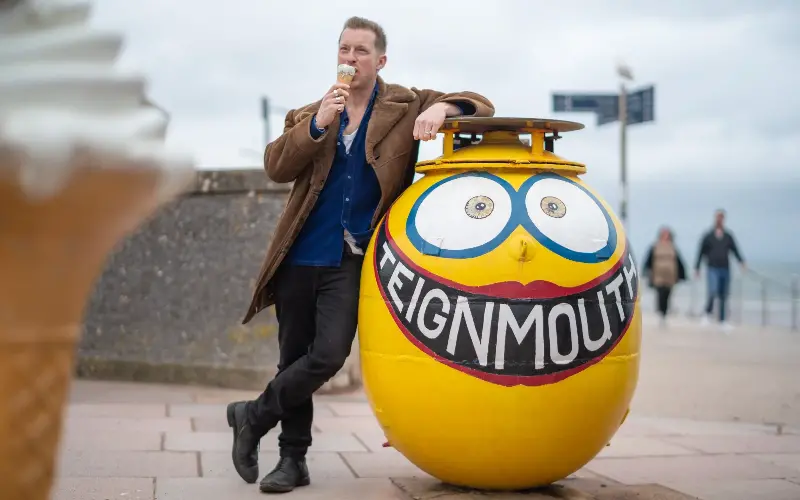
All summer, Telegraph Travel will be taking the pulse of Britain’s seaside towns, examining the efforts being made to regenerate them, and reflecting on whether they are still worth visiting. This week: Gavin Haines visits Teignmouth.
“It’s like California, but with less blue sky and no guns,” quips Canadian-born Sophie Watson, as she stokes the fire at the Devon Community Sauna on Teignmouth seafront. “I’ve lived all over – in Canada, Ireland and England – and this is my favourite town.”
The Californian comparison is lost on me, but I nod along anyway; Teignmouth has put me in no mood to quarrel. I look around, at the merry day-trippers eating ice cream on the prom, at the prim Georgian properties along the seafront, and at the towering cliffs tumbling down to the red beach below, and a wave of contentment washes over me. There’s nowhere like the English seaside.
Yet while many British coastal towns have withered in that familiar way, Teignmouth has bucked the trend. A fishing village, port and one-time smuggling hub turned trendy Georgian resort, it “never really faded”, says Watson, a writer and part-time sauna host.
Keeping the port going has helped. Though small, it still exports clay, timber and grain, supporting vital jobs. It gives the town a light-touch industrious energy, a lived-in feel; Teignmouth is a real place, not some second-home honeypot that empties every winter.
“It’s got a buzz all year,” says Watson, who settled here during lockdown. “The community is strong. My neighbour brings me fresh fish four times a week; there are writer groups aplenty, great pubs with music and endless festivals.”
What’s it really like?
That I can’t walk past an estate agent’s without eying up the properties and thinking about my retirement is telling.
Teignmouth’s setting is sublime. Located at the mouth of the River Teign as it empties into the Channel, the town has a quietly dramatic coastline characterised by towering red cliffs that run all the way to Dawlish. The railway that hugs this stretch of shore is one of Britain’s most scenic.
Parts of Teignmouth town centre have a dated feel and there are some empty shops, but new businesses are popping up. Among them are Halulu, a cocktail bar with occasional DJ sets on the prom, and Teign Street Kitchen, which serves bao buns and Vietnamese bánh mì sandwiches next door.
The latter was opened last year by husband-and-wife team Nina and Geoff Hookins, who returned to Teignmouth after running a restaurant in France. “There’s always a nice vibe in town,” says Nina.
Seaside clichés are in short supply in Teignmouth, which, unlike nearby Torquay and Paignton, never went big on kiss-me-quick nostalgia. The not-so Grand Pier (more on that later) is the obvious exception.
Birthplace of rock band Muse, Teignmouth has a sometimes surprising backstory that’s told in Teign Heritage, a small museum opposite the station. The Pavilions, a modern, seafront arts centre, has regular gigs and shows, while local bands do the pub circuit.
The miles-long main beach is beautiful, but most locals head to the quieter back beach, where pint-clutching punters at the Ship Inn spill onto the sand. Nearby, a ferry takes foot passengers over to Shaldon, a pretty, well-to-do village just across the river.
What’s not to like?
The ironically named Grand Pier, or what’s left of it, looks utterly defeated by the world. During recent winter storms, the sea chewed the end off it and spat it back out again further down the coast.
A GoFundMe page has launched to help finance its reconstruction, but had raised just £10,000 of its £250,000 target at the time of writing. You wouldn’t bet against more of it disappearing in the next storm.
Speaking of betting, that’s the pier’s only real draw these days. Inside, slot machines and penny pushers make promises of riches and break them. They say that the house always wins, but this place is on a losing streak against the elements. Locals lament that it’s been left to go to ruin. “People are angry about the pier,” says Hookins.
Another landmark whose future hangs in the balance is the lido. Councillors voted to close it in February to save cash, sparking outrage which led to a U-turn. It reopened on May 23, for this summer at least.
You have to feel for young people in the town, too. A lack of jobs and high house prices are leading to an inevitable brain drain, locals tell me.
Do this
Launched in 1296, the Teignmouth to Shaldon Ferry claims to be the oldest in Britain. The current boat entered service in 1947 and, per tradition, has faux gun ports painted on the side to scare off the French. “During the Napoleonic wars, the French sacked Teignmouth,” explains skipper Ian Taylor.
Shaldon is “like a movie set”, according to the Canadian tourist sat next to me on the ferry back, or “posh and full of Londoners”, according to the Brummie bloke sat on my other side.
Either way, it’s charming, with pretty Georgian cottages, manicured gardens and plenty of pubs. There’s a beach, too, accessed via an eerie smuggler’s tunnel that runs through a hulking red cliff known as The Ness.
But don’t do this
Eat anything in public without being ready to act in self-defence against the gulls. “They are vicious – they literally take food out of children’s hands,” warns Watson.
Eat this
England’s largest fish market, Brixham, is just down the road, which means Teignmouth gets some of the freshest seafood in the land. Serving it up with particular panache is Catch 22, a new seafood restaurant overlooking back beach. The menu changes daily, albeit with some staples, notably fish and chips, which is up there with the best I’ve tasted.
From a local
“I was diagnosed with PTSD a few years ago and living here helps with that,” says Bill Watson, an ex-Marine originally from Glasgow. I meet him and his partner Jane Beveridge on the main beach, where they are walking their hounds, Arlo and Betty.
“It’s a lovely town, the people are so friendly,” adds Beveridge, who is originally from Cornwall, and proves her point by inviting me to their beach hut for a beer.
“We see a lot of dolphins and porpoises from here,” says Watson, looking out to sea. “It’s relaxing. There’s a group of ladies who come down here every morning to swim and sing. They call themselves the Blue Tits, I kid you not.”
From a tourist
“It’s beautiful, I love the red sand, but it’s never sunny when I visit,” says Esther Demery, a teacher from Windsor, as clouds roll in. Demery is down here visiting her mother and stepfather. “They’re happy in Teignmouth, it’s bringing them a lot of joy.”
Stay here
Teignmouth has lost many of its old hotels and those that remain look a bit tired. Instead, take the ferry to Shaldon and The Ness (named after the nearby landmark). Occupying a handsome Georgian villa at the mouth of the Teign, it has exquisite views and a pub downstairs serving real ales, cocktails and food. Nearby are a wildlife park and those smugglers’ tunnels to the secret beach. Rooms from £106 per night.
Get there
Trains to Teignmouth come directly from London, Birmingham and Bristol. The final stretch along the coast is one of Britain’s most scenic railway journeys.