



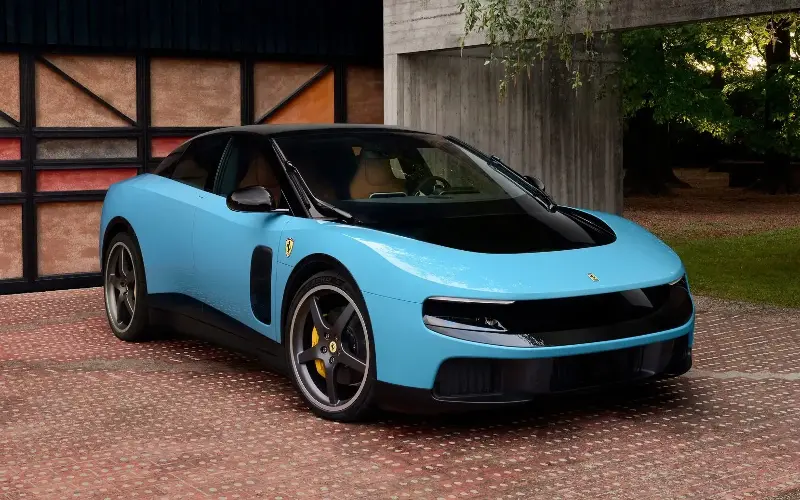
As Ferrari geared up to launch its first electric vehicle, its executives must surely have convinced themselves they were on to a winner.
Ferrari, probably the most glamorous name in the global auto industry, certainly threw everything it could think of at getting its first all-electric car absolutely right.
It had the power you would expect from a sports car manufacturer, with a remarkable zero to 62mph in just 2.5 seconds, a top speed of close to 200mph and a range of more than 300 miles.
It has the brand heritage that comes from making some of the world’s finest cars. And perhaps most importantly of all, it hired Sir Jony Ive, the British designer behind the iPhone and the Apple Watch, to give it a sleek new look.
With a €550,000 (£480,000) price tag, the Luce was definitely not a lawnmower on wheels like some of its competitors.
It didn’t work out as planned, however. In the Italian press, the car was widely ridiculed. It looks like a souped-up Nissan Leaf, according to one critic, while Luca Cordero di Montezemolo, the company’s former chairman, said it risked “destroying the myth of Ferrari” and that it should be stripped of the famous prancing horse logo.
Benedetto Vigna, the current chief executive, tried to defend the launch, arguing that “innovation had to be paid for”, but the damage had already been done. The company’s share price fell by 6pc on the news, and it is very hard to see that many people will be rushing to spend half a million euros on the car now.
Sure, car launches go wrong all the time. Not every new model is a big success. But a pattern is starting to emerge here. When Jaguar launched its latest radically redesigned battery-powered car, now known as the Type 01, it was widely mocked as a Barbie-mobile that had none of the brand’s sleek good looks or sporty heritage.
Production of the Porsche Taycan had to be suspended after weak demand and collapsing resale values, while the odd-looking BMW i3 looked a lot more like a high-end golf buggy than a Beamer and production of that model ended up suspended as well.
Add them all up, and one point is starting to become very clear. When Europe’s luxury auto manufacturers try to muscle their way into the electric vehicle market, something is going badly wrong.
In reality, two big mistakes keep being repeated. First, when they attempt to move into battery-powered cars, they think too radically. Hiring Ive to design a Ferrari may have seemed like a good idea at the time, and if he had ever produced the long-rumoured Apple car he might have come up with something sensational. But the Luce is too big a departure from what we think a Ferrari should look like.
Likewise, the Type 01 has none of the elegance and power that we associate with a Jaguar. It is already a big step to replace the petrol engine with an electric one. There will always be some resistance from consumers. It would make far more sense to keep everything else as familiar as possible to ease the transition into a range of new models. Instead, they are going too far, too fast.
The result? The manufacturers are making too many mistakes.
They are also trashing their heritage. There is nothing wrong with breaking with the past. All the major manufacturers have done that several times in their history, and there is no reason why they should not be able to repeat the trick all over again.
But they need to find a way of doing so while also preserving the qualities that made them special in the first place. If BMW is not proud of its engineering history, and if Ferrari doesn’t think its power image is worth preserving, then it is very hard to understand why the companies think anyone else should care.
Right now, Europe’s car market is being flooded with high-quality Chinese EVs at very low prices. Completely new brands such as BYD and Cherry took 6pc of the Continent’s auto market in the first three months of this year compared with only 3pc in the same period last year.
Even with the European Union retreating into tariffs and quotas, it is growing all the time. Within a few years, the new Chinese players may well completely own the market, as they already do in their own country. Even if the switch to EVs stalls, they have been allowed into the market, and it will be hard to stop them now.
Europe’s luxury auto makers have great brands. But when they launch an EV their brains get scrambled. They think they have to produce something radically different. That is not what the market wants. The real prize is for EVs that have all the heritage and performance and prestige of a Jag, a BMW or a Ferrari, but with a battery under the bonnet instead of the traditional spark plugs.
None of the major manufacturers appears to have realised that yet. Instead, they keep trying to design a car that looks bold and new, and end up falling flat on their faces. The emerging Chinese giants have sensed that weakness and moved far faster to come up with a range of models that have genuine appeal.
With the launch of cars like the Luce, Ferrari is handing them the auto industry on a plate. That needs to change very quickly if they are to have any serious chance of surviving the next decade.