



It’s late on a summer’s evening and I’m on an unusual safari. Our small group has gathered in a particularly pretty glen beneath heather-clad moors in the northern reaches of the Isle of Man. As we set off and ascend a steep trail through towering pine and beech trees, our guide, Andy, points out various wild plants – bramble, blaeberry, wood sorrel – and tells us about their medicinal properties. It’s a gentle prelude to encountering the mammals that we’ve come here to see.
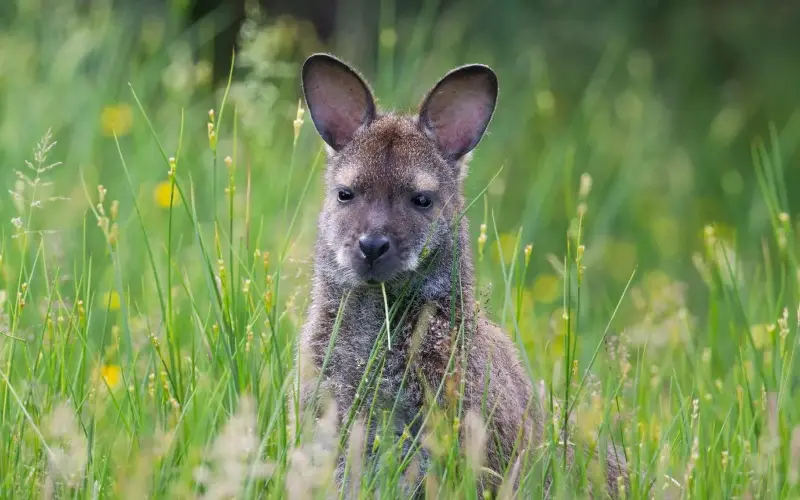
“There’s one,” says Andy suddenly, pointing up to where the path levels onto a plateau. The creature looking back at us is alert and upright, ears pricked. Its face is framed by a strip of white fur and its front paws are darker than the rest of its body, making it look almost like it’s wearing gloves. It looks around before bounding away on its hind legs, tail held high, leaving us enthralled – if not slightly bemused – for having bumped into a wild wallaby.
I’ve seen some amazing wildlife in or near the British Isles over the years – from whales in Scotland to great bustards in Wiltshire and basking sharks here in the Isle of Man – but wallabies, being from the other side of the world, are perhaps the most extraordinary. This particular species, the red-necked wallaby, hails from Tasmania, where the cooler, wetter, temperate climate is not so dissimilar to ours here in Britain.
Throughout the 20th century, escaped individuals formed naturalised populations across the UK, from Loch Lomond to the Chilterns and down into Surrey and Sussex. I remember my amazement at seeing them in a book on British wildlife when I was a child. Some populations (notably the Peak District’s) seem to have since died out, but over on the Isle of Man they’re positively thriving.
“There’s something like 1,200 of them, mostly here in the north of the island,” says Andy, as we continue on the trail in the fading light. “But they’re generally nocturnal, which makes them easy to miss if you don’t know where to look.”
Seeing these Manx macropods is not the only highlight of Andy’s Wild Wallaby Wander (£20pp; happyexplorer.co.uk). As dusk sets in, he leads us to a ruined farmstead where we take a break beside its tumbledown stone walls. He produces a flask and pours us each a cup of herbal tea made with hawthorn flowers and other foraged botanicals.
As we sip, our attention is drawn to a thrush’s song and the hoot of a short-eared owl. The light fades around us. It’s a wonderfully mindful-in-nature moment that Andy makes all the more special by pulling out a flute and playing Manx folk tunes in the darkness. I wonder if, long ago, before these buildings were abandoned, their residents might have also spent summer evenings like this.
When the tour concludes, it’s a 10-minute drive back to Ballaugh, where I’m staying. The village is famed for its bridge, which would be rather unremarkable were it not on the route of the annual TT (Tourist Trophy) motorbike races – the island’s signature event, which is currently taking place. Its humpback shape sends riders airborne, making it one of the course’s most dramatic spots.
Outside of the races though, Ballaugh offers a peaceful hideaway. My holiday cottage, stone-built Glaicke Beg, is a converted two-storey stable beside a stream whose cheerful babble adds considerably to the charm. With a shop and a pub at the end of the lane, it’s a brilliant base for exploring this part of the island.
It’s also only a five-minute drive from Curraghs Wildlife Park, where the island’s wild wallaby story began. The first animals escaped from here sometime in the 1960s and found the surrounding Ballaugh Curraghs wetlands to their liking.
“This is ground zero for wallabies,” says Graham Makepeace-Warne of the Manx Wildlife Trust when he shows me around. We follow a boardwalk across a mix of waterlogged, mossy willow scrub and grassy meadows that will be ablaze with orchids by mid-June. “A recent survey found around 600 wallabies at Ballaugh Curraghs alone.”
Locals have so far been tolerant of this invasive species, but how, I ask, do wallabies impact on the bigger picture? “For sure there’ll be grazing pressure on wild plants, and there’s evidence they might carry parasites,” Graham reveals, “but, on the whole, people really appreciate seeing these charismatic animals.”
He believes the wallabies have an important role to play here. “By being so unusual, they are definitely an attraction,” he says, “and anything that inspires people to engage with nature is a good thing. It has a positive knock-on effect for our wild spaces and native wildlife, which, to my mind, are the Isle of Man’s biggest draw.
“We’re the world’s first whole-nation Unesco Biosphere Reserve, with beautiful coastlines and countryside filled with easy-to-see birds such as hen harriers and choughs, plus dolphins, seals and of course the quirk of the wallabies. It gives us such enormous potential for wildlife tourism.”
How to do it
James Litston was a guest of Visit Isle of Man. The Isle of Man Steam Packet Company sails to Douglas from Liverpool, Heysham and Belfast (return Liverpool crossings from £52 for foot passengers or from £197 for a car). Island Escapes has more than 150 self-catering accommodations, including Ballaugh’s The Glaicke Beg, where a five-night stay costs from £750. Find more information at visitisleofman.com.