



Public art is often – and deservedly – the object of derision. The Orbit Tower in the Olympic Park, by Anish Kapoor and Cecil Balmond, was damned as an example of “fascist gigantism”. Thomas Heatherwick’s B of the Bang for the City of Manchester Stadium was expensive, pointless (though spiky), dangerous and poorly designed; it lasted less than four years before being sold for scrap. Sheffield’s Bowie mural, mercifully removed in 2022, was hilariously bad – less Aladdin Sane, more cross-eyed dimwit.
Some art is so bad it can’t get off the drawing board. Plans to build a giant “Baa Baa Black Sheep” sculpture, designed by Peter Naylor, on a busy roundabout were recently scuppered by a council in Yorkshire as potentially leading to “unacceptable impact on highway safety”. Locals deemed it “at best, irrelevant” and “absolutely ridiculous”.
But it’s not all awful. Here are 10 worth a look if you’re visiting, and 10 to avoid – or have a laugh at.
10 public art icons
Peace Wall, Belfast
Once a symbol of bitter division, the 21 miles of high barriers separating Catholic and Protestant communities have evolved into a complex and multi-faceted medium for local storytelling, mixing history and memorialisation, politics and powerful artistic statements.
Uffington White Horse, Oxfordshire

The oldest and most distinctive hill-figure (or geoglyph) of a horse in Britain, the Uffington White Horse appears in mediaeval documents, but scientific dating has demonstrated it was originally carved during prehistory. Its eye-catching, poetic, almost abstract shape features a beaked head, similar to horses depicted on ancient coins. Measuring 374ft and owned and managed by the National Trust, the horse was the subject of a bid in 2011 to re-label it as a unicorn.
The Dream, St Helens

When the miners at St Helens were asked to provide suggestions for a monument to their tough, dangerous profession, they rejected ideas like giant lamps or figures hacking with picks at a seam. Instead, they opted for Jaume Plensa’s calm, meditative, elongated bust. In shimmering dolomite, the girl’s head is on top of a former slagheap above the shafts of Sutton Manor colliery.
Another Place, Crosby

Staring at the horizon across the sea is a national pastime (perhaps because the water is generally too cold for swimming). The 100 figures created by Anthony Gormley give the flat expanse of sandy beach scale and drama while replicating in an eerie fashion our own vague longings.
The Kelpies, Grangemouth

Rearing up beside the M9 between Falkirk and Grangemouth, this pair of monumental steel horse heads by sculptor Andy Scott represents kelpies: mythical shape-shifting spirits said to inhabit Scottish lochs. Each head is 98ft high, making these the biggest equestrian bronzes in the world – though Turkmenistan claims it has a bigger one.
Stand and Stare, Newport

This beguiling bronze sculpture was erected to commemorate the life and work of local author W H Davies, known as the Welsh “Supertramp” for his travels around the US and to London. The name of the work is taken from the best-known lines of his poem Leisure: “What is this world if full of care/We have no time to stand and stare”. Seagulls sit on Davies’s figure, ready to join him when he takes off again.
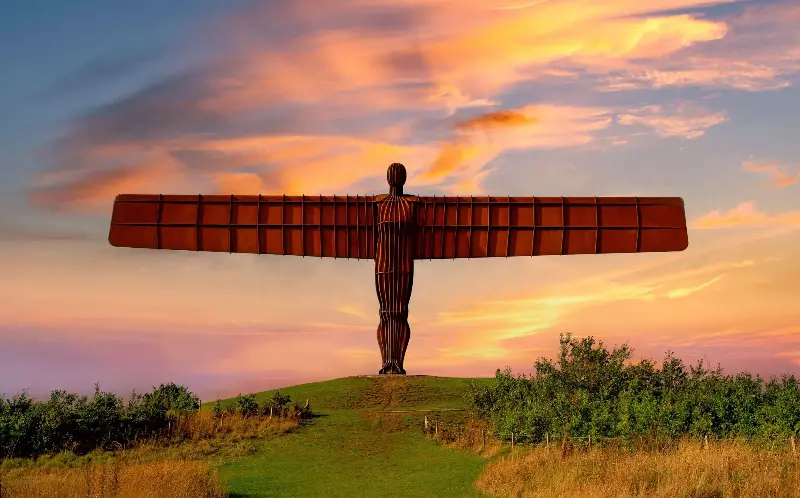
Angel of the North, Gateshead

Gateshead’s oxblood-coloured non-religious angel of steel has been standing over the A1 since 1998. Almost from the start it was a magnet for photographers and a symbol of home for drivers heading back to the North East. The trees around its base have become a full-blown shrine, their branches decorated with memorials to lost loved ones.
Duncan Edwards Statue, Dudley

Duncan Edwards is remembered in Dudley and beyond as a figure who represents football before the onslaught of celebrity, globalisation and big money. He died on February 21, 1958, aged just 21, following injuries sustained in the Munich air disaster. Considered one of the greatest players in the English game, he earned 18 caps for England and played 177 times for Manchester United across league and cup matches. This statue shows his right leg swung back as he prepares to boot the ball down sloping Castle Street.
Llywelyn ap Gruffydd Fychan, Llandovery

Public art sometimes pops up in unexpected places. People parking in the Castle Car Park in Llandovery, Carmarthenshire, get caught out by the figure of Llywelyn ap Gruffydd Fychan standing proud on a tump. Llywelyn was publicly executed here in 1401, in front of England’s Henry IV, for supporting Owain Glyndŵr’s war of independence. Dubbed the “Welsh Braveheart”, he remains fearsome in steel, the empty helmet adding to the aura.
Bolt of Lightning, Burtonwood

This new work by Peter Naylor – the same sculptor behind the axed sheep project – honours the role played by Burtonwood Air Base during the Second World War, the Berlin Airlift, and right up until 1994. Originally an RAF base, it was taken over by the United States Army Air Forces (USAAF) from 1942-46, by the United States Air Force (USAF) from 1948-1965 and by the US Army (as a storage depot) from 1967-1994. The 74ft-high sculpture depicts a Lockheed P-38F Lightning fighter plane, as used during the Second World War.
10 public art eyesores
Harry Kane Statue, Walthamstow

Completed in 2020, unveiled in 2024 – the delay because of a lengthy search for a suitable site – this “likeness” dates from the footballer’s long tenure at Tottenham Hotspur FC; its artistic merits, however, are more an allusion to the team’s current performance.
Jubilee Crown Roundabout, Larne

So naff it’s almost kitschy cool – but not quite – this 26ft-tall crown, placed here for Elizabeth II’s Diamond Jubilee, looks like most golden-hued objects look: tacky.
Couple, Newbiggin-by-the-Sea

When any two strangers indulge in overt, self-conscious romantic posturing, it is always vomit-inducing. When art freezes the deep, cod-meaningful shared look out to sea and dresses it in contemporary high-street fashion, the effect is multiplied.
The Shuttle, Nelson

Cotton mills were noisy, dangerous, hot, sweaty places to work in. Shuttles flew back and forth across hundreds of looms side by side, pulling the weft between the warp, hissing and clacking. This vertical mega-shuttle, in the main square in Nelson, East Lancashire, points in the wrong direction and captures none of the energy or power of the textile era.
Sonic Bloom, Mayfair

Sounding like a fungoid ear infection, this “interactive, multi-sensorial installation” by Yuri Suzuki is a site-inappropriate exercise in primary-colour mass infantilisation.
ArcelorMittal Orbit, Stratford

The brand, the slide and the meaninglessness of the entire architectural gesture: the helter-skelter-y, confused-looking and style-bereft Orbit is, perhaps, a monument to the legacy promises of the 2012 Games.
Church Stone, Basingstoke

This hand-carved work was commissioned to commemorate the Emmanuel Church that stood here. It isn’t helped by the context – garish frontages of drab shops – but the shape is somewhere between a mushroom and a phallus, leading to the local nickname “Wote Street Willy”.
Giles Statue, Ipswich

Was the cartoon character Giles ever that funny? This squat, Weeble-like figure is a lumpy stump of dull stone, detracting from the town’s surprisingly handsome civic architecture.
Richard III Statue, Leicester

This life-size statue of the infamous monarch seems to be climbing a non-existent hill while torn between whether to stab someone with his sword, throw the crown like a frisbee or try to get a tune out of it.
The Hare and the Minotaur, Cheltenham
These figures on a bench, made from repurposed scrap metal, reduce one of the UK’s most incredible wild animals and one of mythology’s most mysterious creatures to a sub-Alice in Wonderland cutesy day out with all the potency of two senior citizens chomping on their ham sandwiches.