



As the clanking Metropolitan line train canters over the same tracks it has done for more than a century, the landscape subtly shifts. The dense development of London gives way to the ubiquitous semi-plus garden – rows of houses that look like two people sat next to one another on the bus.
The Metropolitan line was London’s prestige railway: the first to go beneath the city, and then a pioneer of suburbanisation, bringing commuters from the outskirts into Baker Street and Aldgate. Beyond Wembley, you reach “Metro-land”, as it began to be branded a century ago. The Met extended its lines, and circulated swish brochures that showed how close your house could be to both a railway station and a golf course.
Harrow was dubbed Metro-land’s “capital”. Its station has jazzy, curved waiting rooms and Crittall windows that look like they’re dancing a perpetual Charleston.
Onwards into south Buckinghamshire, it becomes greener. Chesham is the furthest station from London, but the Metropolitan line once cockily continued beyond, to Aylesbury, Verney Junction, Quainton and Brill. In Chesham, I do part of the Chess Valley Walk, in the lovely Chiltern Hills, then dive in for 10 lengths at Chesham Moor Lido, a beautiful pool open year-round and dating back to the 1890s.
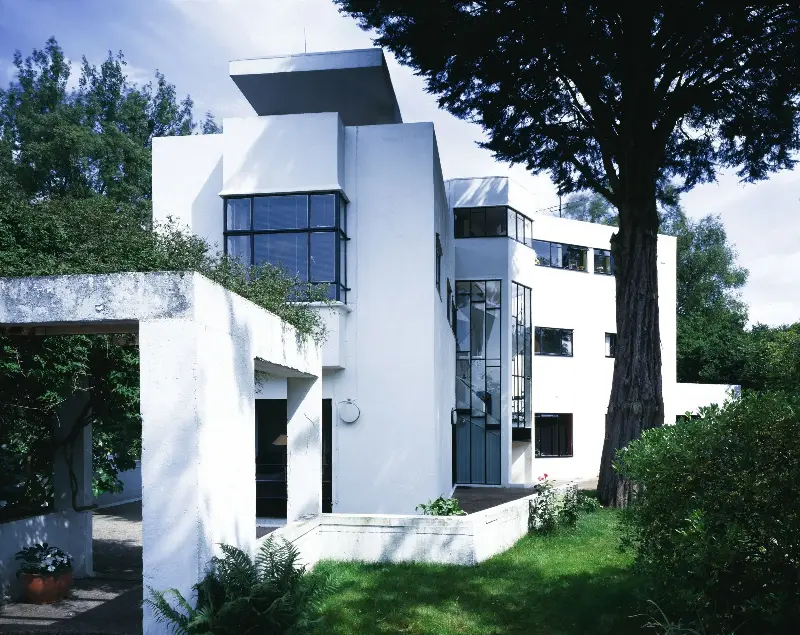
Comedian Claire Cox grew up in Chesham. “When I was 17”, she says, “my dream was to own High & Over in Amersham, a 1930s modernist country house, which is possibly the most Metro-land aspiration someone could have”.
An art-deco wonder
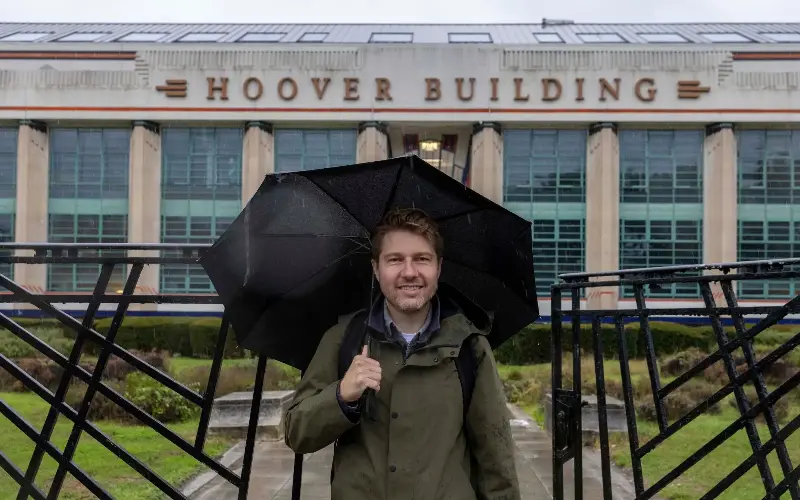
Down at Perivale is one of Metro-land’s best-known sights. The flamboyant former factory of Hoover dates from the 1930s, when rival Henry was merely a speck of dust in his mother’s eye. As the rain buckets down, Deliveroo drivers sprint into the Tesco that now occupies the building.
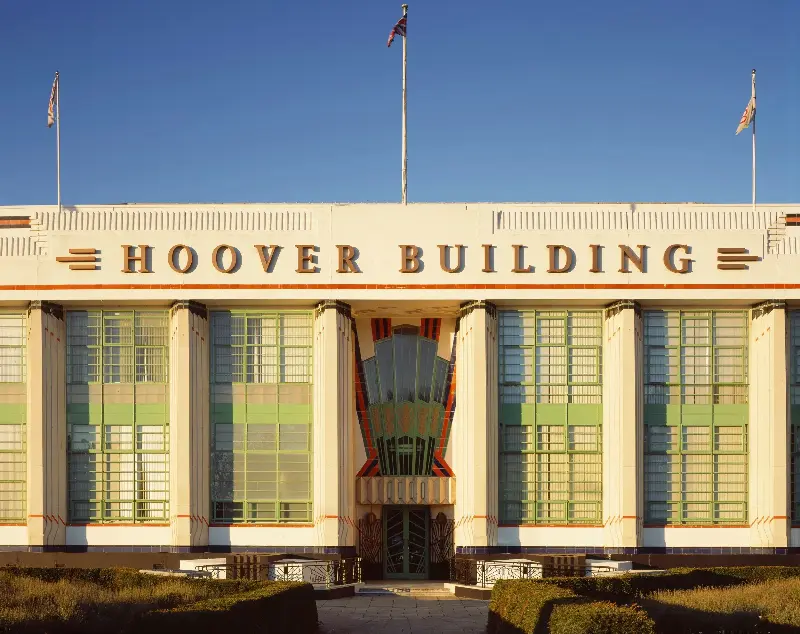
“It’s good they haven’t knocked it down,” says shopper Anne Beasley, as we chat under an art-deco awning next to a chrome uplighter. “They knocked down everything else.”
Anne adds: “They have an open day. There are penthouses upstairs… but they are a bit small.”
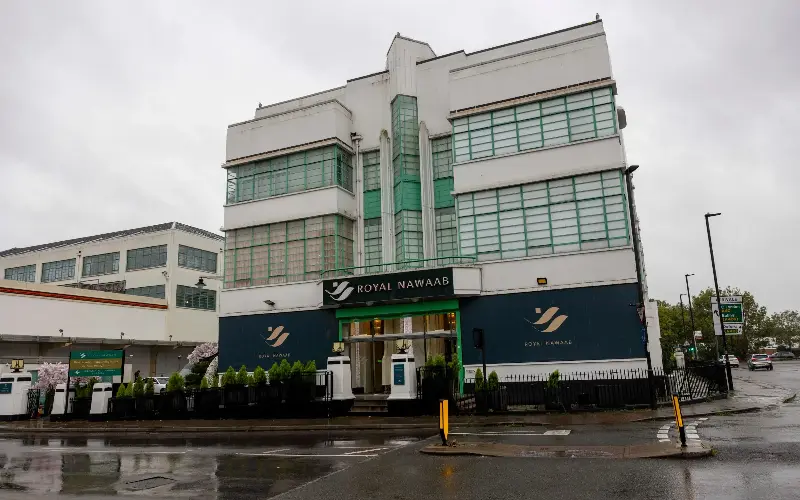
The former staff canteen is now a branch of Royal Nawaab, a restaurant chain set up by Mahboob Hussain, who arrived in Bradford from Pakistan in 1969. I offer to take a photo of a British-Asian family, there to celebrate a birthday, by the fountain. “We’ve come from south-east London,” the father tells me. “A two-hour journey!”
I hop on one of Transport for London’s new Superloop buses, designed to better connect the outer suburbs. The windows are fogged. The overheated, musty atmosphere instantly takes me back to childhood swimming trips, eating KitKats and drinking orange squash on the journey back to school.
Through Yeading and Hayes we pass countless barbers, takeaways and tyre shops, and yet more semis. The rain-soaked traffic is terrible, the smell of a steaming chai livening up the bus. Heathrow’s mid-century American-style hotels along Bath Road – such as the Renaissance and Sheraton Skyline – look straight out of Palm Springs.
A motorway world
Sir John Betjeman popularised the Metro-land moniker, and districts like Kingsbury, north of Wembley, were highly desirable. Writer JG Ballard lived in an art-deco semi in Shepperton, Surrey, with his Ford Granada parked in the drive, and wrote about the bizarre, brutal realities of our newly extruded motorway world.
Semi-detached houses were also constructed by local authorities on estates like the gargantuan Becontree, near Dagenham, east London, and in time this style became less aspirational.
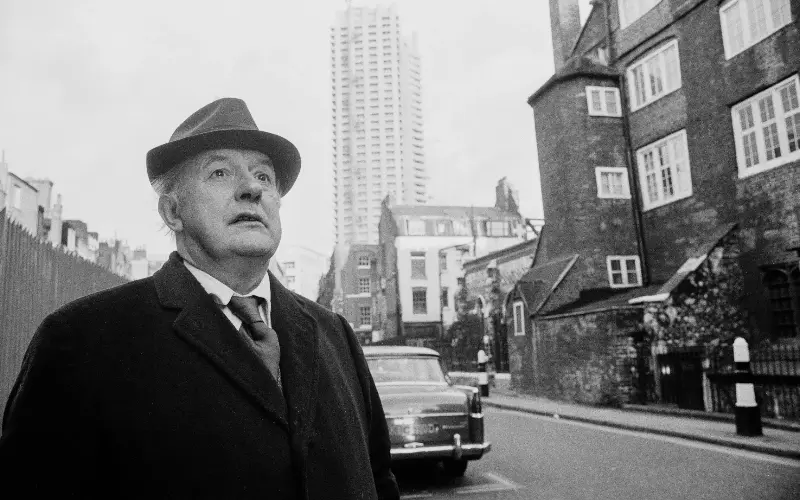
As London sprawled, Ian Nairn caught the national mood in the infamous 1955 “Outrage” issue of The Architectural Review, where he lamented that he could drive from Southampton to Carlisle and every suburb would look the same. He coined a word for the new ubiquity he saw: “Subtopia”.
I head on to Uxbridge, and Brunel University. One of the “new universities” of the 1960s, it is famous for its striking, brutalist lecture theatre building, designed by John Heywood of Sheppard Robson. This tough lump looks overwhelming on a rainy afternoon with no-one else around, and you can understand why Stanley Kubrick chose it as a gritty location for his adaptation of A Clockwork Orange in 1971, which he also shot at Elstree and Radlett.
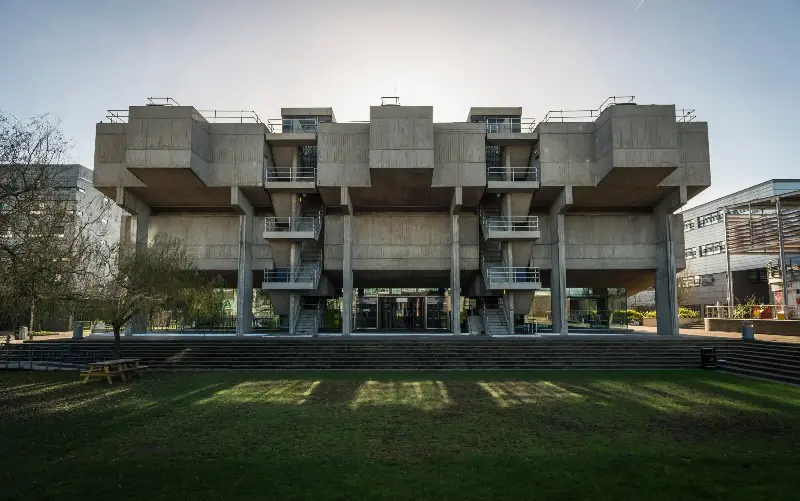
The last student of the day walks out of the building, and tells me there’s no way I can get in to look around. I ask for her verdict on the imposing structure. “I don’t mind it,” she says, “but there’s other buildings I like more.”
Finally, I take a look at the incredible 1969 K-Garage (now a Nissan dealership), at the end of the M1, and another brutalist behemoth, Brent Cross Shopping Centre. Cars and motorways were one reason Metro-land waned. Now we could live further away, in the green and pleasant Home Counties, and commute fast by road on the Westway.
Metro-land lived on, however, as a moniker. And not just for Middlesex and South Bucks, but for all of London’s banal – and sometimes bizarre – outer reaches, some of them wearying, but all with architectural treasures waiting to be stumbled upon.
Five more sights on London’s ‘Metro-land’ fringes
1. Southgate Tube station
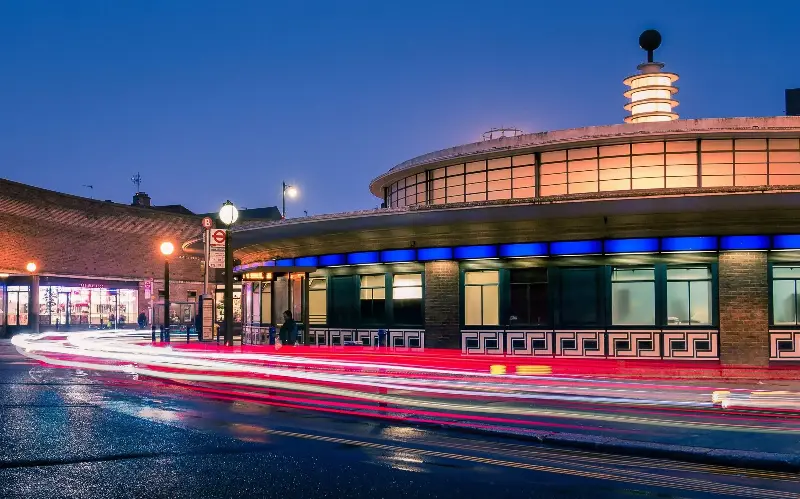
Charles Holden became famous for his incredible Tube stations, and everyone has their favourite. Cockfosters, Arnos Grove and Osterley have their fans, but for many it has to be Southgate. Its 1933 UFO-shaped roof, topped with what looks like an illuminated electrical transformer from a substation, oozes techno-futurism. A fascinating postscript to the Southgate story is its cousin Feuerbachstrasse, which opened in Berlin just eight weeks later on the city’s north-south S-Bahn line. It shares striking similarities, and was the work of Richard Brademann. The design was said to be a coincidence, though apparently Holden had been in Germany in the early 1930s looking at their functionalist industrial architecture.
2. Wembley Arena
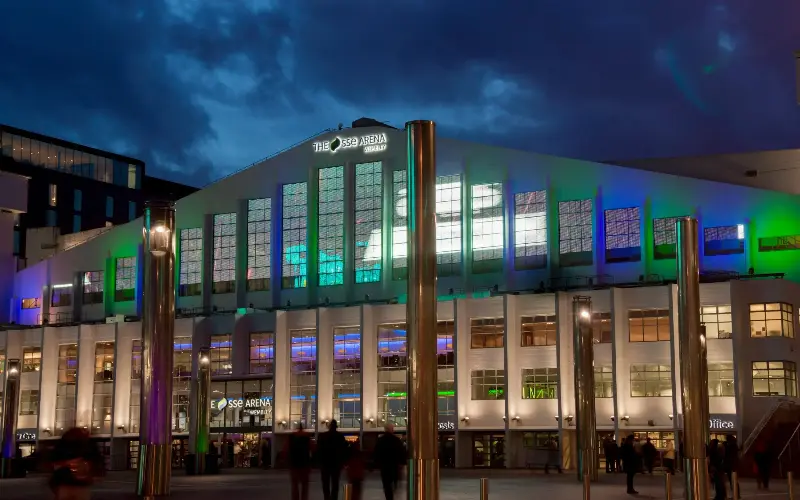
Wembley was one of the new suburbs that thrived as part of Metro-land. The Metropolitan line enabled fans to travel to big sports and music events, just as it does today. The 1934 British Empire Games were the catalyst for the music venue we know today as Wembley Arena. It started life as a pool for the 1934 Games, and then was used again at the 1948 Olympics. Sir Owen Williams was an engineer and so there’s more of a gutsy vibe than the art deco flourishes you might expect. Williams also designed Birmingham’s Spaghetti Junction and another London curio, Peckham’s Pioneer Health Centre.
3. Gants Hill station and Newbury Park bus station
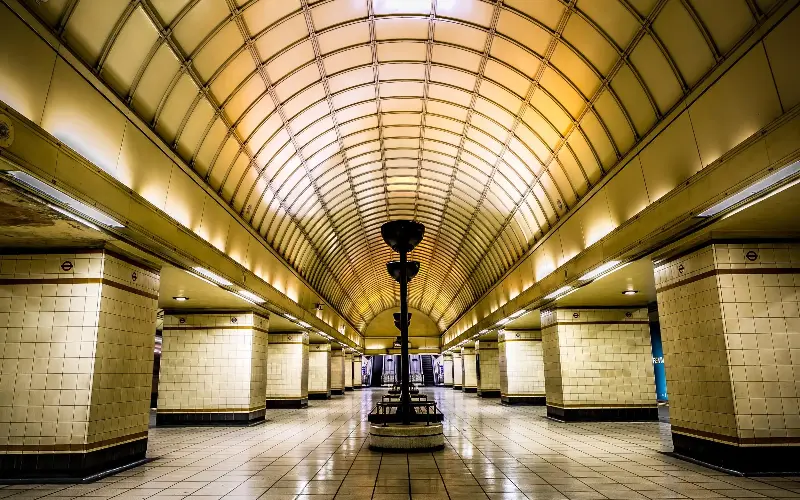
You can travel the world without leaving London. Mile End Tube station looks like a Brooklyn Subway stop and Gants Hill looks like the Moscow Metro, with its barrel-vaulted ceiling dating from 1947. Metro-land’s trains are oft-cited, but what about its buses? These Cinderella workhorses ferried people from Tube stations to farther-flung suburbs, as at nearby Newbury Park. The 1949 copper-roofed bus station is by Oliver Hill, a flamboyant fellow who had a penchant for parties, nudism and a powder-blue Rolls Royce. He also designed Morecambe’s Midland Hotel and the art-deco colony at Frinton in Essex.
4. Hillingdon Civic Centre
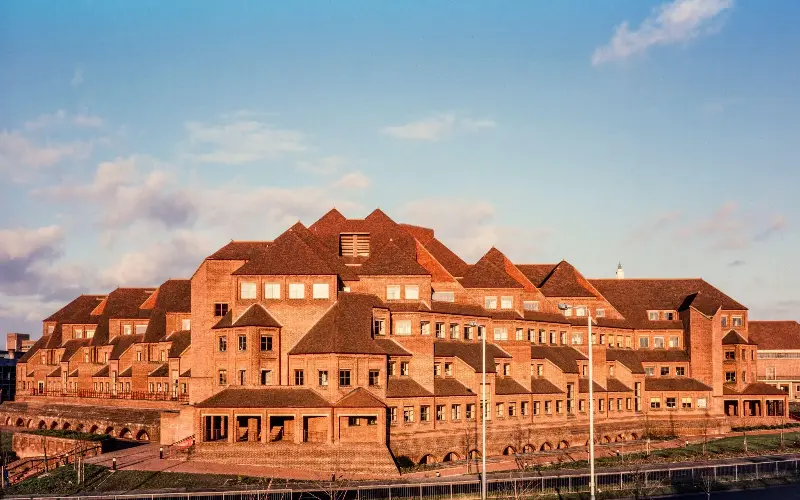
Despite the sprawl, Metro-land was kept in check by planners working for Hillingdon council, who would ensure extensions had planning permission and conservation areas were painted the correct colours. Its 1979 home in Uxbridge, designed by Andrew Derbyshire, ushered in a new era of nostalgia for a quieter rural idyll, and marked the end of grandiose futuristic modernism. Looking like a Temu version of Letchworth Garden City, it began two decades of barnyard design where every suburban Tesco was built with a clock tower and overhanging eaves.
5. Lion Green Road Housing and Dulwich Cricket Pavilion
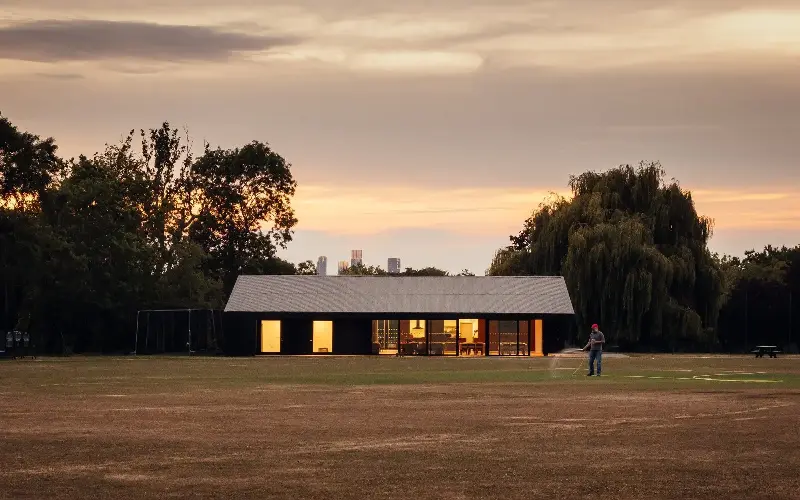
South London’s frayed edges have been celebrated by author John Grindrod, who lived in New Addington, right on the very periphery of London, and wrote the book Outskirts about the green belt surrounding the city. Perhaps the suburbs are coming alive again? The Lion Green Road housing scheme in Coulsdon, by Mary Duggan Architects, recently scooped the 2026 Stirling Prize. And a new cricket pavilion has also opened on Dulwich Common by architect Andy Matthews for Streatham and Marlborough Cricket Club.