



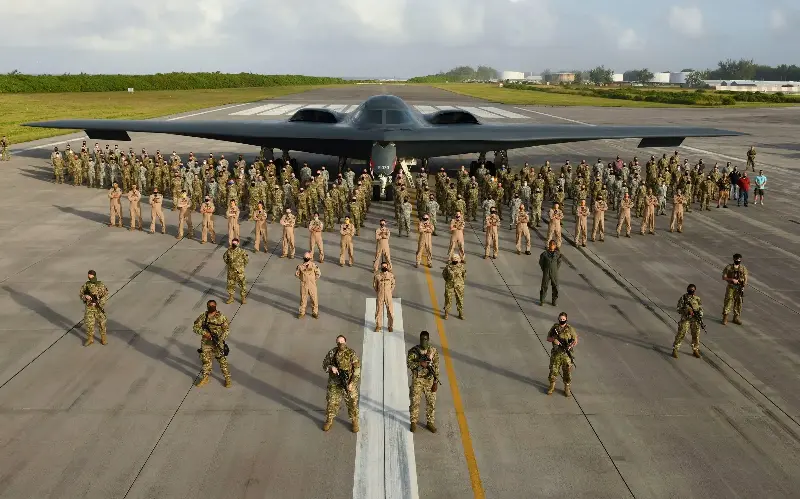
American B-2 stealth bombers are expected to land at British military bases “in a matter of days” to join attacks on Iran.
The UK’s air bases at Diego Garcia, in the Chagos Islands, and RAF Fairford, in Gloucestershire, are both being prepared for the arrival of the US warplanes this week.
The revelation by Western officials on Wednesday comes after Donald Trump warned Iran to expect a devastating wave of strikes.
“We haven’t even started hitting them hard. The big wave hasn’t even happened. The big one is coming soon,” the US president said on Monday.
On the fifth day of the war, an Iranian warship was sunk by an American submarine off the coast of Sri Lanka, reportedly killing 87 people.
Nato air defences also intercepted a missile launched from Iran towards Turkey, which was believed to be heading for a military base hosting US forces.
Turkey warned “all parties to refrain from actions that would lead to further escalation” but the incident threatened the prospect of another Nato ally joining the war.
It was also reported on Wednesday that Israel was preparing for the war to last “several long weeks”.
Iran is believed to be running out of ballistic missiles and appears to have lost its ability to fire massive missile salvos in retaliation against the US and Israel.
However, the US is rapidly burning through its stocks of precision weapons, leaving it “days away” from being forced to prioritise which targets to intercept, sources told The Wall Street Journal.
The UK initially denied Washington’s requests to carry out strikes from RAF bases, citing international law.
But Sir Keir Starmer relented on Sunday night and said he would allow the US to fly missions from the bases for “specific and limited defensive purposes”.
Mr Trump later attacked the Prime Minister over his lack of support for the Iran war, saying he was “not Winston Churchill” and he “ruins relationships”.
Speaking to journalists in the Oval Office, the president said he was “not happy with the UK” over the decision, which led to US planes “flying many extra hours” over the Atlantic to hit Iran.
Sir Keir has since suggested Mr Trump has no “viable” plan for his war in Iran.
He told MPs on Wednesday: “What I was not prepared to do on Saturday was for the UK to join a war unless I was satisfied there was a lawful basis and a viable, thought-through plan. That remains my position.”
The US president faced a vote in the US Senate on Wednesday night about his decision to embark on the war without approval from Congress.
The conflict has sparked anger among senior Democrats, including Chuck Schumer, the Senate Democratic leader, who said: “This is not a necessary war. It’s a war of choice.”
Their scepticism was echoed by Boris Pistorius, the German defence minister, who said it was “illusory” to think that conflicts in the Middle East could be resolved “by military force and unilateral action alone”.
RAF Akrotiri, a British military base on Cyprus, was hit by a drone on Sunday evening. However, the attack only caused minor damage.
The unmanned aircraft was understood to be similar to an Iranian Shahed drone, weapons which have been used extensively by Russia to bomb Ukraine, as well as by Tehran to target Israel and other states in the Middle East.
A source said on Wednesday: “Based on the type of drone and its range and ability, defence intelligence can confirm that that drone was not launched from Iran.” Western officials declined to say where it was flown from.
Britain had increased its ground-based air defence around RAF Akrotiri in the run-up to the attack, officials added. They refused to provide details, citing security concerns.
Previously, the RAF Regiment had deployed Rapid Sentry – a stand-alone system using lightweight multirole missiles (LMMs), like those used in Ukraine – and radar technology.
Air defence soldiers, believed to be from the 12th Regiment Royal Artillery, are also thought to have previously played a role in defending the base.
Meanwhile, British troops with experience working in Ukraine have deployed to the Middle East, it is understood, following requests from “multiple” countries in the region.
“The first of the team arrived in the region yesterday, and the next group are arriving today,” a Western official told journalists on Wednesday.
The official added: “The first lot are Brits who have got experience working in Ukraine and with Ukrainians and they’ll be able to offer specialist advice, particularly on how they might layer the sensing, the warning and the targeting of the drones.”
Among the additional support offered by Britain is HMS Dragon, a Type 45 missile-guided destroyer, which was being stocked with missiles and ammunition on Wednesday.
The Telegraph understands Air Chief Marshal Sir Richard Knighton, the head of Britain’s military, received a request to deploy the ship at 9.30am on Tuesday.
The Type 45 is not expected to sail until next week, with the transit to the eastern Mediterranean taking several more days.
Meanwhile, the US has begun talks with Kurdish militias on the Iran-Iraq border about a potential attack on Iran’s security forces in the western part of the country.
Mr Trump also said the US navy would escort tankers through the Strait of Hormuz as Iran attempts to effectively close the narrow waterway off its southern coast.
In Washington, a split has emerged in the US president’s cabinet over who started the war with Iran.
Mr Trump has insisted he decided to attack Iran on Saturday because he feared the regime would launch a pre-emptive strike on American forces in the region, a claim backed by many of his closest allies.
However, Marco Rubio, the secretary of state, seemingly contradicted the president’s claim by suggesting that Israel led the US into the war by bombing Tehran.