



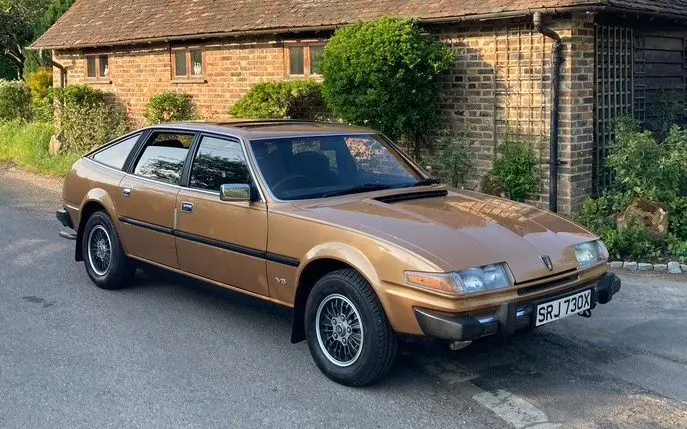
In 1980, at the age of six, Raymond Greaves craved a newly launched Rover Vanden Plas (VDP), the flagship of the SD1 range and European Car of the Year for 1977. More than three decades later, he finally achieved his ambition of owning the car that British Leyland (BL) hoped would tempt well-heeled motorists away from their BMWs and Mercedes-Benzes.
BL unveiled the original 3500 SD1 on June 30, 1976, and in September 1980 the VDP became the head of a facelifted line-up. The sales copy proclaimed, without any attempt at modesty: “There has always been a demand for the ultimate Rover: a car that combines all the virtues of Rover performance-with-economy and exclusiveness.”
The VDP succeeded the V8-S as the ultimate SD1, although Greaves pointed out that his VDP looks more understated than its predecessor: “The gold alloy wheels on the V8-S were not exactly subtle.” But the Rover VDP was less conspicuous consumption on wheels, more mobile living room. The interior was finished in Connolly leather upholstery, although Greaves’ Rover has the rare no-cost option of “hairline velvet” fabric instead.
As befitting a Rover of quality, the VDP had an automatic gearbox (a five-speed manual item was another no-cost option), “headlamp power wash”, electrically powered sliding roof and door mirrors, cruise control and detachable headrest cushions fore and aft. There were even “shag pile footwell rugs”.
Such decadence was only for the few, and in 1981 the VDP cost £12,475, when the Opel Senator 3.0 CD was £12,352 and its Vauxhall Royale stablemate was £12,046. The stately Volvo 264 GLE and Peugeot 604 Ti were £11,104 and £11,097 respectively, while the square-set Ford Granada Mk2 2800i Ghia S cost £11,174. As for hatchback alternatives to the Rover, the Saab 900 Turbo Five-Door Automatic was £11,895 and the Renault 30 TX Automatic a mere £10,349.
But your friendly local dealer could claim that the Rover VDP was unique as a UK-built, rear-wheel-drive, prestige five-door saloon, with a 155bhp, 3.5-litre V8 engine capable of 123mph. For less than the price of an Audi 200 Turbo at £12,950, the BMW 728i for the same amount and the Mercedes-Benz 280 SE at £15,300, the VDP was ideal for “either the individual or the company looking for a unique motoring experience”.
One sales challenge was that the VDP’s target buyer often favoured a separate boot (the SD1 was unusual among large cars in having a hatchback), while another was BL’s terrible image. In 1977, the corporation issued the extraordinary training film The Quality Connection in which David Suchet, Frank Windsor, Madeline Smith and many other well-known actors play Leyland workers whose joint ineptitude leads to a runaway Austin Allegro.
The Quality Connection was for internal use, but the fact that it was commissioned at all denoted BL’s sense of despair. Meanwhile, potential Rover VDP owners might have read in this newspaper on January 26, 1978 that six undertrack inspectors at BL’s factory in Solihull protested that they had been given “smelly overalls”. The consequent one-day stoppage resulted in a production loss of 240 SD1s.
Whether the affluent motorist blamed the unions or the management, such stories were likely to send them to their nearest Audi, BMW or Volvo dealer. For those who still wanted to buy British, there was the £13,331 Jaguar XJ6 3.4 S3 Automatic – a car also associated with BL’s many and various problems, but one with “traditional” styling and a name that managed to retain a sense of independence within the BL empire.
Production of the Series 1 VDP finished in September 1981, coinciding with the end of SD1 manufacture at Solihull. It was replaced by a facelifted version built at Cowley near Oxford in 1982, four years before the Rover 800 succeeded the SD1 after 303,345 units. Greaves observes: “With the Series 1 VDP only built in the recession-hit year from September 1980 to September 1981, it is unlikely that many were made in the first place, and staggeringly few have survived. DVLA data suggest only 18; 15 automatics and three manuals.”
Chris Powell of the Rover SD1 Club finds Greaves’ VDP “exceptionally lovely: the body colour is amazing, and the interior is very ‘gentleman’s club’”. It left the factory in December 1980 but wasn’t sold until August 1 1981. Greaves says: “It was in original ownership until 2014 at 13,500 miles and was brought out of hibernation by a BL-specialist dealer at that point, before I bought it in 2015. It has been carefully recommissioned but remains astonishingly original. A true timewarp car, still with only 15,500 miles on the clock.”
Greaves finds that “a fresh-out-of-the-box SD1 is remarkably good to drive. The VDP is best summed up as ‘smooth, swift, sonorous’. The suspension has sumptuous compliance that would shock drivers of modern cars, but also retains excellent control so it can be hustled if you are in the mood. The steering is direct, and the performance is lovely, torquey, and decently swift”.
As for the public response to his Rover: “The SD1 gets a wonderfully warm reaction. Most commonly, it is ‘My dad/grandfather had one/two/three of those!’ Another classic is: ‘The police loved those and I was stopped speeding by one!’”
And, perhaps most important, “the shag-pile over-rugs are still present and correct”.
Thanks to: Raymond Greaves and Chris Powell of the Rover SD1 Club.
We use the fascinating howmanyleft.co.uk for figures of surviving examples but some cars present more of a challenge than others, so the figures are rarely authoritative. Some pre-1974 records were lost before the DVLA centralised the process, while some cars have their model type misnamed on the V5 registration documents. A further issue is the omission of the exact model name or generation, or distinction between saloon and estate bodystyles.