



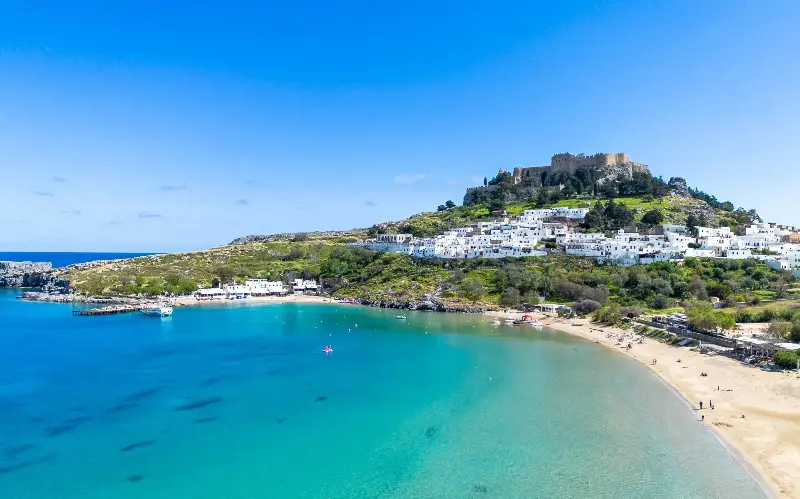
Everywhere you look along Rhodes’s extensive coastline, you’re likely to spot a beach. From the family-friendly golden shores and ultramarine waters of Tsambika in the north-east to the rolling sand dunes of Mavros Kavos in the south, the choices are endless.
Several beaches are even linked with significant individuals and periods in the island’s history – including Hollywood star Anthony Quinn. There’s also St Paul’s Bay, named after the Apostle who is thought to have paid a visit, and Kallithea Springs, built during Mussolini’s reign when Rhodes was under Italian occupation.
Elli
This sand and pebble beach on the northernmost tip of Rhodes Town is often busy, especially with families who gravitate to its safe shores. Youngsters enjoy jumping off a three-level diving platform, a 1930s retro landmark known locally as the trampolino, and there are umbrellas, sunbeds and various watersports on offer. As well as stalls selling fresh fruit, beach bar and restaurant Ronda has an all-day menu that means you can brunch, lunch, drink or dine until late. Top tip: the western side tends to be windier than the east.
How to get there: The walk from Rhodes Town takes around 20 minutes.
Anthony Quinn Bay
This pebbled cove is named after Anthony Quinn, who swam in its crystalline waters during the filming of The Guns of Navarone in the 1960s. The American actor purchased land nearby but, despite a protracted tussle with authorities, never obtained the titles. Surrounded by craggy rocks bursting with bright flowers in spring, these days, the mini oasis is a drawcard for couples. Arrive early to snag one of the few sunloungers and make the most of the sunlight on its north-east-facing shores. Or avoid the crowds by visiting in the late afternoon. There is a solitary bar selling refreshments.
How to get there: From Rhodes Town, the KTEL intercity bus connects to Ladiko/Anthony Quinn in about 30 minutes.
Agia Agathi
With its long sweep of golden sand, shallow aquamarine waters and little else, Agathi is ideal for peace and quiet. With no thumping beach bars, no parasols or fancy day beds for hire, what you’ll find instead is a well-sheltered haven of natural beauty and tranquillity far from the madding crowds. There are no trees so bring an umbrella or pop-up tent for shade, and plenty of food and water. Pay a visit to Agia Agathi Cave, a tiny church carved into rock just north of the beach.
How to get there: The beach is best reached by car. Parking is available directly behind the beach.
Tsambika
Families flock to this impressive expanse of coarse blonde sand, where the sea bottom shelves gently, to swim in warm teal waters that turn lapis blue the deeper in you go. Local youth gather at one of several modest beach bars, which provide sunloungers and umbrellas for hire, or take to the sand to play beach volleyball. Head to the southernmost corner of the beach and lay out your towel at the base of rolling sand dunes, where it’s more tranquil.
How to get there: The KTEL bus from Rhodes to Tsambika beach takes around an hour. Parking is plentiful if you prefer to drive.
Kallithea Springs
In 1929, Rhodes’s Italian occupiers built public baths to take advantage of healing mineral springs known to voyagers since ancient times. The site, just five miles from the island’s capital, has since been fully restored. While the baths are no longer operational, it’s worth walking the pebble stone mosaic pathways and seeing the two Mussolini-era, white-domed buildings crowned with Latin phrases. The elaborate multi-arched Rotunda hosts a display of monochrome photographs depicting the baths’ glory days. Chic Rhodians favour the small sandy beach for its comfy chaise longues, café and calm waters. It’s a popular location for scuba-diving lessons and snorkelling.
How to get there: Summer KTEL bus services connect Rhodes to Faliraki via Kallithea Springs.
Lindos
Despite Lindos’s main beach teeming with holidaymakers in the summer months, it retains an air of serenity. There’s nothing like sitting on its soft, golden sands and cooling off in cerulean seas as you look up at the whitewashed town and its ancient acropolis. It’s a worthwhile beach stop, particularly after you’ve trekked up to the archaeological site, and sailors often drop anchor in this blissfully sheltered spot. Shallow waters deepen very gradually, making it highly suitable for youngsters. Tavernas and cafés are in easy reach and there is parking, though it fills up quickly. If you’re after something a bit quieter, neighbouring Pallas beach might suit you better.
How to get there: The KTEL intercity bus runs along the coast from Rhodes to Lindos.
St Paul’s Bay
A rocky headland reaches around shimmering emerald waters at St Paul’s Bay, leaving only a slim passage between the bay and the open sea. There are two beaches here, the smaller of which is is at the northern end, below the Acropolis of Lindos. The fine sand beach to the south is close to St Paul’s Chapel, dedicated to the apostle who is said to have been shipwrecked here on a missionary journey. A smart restaurant beach bar, Tambakio, can deliver coffee, cocktails and snacks to your sunlounger, and there are changing rooms and showers to freshen up after a dip in the water.
How to get there: Take the KTEL intercity bus from Rhodes to Lindos and walk to bay, or KTEL intercity bus Rhodes-Pefki and alight one stop after Lindos.
Kiotari
Hotels, restaurants and a shopping centre have opened in recent years in this up-and-coming resort area, yet Kiotari still retains a relaxed feel. Couples and families adore its long, broad beach of steely sand, shingle and deep sapphire waters. There are umbrellas and loungers if you like, but space abounds if you desire some privacy, so you may wish to pack a picnic and bring your own shade. Water can be replenished at mini markets and you pick up pastries from local bakeries. For active beach-goers, the Kiotari Water Sports Centre offers waterskiing, wakeboarding and parasailing, among other activities.
How to get there: The KTEL bus connects Rhodes and Kiotari.
Mavros Kavos
If you like your beaches wild and free, seek out Mavros Kavos, a well-hidden local secret in a completely untouched part of the island. Sea daffodils and a rare native cedar species thrive amid pristine sand dunes lapped by invigorating cobalt waters. Bring shade, water and snacks. Your best bet for a meal is Platanos taverna in nearby Lachania village.
How to get there: By car only. On the main road heading south to Prasonisi, keep an eye out for Italian-built St Mark’s church and its clock tower. Turn into the dirt road opposite and drive for three miles (five kilometres) until you reach a crossroads, then turn right for Mavros Kavos.
Prasonisi
At Rhodes’s southernmost tip lies this remote playground for windsurfers and kiteboarders who travel here from around the world to harness the powerful Meltemi winds that blow steadily from June to September. A slender strip of sand connects the mainland to a minute islet, with twin beaches on either side, one with flat water and the other lapped by waves. Bring your own kit or hire from well-equipped local providers. Even if you don’t surf, it’s worth the winding drive across shrub-covered slopes to witness the spectacle and see the experts fearlessly flip, twirl and soar above the Aegean.
How to get there: Join the KTEL bus on the coastal Rhodes-Prasonisi route.
Fourni
Mostly known to Rhodians, this isolated sand and pebble strand tucked below Monolithos village is a tiny beach haven. Few visitors venture to the windswept western beaches – let alone this side of the island, which remains unspoiled – as the sea is usually wavy. Βring your own parasol and supplies or arrive early so you can take shade below striking boulders at the northern end. Don sturdy shoes and trek to the southern end in search of caves and mystical baths carved into the rock. After you’re done swimming for the day, head up to Monolithos Castle to witness a deep orange, dramatic sunset you won’t soon forget.
How to get there: By car, follow the road signs to Monolithos Castle. The municipal Rhodes-Monolithos bus is another option.
Glyfada
Tucked between towering cliffs, with a sweep of sand, pebbles and satin-smooth rocks, remote Glyfada is a tranquil spot for those seeking serenity. Its mirror-clear waters teem with moray eels and starfish (bring a snorkel), and there’s an aptly named Taverna Paradise at the beach’s northern end. Bag a table to enjoy delicious home-cooked dishes served up by 80-year-old grandmother, Anna.
How to get there: By car, follow the signs to Siana and take the turn off for Glyfada.
How we choose
Every beach in this curated list has been chosen by our destination expert, to provide you with their insider perspective. We cover a range of areas and styles, from popular city beaches to lesser known corners – to best suit every type of traveller. We update this list regularly to keep up with the latest openings and provide up-to-date recommendations.