



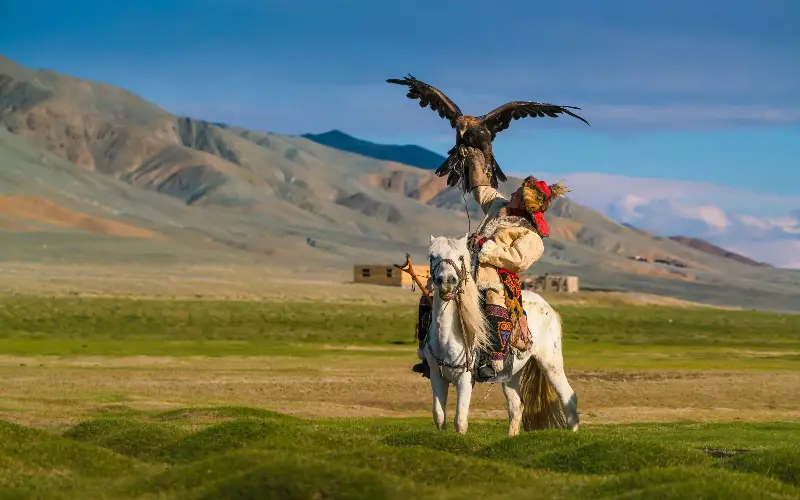
In this age of smartphones and social media, the world has begun to feel like a much smaller place. Viral videos lead to crowds and the headaches of overtourism, but there are still plenty of places that the hordes have yet to trample – if you’re willing to put in the effort to reach them. For this, look no further than Mongolia, the landlocked country that can accurately be described as one of the world’s last frontiers.
Mongolia boasts wide-open steppes, glacier-topped mountains, shimmering lakes, fast-flowing rivers and the magical, multi-chromatic wonder of the Gobi Desert, along with historical sites dating back thousands of years. This birthplace of Chinggis Khan is a land where raw, unspoiled nature is the name of the game, as recently showcased in Season 6 of Race Across the World, with contestants journeying through striking scenery across unmarked roads.
The country is bursting with wildlife and populated by warm-hearted and resilient people, many of whom still embrace the traditional nomadic lifestyle of their ancestors. And while you’ll certainly experience immense herds of livestock, nights in felt tents – known locally as gers – and a sky that seems to go on forever, a visit to Mongolia is more than just a glorified camping trip. Its capital, Ulaanbaatar, is a surprisingly modern and dynamic city, with top-notch museums, cool bars and a youth scene that gives it its own urban flavour.
While Mongolia’s vast spaces are some of the least densely populated in the world, word is getting out about its offerings as a tourist destination. 2025 saw nearly 850,000 visitors arrive, with 2026 projected to hit the one million mark. This makes now the perfect time to dive into what this country has to offer; here’s how to do it.
Where to go
Ulaanbaatar
With a population of 1.75 million, Ulaanbaatar is home to half the people in the country and is a place where most visitors spend at least a couple of days. Once a grim Soviet backwater, the city has enjoyed an influx of mining wealth in recent years, as seen in its gleaming new high-rises, as well as the sleek and stylish fashion sported by some of the locals.
While centrally located Sukhbaatar Square may be the city’s soul, Narantuul Market is its heart, a dizzying labyrinth of stalls selling everything from horse saddles to cast-iron ger stoves to varieties of yogurts and curds you never knew existed. State Department Store was the only mall of its kind during Mongolia’s communist era, but now it is both a landmark and a great place to shop for locally produced cashmere and other goods, while the area around Seoul Street is packed with restaurants and watering holes that keep pumping into the wee hours of the morning.
It pays to brush up on your history before heading out to the provinces, and Ulaanbaatar has you covered: The National Museum of Mongolia traces the country’s history all the way from the stone age to the 21st century, while the Chinggis Khaan National Museum boasts nine floors of exhibits dedicated to the glory of Mongol Empire and the man who founded it.
The Gobi Desert
Few places on Earth conjure images of mystery and majesty like the Gobi. This vast desert stretches throughout northern China and southern Mongolia and is high on most any visitor to Mongolia’s itinerary for good reason: the lunar, often incredibly colourful landscape approaches a beauty that at times becomes dreamlike.
Whether you’re riding a camel at the base of the massive Khongor Els sand dunes or marvelling at the deep red and ochre face of Bayanzag – the “Flaming Cliffs” known for dinosaur fossils – a visit to the Gobi will have you feeling transported to another world.
To top it off, every night you’re in for an atomic sunset that blows away any man-made light show you’ve ever witnessed, followed by a glimmering tapestry of stars unsullied by the glare of city lights.
Orkhon Valley
The Orkhon is one of Mongolia’s great rivers, and its lush valley constitutes the country’s historic heartland. After all, this was where Ogedei, Chinggis Khaan’s son and successor, built the imperial capital of Kharakhorum. Known today as Kharkhorin, this town is home to Erdene Zuu, one of the country’s great monasteries.
The Orkhon Valley itself offers verdant grazing land where you’ll find immense herds of sheep, goats, yaks and horses running free, which also makes it an ideal place to experience a nomadic family homestay. For those keen to do some equestrian exploration, the region is also ideal for horse trekking. From the saddle you can take in sights such as Orkhon Falls, Tovkhon Monastery and the beautiful Khuisiin Naiman Nuur “Eight Lakes” nature reserve nestled in the surrounding Khangai Mountains.
Lake Khovsgol
Known as Mongolia’s “Blue Pearl”, this massive lake in the country’s north holds 70 per cent of the country’s freshwater and is a popular getaway for both international visitors and Mongolians. Its southern shore is dotted with tourist camps ranging from basic gers to luxury eco compounds and the lake and its surrounds offer kayaking, island-hopping, hiking, riding and even scuba diving. The west side of Khovsgol is rimmed by the craggy Khoridol Saridag Mountains, which present great opportunities for alpine trekking.
In early March, the Lake Khovsgol Ice Festival takes place on its frozen surface, a celebration of the long, dark winter months, which features ice sculptures, sleigh races, ice sumo, an archery competition, dog sledding, a tug-of-war, as well as shamanistic rituals.
The Altai
In Mongolia’s far west you’ll find the lofty Altai Mountains, home to bears, ibex, argali sheep and the elusive snow leopard. This region is also inhabited by ethnic Kazakhs, who are quite distinct from the Khalkha majority in Mongolia: They speak a Turkic language, practice Islam and maintain the time-honoured art of eagle hunting.
Altai Tavan Bogd National Park is the region’s best-known reserve, home to the “Five Saints” it’s named for: a cluster of awe-inspiring, 4,000-plus-metre peaks thrusting up from a single massif. There are also gargantuan glaciers, alpine lakes and rivers tumbling forth that may make your heart soar higher than the mountains that birth them. It is often the final destination on an itinerary through Mongolia, as it acts as a kind of grand exclamation point in a land not wanting for jaw-dropping beauty.
How to do it
Know before you go
Mongolia can intimidate the first-time visitor, because of the enormous ground to cover, unpaved roads and remote corners virtually untouched by tourism. But there are ways to make your trip more manageable, while still experiencing the country’s vast wilderness.
Most visitors to Mongolia use a tour company or hire their own private driver and guide. While there is a bus system, it doesn’t serve the whole country and won’t get you to many of the more remote places. It is possible to hire a car through services such as SIXT, though self-driving for first-time visitors to Mongolia is not recommended because of the extremely rough road conditions and lack of signage.
When to go
Most visitors travel to Mongolia in the summer when temperatures are at their warmest. Winters are exceptionally harsh, with lows of -40 or more in spots, though the Lake Khövsgöl Ice Festival takes place in early March and is well worth checking out as long as you pack warm clothes.
What to book
Goyo Travel offers a 24-day Grand Tour that takes you through the Gobi to Lake Khövsgöl and all points in between starting at £4,095.
View Mongolia Travel has eight-day tours of the Gobi and Orkhon Valley from £945.
Where to stay
In Ulaanbaatar, five-star Shangri-La Ulaanbaatar has rooms from £350, while budget-friendly Hotel Nine starts from £90 per night.
The Three Camel Lodge has two-night packages staying in a luxury ger in the Gobi Desert from £2,790.
Dalai Eej Resort has cabins and suites on the banks of Lake Khövsgöl starting from £70.
How to get there
While there are no direct flights to Mongolia from the UK, Air China operates a regular route from Gatwick to Ulaanbaatar via Beijing, while Turkish Airlines flies out of both Heathrow and Stansted, usually via Istanbul.