



Race Point Beach, at the northern extremity of Cape Cod, is a beauty. From my position at the water’s edge, taupe-coloured sands stretched in either direction, their empty expanses backed by dunes whose beach-grasses waved in the ocean breeze. Families sat on blankets spread beside coolers packed with drinks and snacks, not far from where they’d parked their monster four-wheel drives on the sand.
Out at sea, I could hear the creaky calls of terns as they dived to catch tiddlers, but what really caught my eye was something in the middle distance, where plumes of spray erupted intermittently from the surface.
The whales that produce these vapour spouts are one of Cape Cod’s biggest attractions. They come because the cape – which curves into the Atlantic like an arm flexing a bicep – extends beneath the waves as a gravelly plateau. Known as Stellwagen Bank, it channels nutrient-rich currents towards the surface, fuelling a plankton bloom that attracts countless fish and their much larger predators. I may have been wonder-struck, but most were nonplussed: seeing whales from here is commonplace.
For a better view – and to find out more about them – I headed to the visitor centre for the Cape Cod National Seashore, whose 40-odd miles of coastal habitat comes under the protection of the National Park Service. Positioned atop an ancient dune, the facility’s sea-facing deck is well placed for observing Race Point’s marine life.
Through a telescope, I could see not just the whales’ spouts but also their tails as they dived, plus a handful of Atlantic grey seals (the same kind we have here in Britain).
“We get four whale species here, but you can tell these ones are humpbacks from the shape of their tails and their spouts”, explained the ranger helping visitors to interpret what they could see. “Back in the mid-1800s, whaling fleets decimated their numbers; but since the Marine Mammal Act was passed in 1972, humpbacks in particular have rebounded.”
Seals, previously persecuted, have bounced back too: up to 50,000 of them now reside on the Cape. Their return has prompted a boom in their main predators – great white sharks – which are also now seen much more frequently. It was sobering to think that Amity Island, the fictional setting for Jaws, was inspired by real-life Martha’s Vineyard, a little further down the coast.
Beyond its beaches and dunes, Cape Cod National Seashore encompasses thousands of acres of marshes and woodlands whose pines and oaks are stately in places, wind-stunted in others. Much can be explored via paved cycle trails that loop through the landscape, one of which I followed into town from the visitor centre.
In spring, the ground is bright with flamingo-pink lady’s slipper orchids, but my late-summer ride was coloured with the dusky fruits of sea plums and standing-to-attention spikes of yellow goldenrod. The trail eventually delivered me to Provincetown, the furthest-flung of Cape Cod’s settlements, where I was staying at one of its small-scale resorts (there isn’t a chain hotel for miles).
Getting there involves a three-hour drive or 90-minute ferry ride from Boston (I chose to top and tail my trip at the Hilton Boston Airport for the chance to experience the city, while also providing a contingency in case bad weather disrupted the ferries).
The Provincetown Fast Ferry (baystatecruisecompany.com) had dropped me at the heart of bustling Commercial Street, behind which lie lanes of clapboard houses, their gardens ebullient with creamy hydrangeas. Rising above it all is the towering Pilgrim Monument, a landmark that commemorates the Mayflower’s first landfall here in 1620 before the Pilgrim Fathers founded Plymouth Colony on the Massachusetts mainland.
By the 1700s, Provincetown had established itself around fishing and whaling. Tourism has long since replaced these industries, but whales are still integral to the town thanks to the whale-watching tours that draw visitors from April till late October.
I joined one such trip with Dolphin Fleet ($75/£55 per person, whalewatch.com), the company that pioneered whale-watching tours here in 1975. Although similar trips depart from Boston, Plymouth and elsewhere on the mainland, they all head to Stellwagen Bank; so sailing from Provincetown involves less to-and-fro and more time spent with these maritime giants.
We set off past a sandbank where scores of seals had hauled out to rest, then continued to the waters off Race Point. “If you see a spout, shout out!” said the guide as we scanned the sea for signs of life. But it was those creaky-calling terns that gave away the whales’ position by diving for the fish that these huge mammals herd up from the depths.
We approached as three humpbacks surfaced together with loud exhalations accompanied by those telltale, misty clouds. We were close enough to see the tubercles (lumps) atop their heads and to be momentarily cooled by the whale-perfumed spray. They dived away in a movement that was surprisingly elegant for such massive beasts, flashing tail-flukes that are as unique to each animal as a fingerprint.
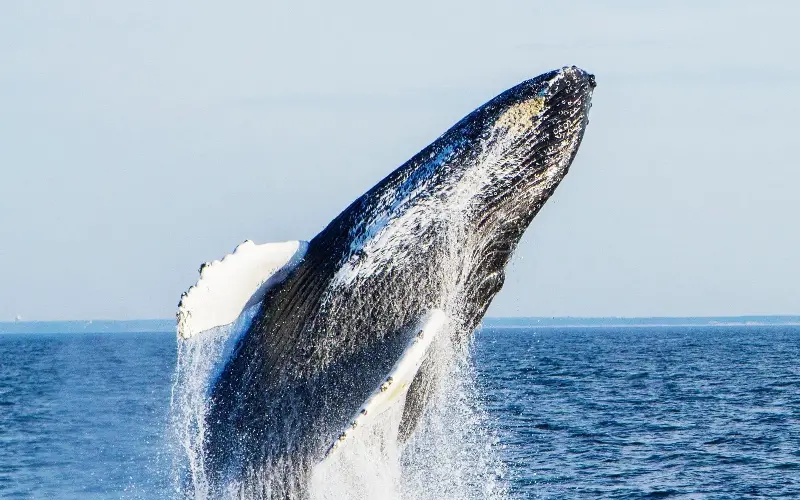
Further on, another spout – taller, straighter – indicated a fin whale, the second-largest of all whale species. “Some days,” the guide revealed, “we’ll see humpbacks breaching, or even occasional great white sharks. Every trip is unique; you never quite know what you’ll see.”
Later, back on land, I found a café on Commercial Street and settled back to soak up Provincetown’s scene. It’s fantastic for people-watching. The passers-by span a mix of young families, summertime revellers and silver surfers queuing for lobster rolls next to drag queens promoting evening shows (Provincetown has a huge LGBT+ community).
What unites this disparate demographic is that nobody cares about anyone’s differences. It gives the town a feel-good ambience that’s inclusive, accepting and tolerant. And sure, although I made some great memories with my beach time, biking and whale-spotting boat trip, it turned out that Provincetown’s laissez-faire vibes were the thing I treasured most when I left.
How to do it
James Litston was a guest of the Massachusetts Office of Travel & Tourism (visitma.com). Bon Voyage can package two nights at the Hilton Boston Airport and five nights at Provincetown’s Ellery Hotel (room-only basis) with return flights and ferry crossings from £1,995pp (0800 316 0194, bon-voyage.co.uk).