



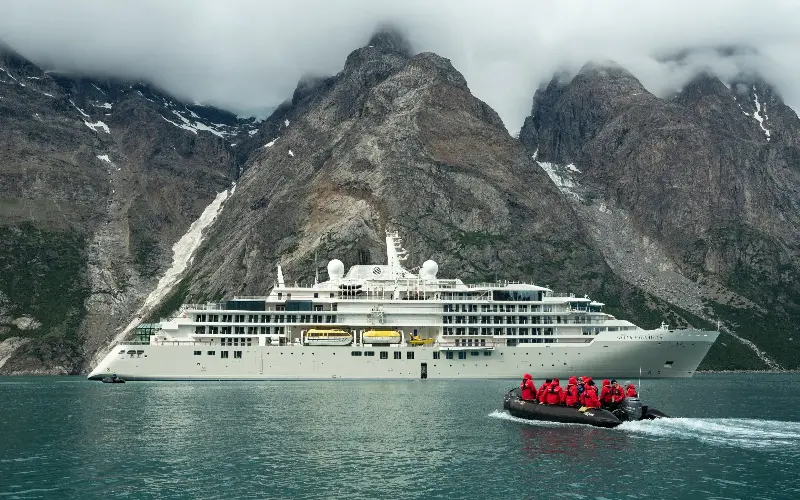
Gripping the top of the world in an icy embrace, the Arctic Circle stretches from the North Pole to a latitude of 66 degrees, 33’N encircling an area that accounts for six per cent of the earth’s surface.
More accessible than its Southern Hemisphere counterpart and with a greater variety of animal species, the Arctic is famously the realm of the polar bear and sightings of this fearsome predator remain the ultimate prize of cruises here.
This icy expanse is also rich in Inuit cultures, where ancient legends, along with a haunting history of whale hunting and intrepid exploration, paint a fascinating picture of lifestyles now and from centuries past.
Another string to the Arctic’s natural bow is its year-round allure of the great outdoors, where the midnight sun ushers in endless summer days while prolonged winter nights bring the mesmeric appeal of the Northern Lights.
In this guide:
Before you book
Where can I go?
The Arctic is vast, so you need to pinpoint which area you want to explore. Spanning myriad countries, including Norway, Canada and Russia, plus Alaska and Greenland, across 5.5 million square miles, this stark and beautiful wilderness is an icy cornucopia of snowy fjords, expansive glaciers and dramatic seascapes.
The most northerly of these can only be accessed by ship during the height of summer along legendary maritime routes that have carved their place in the history books, though this region has become increasingly popular in recent years as expedition cruising has boomed.
Sailings along the Norwegian coastline tend to be more convenient and offer soft adventure, while expedition cruises that delve into more inhospitable territory are generally better suited to intrepid travellers.
When should I go?
The main Arctic cruise season runs from May to September, with early-season voyages generally shorter and tending to keep further south as winter ice is still melting. However, this is a good time to spot Arctic bird species before they migrate and catch sightings of polar bears and walruses as they finish their winter hunting.
July and August mark high summer when Arctic flora reaches full bloom and many wildlife species take advantage of the warmer temperatures to rear their young. Amid the retreating ice, this is the window when more northerly routes open up for a short time.
As September signals the end of summer, ships generally return to more southerly routes as nights close in and temperatures drop.
The harsh winter months rule much of the Arctic out of bounds, though rising interest and increased sightings of the aurora borealis have enticed more sailings to view this spectacle and take part in the rising number of adventurous activities.
What types of cruises are available?
Intrepid explorers wanting to reach the North Pole can choose from a handful of sailings on the luxury ice-breaker vessel Le Commandant Charcot, owned by French cruise line Ponant.
Norwegian lines Hurtigruten and Havila Voyages run year-round passenger and cargo services to isolated coastal communities, which sail to and from Bergen as far north as Kirkenes at the top of Norway, less than 10 miles from the Russian border.
Expeditionary sailings, especially ones involving hikes across the Arctic tundra, kayaking expeditions and trips involving Zodiacs (small boats), can be pretty physical, so you need to be reasonably fit. Expedition ships, which are more suited to extreme conditions and offer intrepid voyages off the beaten track, include upscale “six-star” lines Seabourn, Silversea, Scenic and French line Ponant.
Other dedicated adventure lines include Quark Expeditions, AE Expeditions, HX Expeditions and National Geographic-Lindblad Expeditions.
Who to cruise with?
Consider the ship size, as this varies and will determine the type of voyage. Modern mass-market cruise ships holding thousands of guests follow more mainstream routes, while smaller expedition vessels with ice-strengthened hulls, some carrying as few as 20 or 30 guests, others upwards to a few hundred, venture into more inaccessible regions.
For a regular cruise experience on a larger ship, lines such as P&O Cruises, Princess Cruises and Cunard offer summer sailings to northern Norway and the North Cape from the UK, while MSC Cruises offers sailings from Hamburg.
Midsize companies, including Fred Olsen Cruise Line and Ambassador Cruise Line, depart from various UK ports, while Viking and Saga Cruises also offer UK departures. Norwegian coastal voyages between Bergen and Kirkenes are operated by Havila Voyages and Hurtigruten.
In addition to the dedicated expedition and adventure lines, there are also smaller vessels, such as the former Finnish government vessel Balto, which holds just 12 passengers; former herring lugger, the Rembrandt van Rijn; and the schooner Nooderlicht. These are featured by specialist companies such as The Small Cruise Ship Collection, Swoop Arctic and Wildfoot Travel.
Ports and sights
Can I depart from the UK?
Yes. Unlike other remote regions of the world, the Arctic is remarkably accessible from the UK and other northern European ports. The most common departure port is from Southampton, while other options include Newcastle, Dover, Liverpool, and Scottish ports like Leith for Edinburgh, Dundee and Glasgow.
Ex-UK sailings on major mainstream cruise lines mainly depart to northern Norway and/or Iceland during the summer months, though there are some winter departures too.
Where else can I depart from?
Cruises also depart from other northern European ports, such as Amsterdam, Hamburg and Copenhagen, with itineraries tending to follow the Norwegian coastline, some calling at the Lofoten Islands and sailing past Europe’s northernmost point at the North Cape.
Deep in the Arctic Circle, Norway’s Svalbard archipelago is closer to the North Pole than its mother country. The capital, Longyearbyen, on the main island of Spitsbergen, is a key embarkation point for expeditionary voyages around the islands. These tend to last one or two weeks, though some depart from other points such as the northern Norwegian city of Tromsø. These departures are concentrated in the warmer, lighter summer months as winter sailings to this region tend to hug the Norwegian coast, sailing as far north as Alta or Kirkenes.
Despite holding the wild, rugged characteristics of the Arctic, Iceland actually sits just south of the Arctic Circle, with only part of its small offshore island, Grimsey, falling within it. However, the Icelandic capital Reykjavik is often a departure point for cruises to Greenland, which is one of the rising stars of the expedition world.
What route should I take?
A bucket-list experience comes on sailings through the fabled Northwest Passage, famous among mariners and explorers. This route linking Europe with North America only becomes navigable for a short time during late summer when the pack ice melts and ships can pick their way through, though conditions are notoriously unpredictable.
Voyages are few and far between, taking between roughly 13 and 25 days, with sailings going between Iceland or Greenland and the Canadian territory of Nunavut or Alaska.
The Northeast Passage, heading through the bountiful wildlife, untouched landscapes and indigenous tribes of the Russian Arctic, along the north Siberian coast, is another fascinating and relatively undiscovered region, though this is currently off-limits.
What can I see?
If spotting polar bears is your dream, opt for voyages to the areas where they are most commonly spotted – notably Spitsbergen in the Svalbard archipelago, Canada or Greenland’s east coast.
Greenland is attracting increasing attention. More in-depth expeditionary sailings along its coastline tend to depart the Danish territory’s main gateway, Kangerlussuaq, with some sailings heading west into Canada’s high Arctic territories. This vast wilderness, with its mix of tiny fishing communities and spectacular landscapes of breathtaking fjords, soaring mountains and the chance of spotting polar bears, has proved popular for those wanting to explore its east and west coasts.
Meanwhile, those keen to see the Northern Lights will have the best chance during the winter season and by going as far north as you can into the aurora oval, which covers latitudes between 60 and 75 degrees in Norway, Sweden, Finland, Iceland and Canada.
About our expert
Sara Macefield
After finding her sea legs 20 years ago, Sara has gone on an estimated 200 voyages (and counting) across the world’s oceans and rivers, with Antarctica and the Galapagos Islands scoring as all-time favourites.
This article was first published in May 2024 and has been revised and updated.