



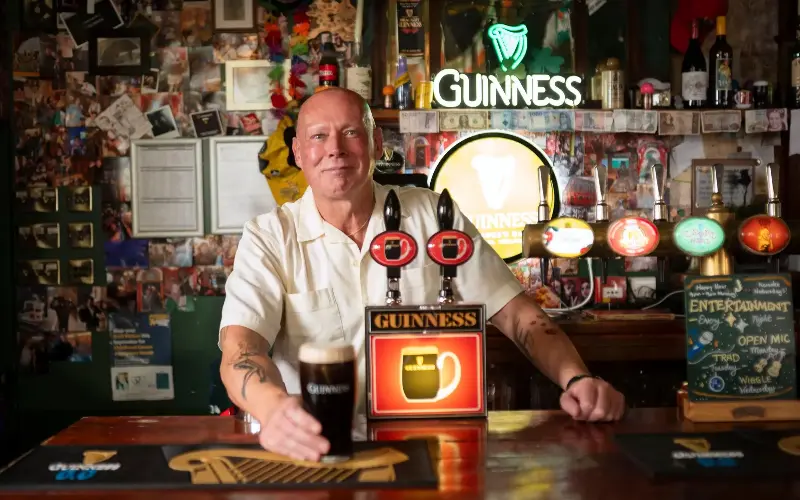
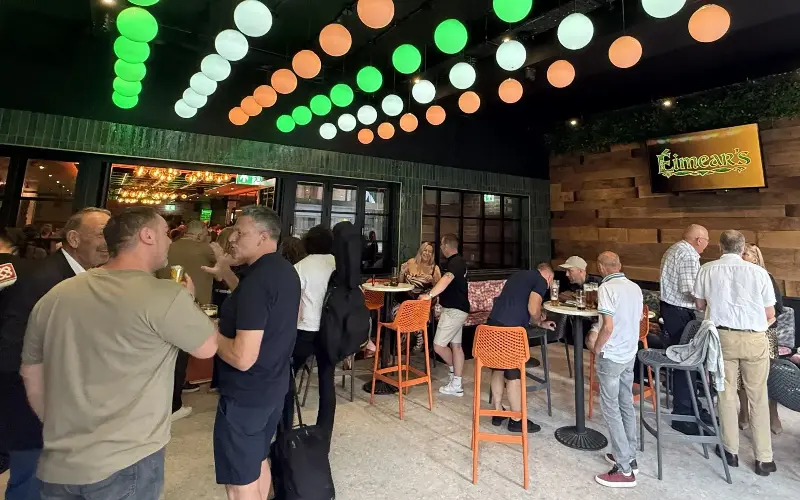
“Low lie the fields of Athenry,” sang the crowd, variously sitting, standing and swaying together, sharing a moment with the live band. I’d taken just two sips of beer at Éimear’s, in Birmingham’s city centre, but it was impossible not to be swept up in the atmosphere. Welcoming, fun – a bit of craic, you might say – it is echoed across the land at some of the country’s most thriving pubs.
Éimear’s opened earlier this year and is among a swath of new Irish bars and pubs in the UK. Figures from the hospitality experts DesignMyNight indicate that new openings in the category have risen by 131 per cent year-on-year in 2026, with more in the works. Good news, then, for fans of a dark pint.
There’s no official rulebook for what makes an Irish pub, but most of us would recognise one when we walk in – Guinness on tap, a glimpse of flowing Gaelic script, live music, often sport. But what is it about Irish pubs that keeps us coming back, and that is encouraging more to open?
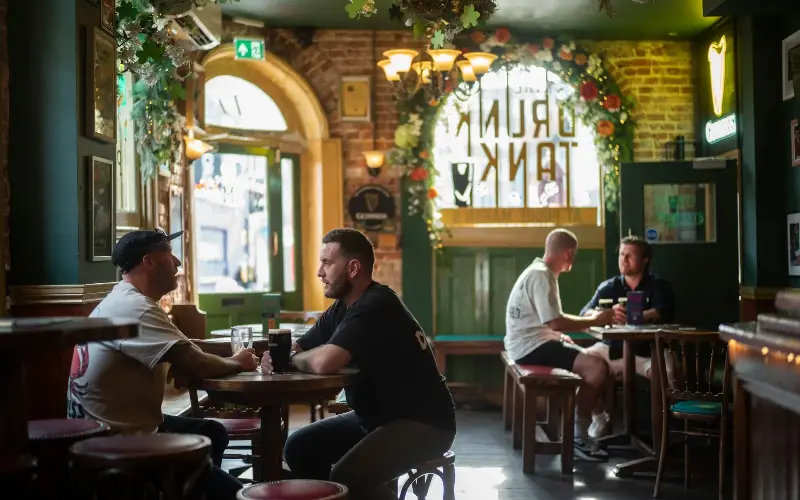
It certainly helps that there’s a surge in the popularity of stout; a Heineken report this year indicated a 19 per cent increase in sales of the drink, whose popular brands include Guinness and Murphy’s. But there’s more to it than the brews.
“Irish pubs are local pubs for everyone all over the world,” says Aidan Mahon, who hails from Cork but runs Pogue Mahon’s in Norwich, a city that’s home to one of Britain’s oldest Irish cultural societies. “It’s a place for conversation and socialising,” says Mahon. “We have live music every night of the week, we do food, there’s a cabaret and a games room. Back home in Ireland,” he continues, “the pub is a central part of the community. They are multifaceted businesses offering much more than just alcohol.”
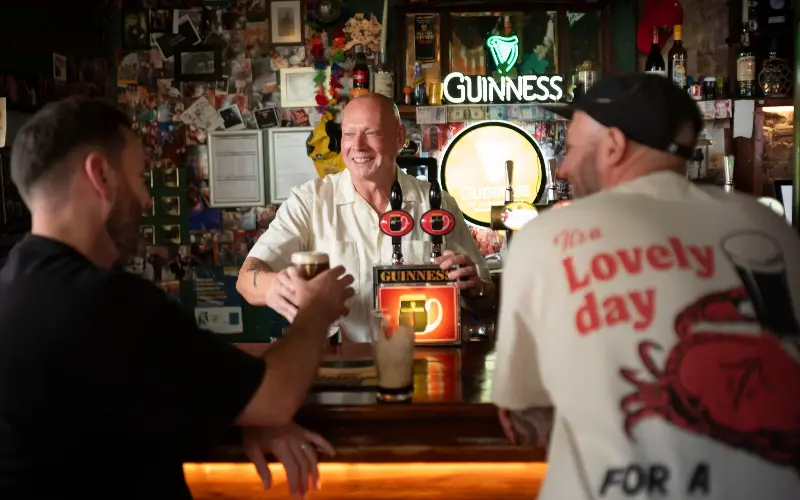
Indeed, pubs in Ireland are known to include newsagents, sweet shops, hardware stores and more on-site. Some of them even double up as undertakers. They are a place where communities traditionally come to mark many of their biggest events.
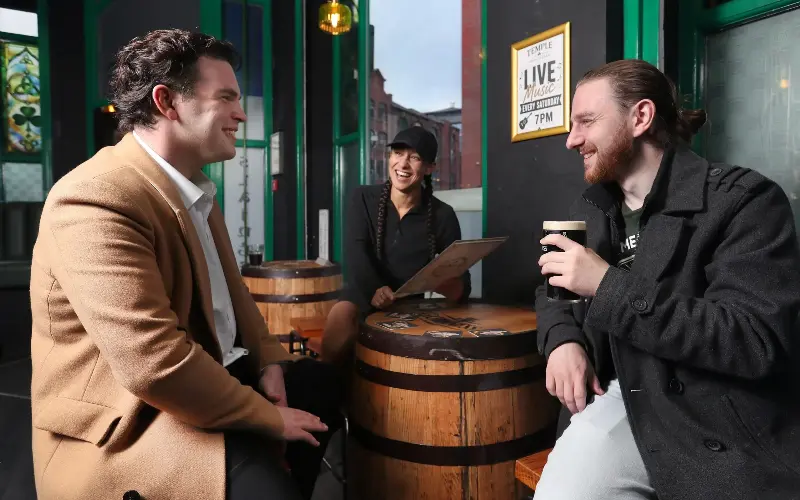
While chains of Irish-theme pubs such as O’Neill’s and Katie O’Brien’s are opening more venues, the Irish pub surge in the UK is especially strong among independent traders. These include Pogue Mahon’s, which opened in 2021, and the Temple Tavern in Leeds, which opened in July. The latter is headed up by Dubliner Pierre Thomas. “With the cost-of-living crisis people are looking for more for their money when they visit a pub,” Thomas says. “They don’t just want a drink; they want an authentic experience. I saw how popular the Irish-theme pub chains were in Leeds, and I wanted to offer local people a proper, genuine experience of an Irish bar, full of the real craic agus ceol” – essentially, fun and music.
Live tunes are part and parcel of an evening spent at Éimear’s, which is owned by Wayne Tracey. He was born and bred in Birmingham, but both his wife and his father are from Dublin, and the pub (one of a number of bars he runs) is named after his daughter. He believes that the music, along with the fact the venue offers table service, draws “an older crowd from all backgrounds – Irish and Brummies”, he says. “People want an experience, more than just a drink. We sell so much Guinness in our other venues which aren’t Irish bars that the boom can’t just be down to that. At Éimear’s it’s about offering an authentic experience of Irish culture.”
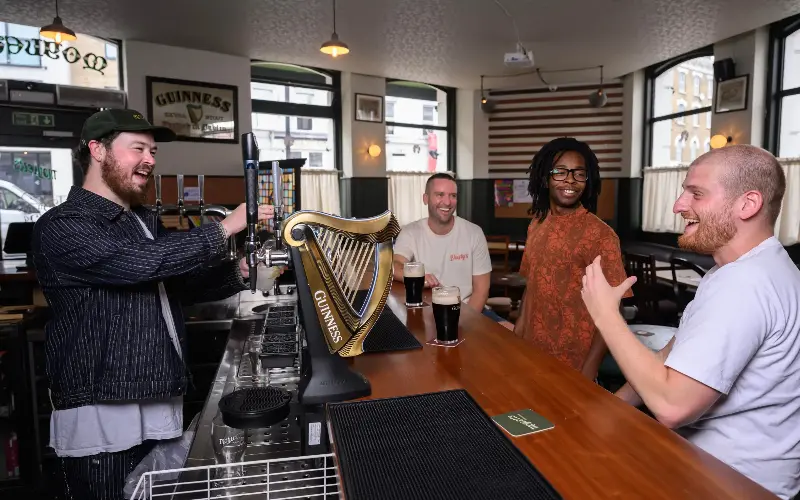
In London, Rupert Moylett is another independent landlord who has opened an Irish bar with a poignant family connection. “We opened Moylett’s in Hackney in December,” he explains. “It was important for me to use my family name for my business, as my dad felt he couldn’t do that when he ran his business after moving to London from Dublin [in 1984].” Moylett’s customers are “all ages and from all backgrounds”, he says. “We’re a third space, a place where people can enjoy time away from home.” He hopes to introduce Irish language lessons at the pub.
Meanwhile at Nancy Spains, one of the latest Irish bars to open in Manchester, Guinness isn’t even on the menu. “We only serve Murphy’s,” says the Kerry-born Peter O’Halloran, who launched the pub concept with his brother, Nicky, in London in 2024. The Manchester branch joins two in the capital, with another pair in the pipeline.
“When we moved to London we found it hard to find [places with] the energy of the pubs back home, so that’s where Nancy Spains came from.” Murphy’s is top choice because it’s the brothers’ personal preference, but “an Irish pub isn’t really about the drink”, O’Halloran stresses. “It’s more about the welcome. It’s one of the few places left where people go to specifically talk to each other.”
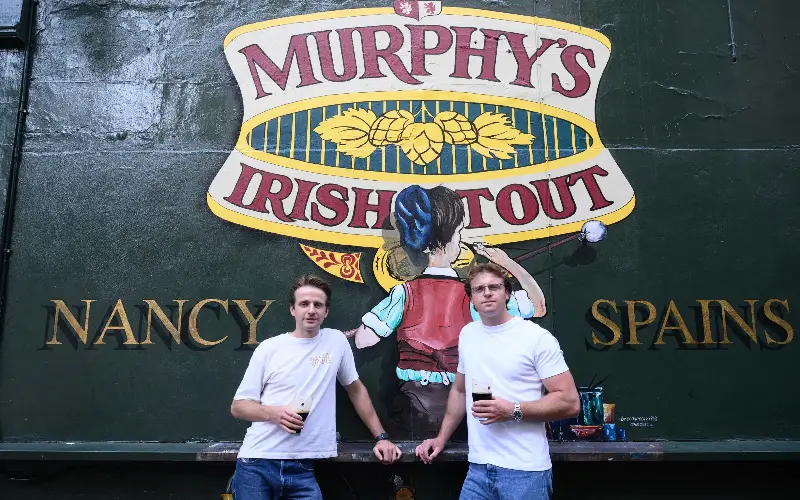
Yes, there is live music at Nancy Spains, along with GAA (Gaelic Athletic Association) sports and rugby on the television screens, but “the welcome” is what many feel is pertinent to Irish pubs – céad míle fáilte, “a hundred thousand welcomes”, in fact.
If a sense of community is what draws people to these venues, perhaps we need it more these days than most. Peter Connolly, whose family come from Galway, opened Nortons in Birmingham’s Irish Quarter just before the Covid pandemic began.
“A generation of young people were in lockdown throughout the pandemic, unable to go out and socialise and get the traditional pub experience. Now they want more than just a drink. Irish bars are the perfect place for that,” Connolly says. “We sponsor football teams, hold Gaelic lessons. We’ve even hosted a Catholic mass and school choir.”
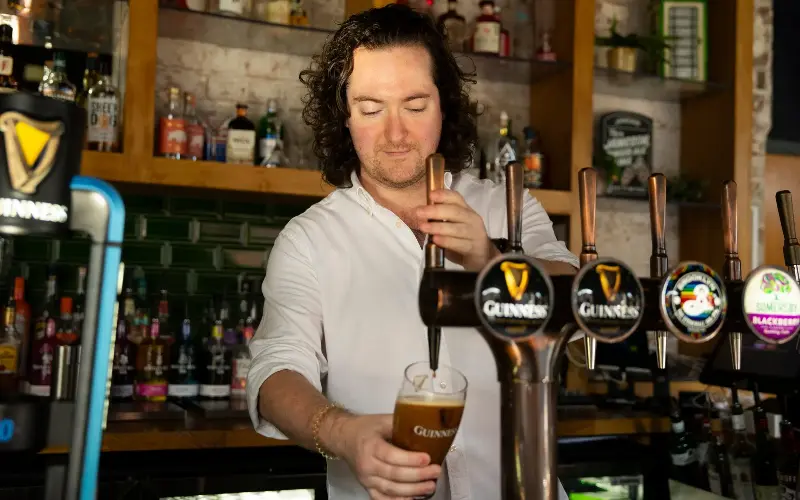
Yet, despite the positive sign of new openings, Irish pubs must overcome the same challenges faced by the rest of the industry – not least in Northern Ireland.
“Rising costs and a lack of long-term support are putting many hospitality businesses under increasing pressure,” says Gillian Hough, the vice chair of the Campaign for Real Ale (Camra). “Measures to support pubs in Britain, such as reductions in business rates, are welcome. However, any action must extend across the whole UK, including Northern Ireland,” she argues. Northern Ireland’s “surrender principle”, which limits the number of available alcohol licences for pubs and restricts beer supply, is something Camra has sought to overturn for nearly 20 years.
“Across the UK, Irish-themed pubs are an essential part of community life, providing welcoming spaces where people can celebrate Irish heritage,” says Hough. Their success, perhaps, is down to their stability. “We just keep doing what we’ve been doing,” says O’Halloran.
“It’s a formula that never goes out of fashion.”