



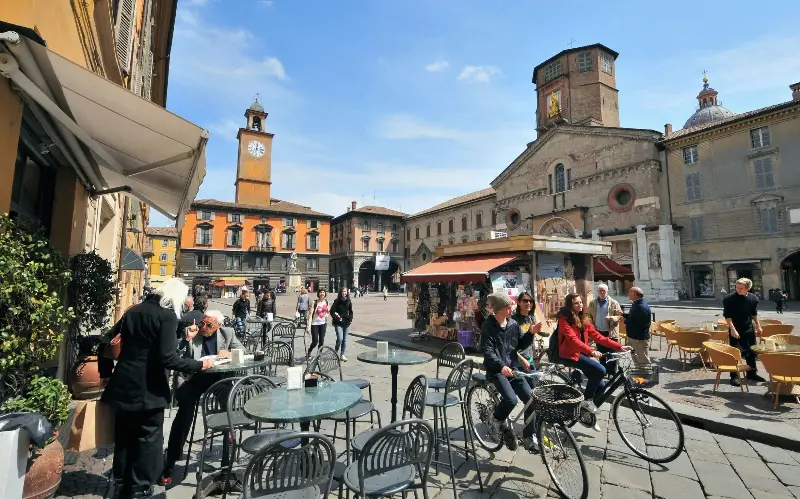
For the first time in over three years, the Princess of Wales is about to embark on an official overseas visit and nowhere could be more appropriate than the quietly dignified city of Reggio Emilia, an international centre of excellence for early childhood. The focus of the royal visit is the Reggio Emilia Approach, a trademarked educational method for preschoolers – a research trip for the Royal Foundation Centre for Early Childhood. But there will be opportunities to discover other unique aspects of the city during her two-day visit.
Reggio Emilia is fundamental to both Italian history and gastronomy and as the small city is often overlooked in favour of its more famous neighbours Parma, Modena and Bologna, those who do go are rewarded with an authentic experience of real-life Italy in a place where human values are held in high regard. I’ve lived in the surrounding Emilia-Romagna region for more than 20 years. Here is what to expect from a visit to the city.
Learn about the Reggio Emilia Approach
The Loris Malaguzzi International Centre is devoted to the work of Reggio Children and the Reggio Emilia Approach, which aims to safeguard and promote the rights and potential of young children. The centre, named after the locally-born founder who conceived the method which has been adopted in numerous countries around the world, is housed in former cheese warehouses near the station and celebrates its 20th anniversary this year.
Anyone can visit the permanent exhibitions – including The 100 Languages of Children, initiated by Malaguzzi – bookshop and cafeteria, take part in guided tours or join the ateliers held regularly for children, education professionals and the general public (open Monday to Friday).
Stroll the piazza
Piazza Prampolini, Reggio Emilia’s main square where the Princess of Wales is likely to greet the public during her visit, is dominated by the city’s Romanesque cathedral. The interior incorporates artistic features old and new, including a contemporary altar and an Assumption painted by 17th-century artist Il Guercino whose work also decorates the nearby Basilica della Ghiara, a Baroque masterpiece.
The town hall on the piazza is home to the Sala del Tricolore, where the green, white and red flag (originally with horizontal stripes) was first adopted in 1797 as a symbol of the short-lived Cispadane Republic. A fascinating museum in the adjacent rooms traces the history of the Italian flag.
Sample a sip of fizz
The Spergola grape, native to the hills near Reggio Emilia, has recently been gaining recognition for the fresh, elegant wines it produces. While the Venturini Baldini winery makes an inviting Charmat-method Spergola spumante as well as an oak-aged still version, it’s the area’s Traditional Method sparklers that are most intriguing.
Ca’ Besina by the Casali winery was the Emilia Romagna region’s very first Traditional Method spumante in the late 1970s – I particularly love the pas dosé version. Reggio Emilia is also central to Lambrusco production; my favourite of the Lambrusco family of grapes is Salamino for the berry-fresh, purple-hued wines it makes, such as delicious semi-sparkling Concerto, by the Medici Ermete winery.
Try the local specialities
My go-to place among the food shops and restaurants clustered in the narrow lanes between Piazza Prampolini and Piazza San Prospero, is Antica Salumeria Giorgio Pancaldi, a deli with tables dating from 1962. It’s an ideal spot to try one of the city’s best-loved specialities, erbazzone, a tasty pie filled with chard, spinach and Parmigiano Reggiano and, while it’s usually made with lard, vegetarian versions do exist. I also love the charming organic Fattoria Rossi farm run by the Rossi family since 1868. There’s accommodation and a farm shop where you can try and buy the produce or book for a Parmigiano Reggiano tour and tasting.
Explore ancient castles
Of the many castles in spectacular hillside locations near Reggio Emilia, the ruined fortress of Canossa, which dates from the middle of the 10th century, is perhaps the most evocative. Its excellent museum gives insights into the life of Matilde di Canossa, a fundamental figure in medieval Italy. Nearby, the beautifully preserved Rossena castle and adjacent Rossanella, linked by footpath, were built to defend Canossa. Close to the Venturini Baldini estate, the intact Bianello castle was bought by Matilde’s mother in 1044, just two years before Matilde herself was born. It’s surrounded by the Oasi Bianello nature reserve and hosts the Tre Tenori restaurant.
Visit out-of-town arts
An easy cycle path links several villages on the banks of the River Po, about half an hour’s drive north of Reggio Emilia. Bicycles are rented by River Passion, a 2.5-mile pedal from Brescello where Giovanni Guareschi’s Don Camillo stories were filmed.
While Guareschi wrote his humorous tales in the middle of the last century, the morals of the stories, where human values win over ideologies in the clashes between the parish priest and Peppone the mayor, are eternal. The village is full of references to the characters and there’s a dedicated museum. A bit further at Gualtieri, see works by troubled, naïve artist Antonio Ligabue at the recently reopened Palazzo Bentivoglio.
How to do it
Ryanair flies from Stansted to Parma airport, 20 miles from Reggio Emilia, while Bologna airport (40 miles) has frequent flights from various UK destinations. Both cities have good rail connections to Reggio Emilia. Accommodation options in the city include historic Hotel Posta and contemporary Locanda La Concia.